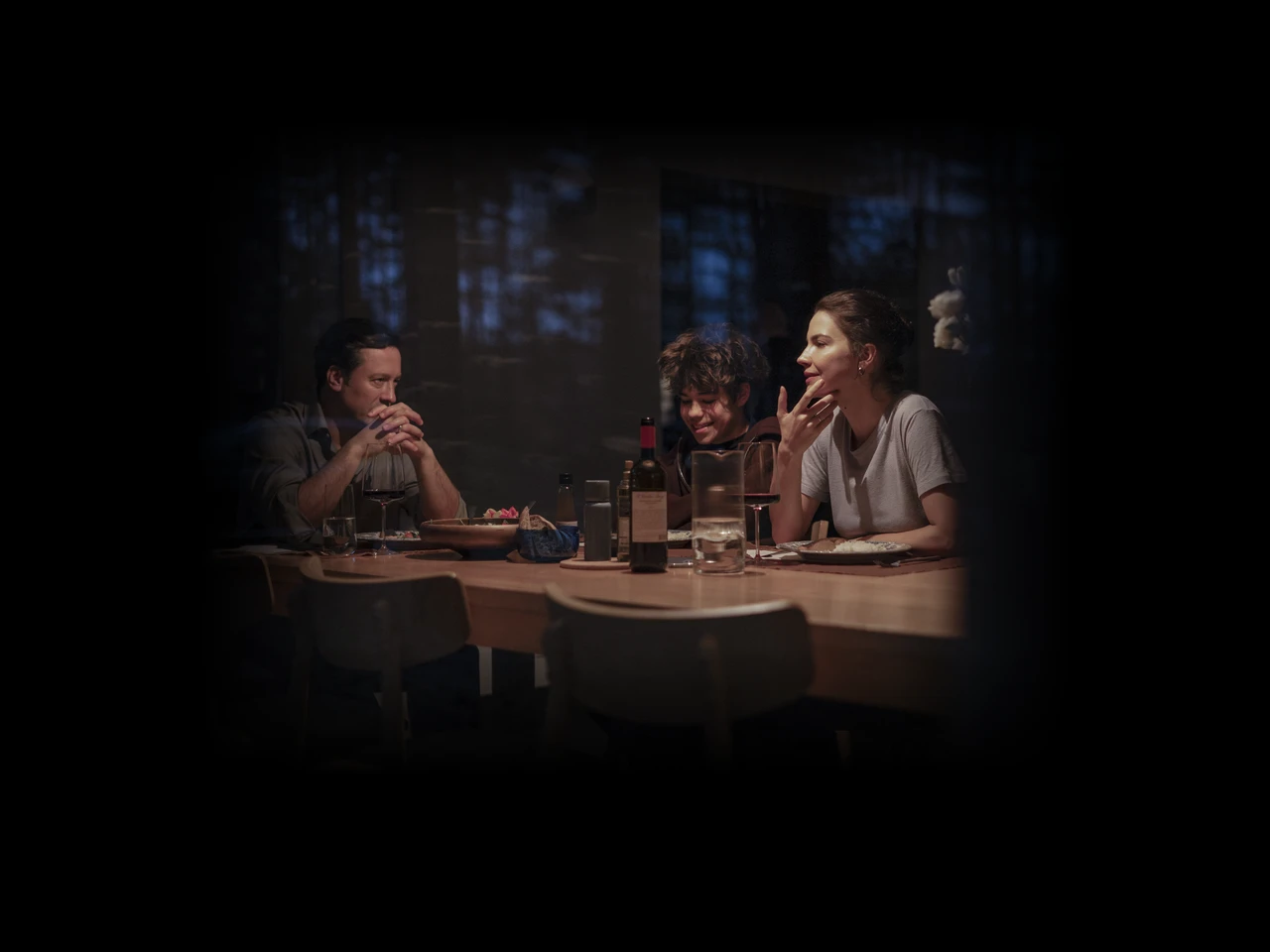
The breakthrough performance that took Cannes and NYFF by storm is nothing short of a revelation.
Cannes Grand Prix winner Minotaur recently made its US debut at the New York Film Festival, marking the return of Russian auteur Andrey Zvyagintsev. His reemergence is remarkable, if only for the fact that a life-threatening brush with Covid left the director comatose for nearly forty days in 2021, with feeling and use of limbs remaining elusive for another several months. In a kind of parallelism that Zvyagintsev has masterfully seized upon with this latest work, the personal peril inherent to this creative intermission happened to run astride Russia’s convulsive descent into revanchist violence and international ignominy. The film that results is a finely calibrated, restrained exploration of the banal venality that continues to mar the country’s socio-political landscape.
Minotaur is a meticulously crafted indictment of such a landscape, the manifestation of which is embodied in exquisite fashion by one of the great finds of Zvyagintsev’s career. Iris Lebedeva plays Galina, the forlorn and errant wife of a Russian transport company CEO, a woman on the edge simmering with a potent evocation that wields subtlety and vigor to hypnotic effect. It’s a virtuosic performance that expertly traverses turbulent psychological territory, striking chords of profound melancholy and subdued rage, a physical incarnation of the film’s piercing and resonant critical gaze. I sat down with Iris after the NYFF premier to discuss this breakthrough role and her immersion in the work itself.
To start things off, welcome to New York. This is your first time in the city, I’m curious to hear about your initial impression.
I think my thoughts about New York have been based on movies, first of all. And I didn’t know what to expect. I have this kind of sense that it’s somehow a beautifully composed picture because of films, but of course at the same time there is an idea that it’s dirty, you have the garbage, rats, all of these things (laughs). And I thought “okay, I’ll just come and we will see.” And I found that New York is actually a very cozy city. And I’ve really enjoyed watching people – parents just going for a walk with their children, families with their dogs.
And I’d like to say that even dogs are different here (laughing). I don’t know why. They’re really unlike other dogs, somehow with their specific faces.
And my husband and I had the chance to walk 20,000 steps yesterday, we went from Broadway to Times Square. We went to MoMA, and of course Central Park. And by this point I feel like I have seen quite a bit, and I of course have the thought that I’d like to live here for a while. Okay, maybe — but if it would be while filming a project, for two months, and I’ll work and also live here. That would be great.
Well, I hope that’s on the table for you soon. I’m sure it will be.
Yes, fingers crossed.
I’m curious — just referencing the post-screening Q&A, Justin Chang asked about your preparation and approach to the character. You mentioned some images, or maybe some source material, that you used to find inspiration. Are you open to talking a little bit more about the nature of those images, and from what source material you drew inspiration for your initial approach to playing Galina?
From the second that I was told that I’d have the opportunity to audition with Andrey, I was extremely hyper-focused. From that moment, I decided to explore the films that he likes most, the work that he himself has drawn inspiration from. I explored this kind of cinematic world that he comes from and looked to surround myself with an environment based on this aesthetic. I think this instinct also came from a place of understanding that we as actors can often be different in some sense to the director, and in exploring his world I was hoping to find this vibration of his aesthetic, of his feelings of beauty. And thankfully it turns out that we have similar taste in film, and other artistic mediums. Like Andrey, I also love the French New Wave, and directors alongside it like Louis Malle, in particular. Jeanne Moreau is one of my favorite actors as well.
So I tried to create this environment first. And then additionally what helped to craft Galina was to find music and quotes — these sources also revealed the atmosphere of what I was trying to bring to this character.
And at one point in the casting I was told very directly – “you should be like Galina, embody her in your life.” And so to be like Galina, I knew that I needed to find just one seed, but what is it? What is it? I felt a bit anxious, because I knew that at this point in time they were in the process of evaluating other actresses, and I didn’t feel the ground as being so solid beneath my feet, in a way. And I was sitting at the park, having spent a very long day with such strange feelings as a result of this anxiety. Thinkingthat on this day I have met both God and the devil (laughs). At this very moment I suddenly remembered a quote from a book by one of my favorite authors – “A woman, by herself, does not exist. She is a body and reflected light. And now you absorbed my light and left. And all my light left me.” ”
This was the seed for Galina. I didn’t want to reflect too deeply about the essence of these words — the context, their relationship to the truth, and so on — but just those words on their own helped me to feel the ground beneath my feet again. And later that same evening, Andrey and his team invited me for a drink. And here I think they recognized a more potent radiance emanating from me than before, and I could feel from that moment that I have a great chance to land the role of Galina.
Something that seems really unique about this film from an actor’s perspective is that it has two prominent contextual realities that you are entering into as the character. One is the socio-political reality, which is thematically omnipresent, and the other is the psychological dimension that shapes the emotional constellation of these characters in any given space. I’m curious, as you’re entering into that space, are you cognizant of both of those worlds? Are you prioritizing one over the other? Is it actually less about assimilating the socio-political environment?
I had this exact question to Andrey, asking: should I, as the actress, and Galina as a character, take this context — what’s going on around her – into my work. Because of course she is hearing this news, or maybe she knows something from her husband. And he told me, “No way. Please, no. Just think about your scenes, about what’s going on in these scenes.” Because it’s impossible to “play a war” — it’s impossible to “play social context.” You just have what is written in the script.
I had a very similar question from one journalist, and it was in some tough way how he asked me. And I asked him: for example, you have an interview with me, but before this you went to make coffee in your kitchen. And your face, while making coffee — does it reflect the context of a war, and the implications it has for the future procedural aspects of your work? No. You just go and grab your coffee, right? And it’s impossible to play that sense of assimilated context.
On that same note, the physical space that Andrey created is of course very specific. The family home is very minimal, very sterile. You still have this natural world around you, but it’s also quite stark and barren. Are you relating to that as well in these scenes? Are you sort of accommodating that space through your character? Is that less of a conscious decision as well?
Well this can also be an answer for your previous question. Andrey and the team created this specific environment around the characters in the best way, the most precise way. So the house, the camera work, how the set designers decorate the home – everything was incredibly intentional. I could open the drawer and find floss. It’s not even for filming. It’s hidden in the drawer. And everything that you have around you helps a lot.I came to this apartment, this house, and it was really cold. The floor was cold. Everything was gray. The environment and atmosphere was difficult. And the whole team helped to be in focus on what you need to play.
I think it’s interesting that the concept of atmosphere keeps emerging here as an exploratory space for you. I know that Andrey is known to take a fairly meticulous approach to his sets: many takes, a degree of precision and technical savvy. I’m curious, how did you and the cast strike a balance between finding the room to explore while hewing closely to Andrey’s honed vision?
Iris: Honestly, I don’t remember any directions, for example, where he told me that I did something wrong. No. He just let me and other actors exist in our characters as we saw fit. But I’m pretty sure that his creation of the environment also helped us to present the work the right way. And as for a lot of takes— it’s not just because actors do something wrong. His arrangement of the scene can be sometimes complex, but in a way that brings out something special in the actors.
For example, we had one scene where we had a lot of people, a few characters — that scene where it’s the birthday party of Seryozha, our son. We filmed it with two cameras running simultaneously. The house is L-shaped, with a lot of glass. One camera was inside, in one corner, looking down the corridor. The other was outside, by another part of the house, where it could see through the glass and then turn towards the lawn where the children were playing.
The whole sequence was performed in one continuous take. First, we see Gleb arrive and have a conversation with Galina. Then Galina walks down the corridor to the kitchen and approaches Gleb’s mother – the outside camera sees this through the glass. That camera then turns towards the children playing on the lawn. In the background, we see Gleb walking along the corridor inside the house and entering his study, rather than going to speak to the children. It’s very difficult to manage all of this, and we end up with many takes because it’s so technical. But it really helps actors to improve our work, or to find details, nuances. And I don’t remember any day when I thought, “Oh, it’s enough, maybe we will stop.”
For the scene with Galina and Inna chatting in the restaurant bathroom we had 26 takes, because something didn’t work. It seems like a fairly simple scene, but the way it was filmed was technically very complex. The performances, the camera angle and so many other elements all had to work together. I probably don’t even know all the technical aspects involved. After those takes, it became clear that the set needed to be adjusted to achieve what Andrey had in mind.
So we came back two weeks later, after the set designers had found another solution, and were able to film the conversation as a reflection in the mirror. And then we did another sixteen takes, I think – or somewhere around that (laughs)! And it was okay — it was invigorating to know that we are in the process of improving it.
And I understood that Andrey creates these scenes like a puzzle, and in some instances I am honestly probably as important as a tree on a street corner (laughing). But for each piece of this puzzle, he allowed us to improvise a lot. So he tells us: you have to go there, turn there, and then it’s up to us to perform the scene. And how we feel — our emotions, the manifestation of our thoughts, or the context inside us — it’s just our work. So Andrey tells us: you have to go there, turn there, and then it’s up to us to perform the scene. He gave us precise choreography, but he didn’t tell us exactly what emotion to feel or how to express it. He left us space to find that for ourselves.
I think the world that’s portrayed in the film is interesting, again from the actor’s perspective, in that it bears an almost complete resemblance to our current reality, with its themes and events distilled in a way that makes them even more real. And I’m curious, as you left Galina’s reality and returned to one not so dissimilar from hers, have you found that there is anything from the character that has been more difficult to leave behind, or that has stuck with you that you didn’t expect? Or has it been easy to draw those boundaries, and simply walk away?
Honestly, it was a really long period that I was living with Galina. And we really had a big privilege to work during three months in Riga. I was there without my husband. I didn’t do anything like homework, housekeeping, or anything resembling a daily routine. I was at my flat, which we rented, just waiting for my scenes, and it was a huge privilege to be very deep in the material. And of course, because it was such an important moment for me, I felt like sometimes I lost this balance between meand Galina. Sometimes I really didn’t understand – for example, if I tried to choose this jacket or sweater in this shop – was it because I liked it, or was it Galina’s choice? Also Andrei talked about Galina — how beautiful she is — and I would catch myself feeling almost jealous of Galina (laughing). Because maybe she has a kind of allure that I perhaps don’t have. “I remember thinking, ‘Iris, what’s going on?’”? But I can’t avoid these feelings. My brain of course understood that it’s not exactly normal, but I really experienced these feelings. It was strange. And what did I do? I talked to my therapist a lot about it. And when it was the last day — like a few days after our last day — I had been doing a special ritual every morning when I had a shooting day. I performed
this ritual for the last time, and I said goodbye to her, and it was fine.
I felt that one of the more moving aspects of Minotaur was its exploration of sacrifice. Its capacity to sever bonds, and also to somehow unite and pacify. This plays out in an interesting way as it relates to Galina and Gleb’s relationship. I’m curious what sacrifice may mean to you in the context of this film— either individually, as an artist, or from Galina’s perspective.
You know, since the movie was released at Cannes, I’ve heard so many variations of questions about what Galina meant, or what she thought, or what may be the final meaning to her actions. And Andrey told us, “Please don’t explain your character.” But what I’ve tried to keep focus on is that their relationship is mostly about how Gleb didn’t choose her. And probably at the end he understood that he chose her — from the one hand. On the other hand, she understood that she doesn’t have another way forward.
So I think maybe she was ready to break with everything, because she was inspired by the conversation with that attractive, beautiful blonde woman. Maybe she thought, something else is possible. But when she found these pictures, and when she found that Anton disappeared, she realized that she’s in a cage. And we don’t know how their life will be in the end. Because when the film is finished, these characters continue living. Life goes on. But we don’t know how they will live. Maybe she is dead inside her soul forever. Maybe she will try to change something in her life. But I don’t feel particularly good about her state of being after my last scene with her.
And we don’t know where her life leads — or at least we can imagine — but we have some idea of maybe where yours is heading. Any idea of what may be on the horizon?
Of course I think this movie opens doors for me. But from the other side, I understand that I’m a Russian actress and I’m not a native speaker in English. So I would say that I’m open for everything, but ready for everything also. II think I’m now a bit more visible to other directors, who will find me and my way of expressing a film close to theirs, and of course I hope I will have interesting opportunities there.
.
