Good theater entertains, but great theater refuses to let its audience remain passive.
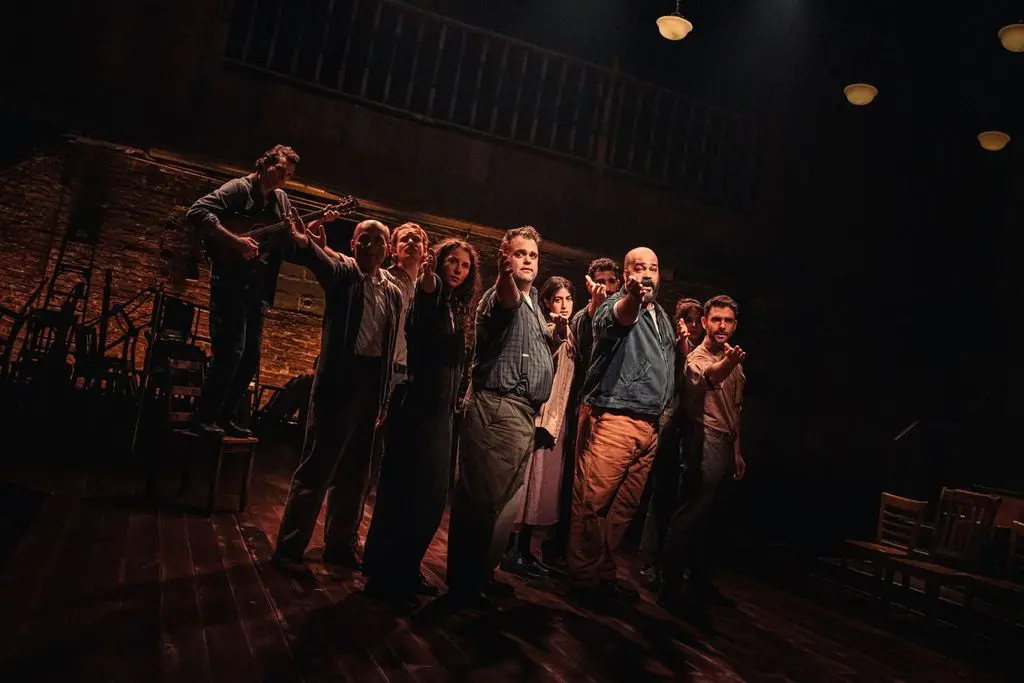
Nearly a century after its debut, Clifford Odets’ Waiting for Lefty still possesses that rare power. Written in 1935 during the depths of the Great Depression, the play feels startlingly immediate in an era marked by economic insecurity, labor unrest, and widening inequality. Framed by a meeting of taxi drivers debating whether to strike, Odets’s drama unfolds through a series of vignettes exposing the injustices faced by working people. By repeatedly breaking the fourth wall and placing actors among the audience, the production blurs the line between spectator and participant, transforming the theater into something that feels less like a performance and more like a collective political rally.
This is Steven Pasquale’s directorial debut, and it is an impressive one. Drawing on his extensive experience as both a stage and television actor, Pasquale expands on Odets’s vision by intensifying the production’s focus on working-class struggle. Between the vignettes, he incorporates music, movement, and pantomime to create a sense of continuity and urgency. Working with choreographer Susan Misner and the folk-rock duo “Yeller Tooth,” comprised of Sahar Milani and Cameron Scoggins, Pasquale blends Depression-era protest songs such as “Brother, Can You Spare a Dime?” with a contemporary score. The result is a production that feels both historically grounded and strikingly relevant.
The action centers on a contentious union meeting in which taxi drivers debate whether to strike against their exploitative employers. As tensions rise, the workers await the arrival of their elected chairman, Lefty Costello. During the wait, the meeting unfolds through flashbacks that expose the economic hardships, political corruption, and personal sacrifices endured by working people. The ten-member cast seamlessly transitions between characters, drawing the audience into both the individual stories and the larger struggle for collective action.
Photo Credit: Marc J. Franklin
Zach McNally serves as the linchpin of the production’s movement ensemble in the largely symbolic role of Lefty Costello. Through expressive pantomime and choreography, McNally helps weave the disparate stories into a cohesive whole, embodying the hope and solidarity that Lefty represents throughout the play.
Tala Ashe delivers one of the evening’s most memorable performances as Edna Mitchell. In an explosive confrontation with her husband Joe, played by Raffi Barsoumian, Ashe portrays a woman unwilling to accept a life of poverty and resignation. Barsoumian captures Joe’s exhaustion and despair with remarkable authenticity, portraying a man worn down by impossible economic circumstances. Together, they create a powerful portrait of a family pushed to its breaking point, while illustrating how economic injustice affects not only workers but also those who depend on them.
Austin Durant excels as Miller, a gifted industrial chemist offered financial security in exchange for betraying his principles. His wealthy employer asks him to develop poison gas and inform on his coworkers’ union activity, forcing him to choose between conscience and survival. When Miller objects that the gas will kill civilians, his employer dismisses concern for human life as incompatible with big business. Durant conveys Miller’s outrage and resolve with conviction, turning a political argument into a deeply human struggle to preserve his integrity.
Greg Hildreth is equally compelling as Harry Fatt, the corrupt union official determined to prevent the drivers from striking. Hildreth gives the character a commanding presence that makes him a formidable obstacle to collective action. Opposite him, Doireann Mac Mahon brings warmth and emotional depth to Irv, a veteran cab driver whose observations underscore the physical and emotional toll of working-class life. Together, they represent the opposing forces that drive the play’s central conflict.

Photo Credit: Marc J. Franklin
Cameron Scoggins and Sahar Milani make invaluable contributions both as performers and composers. Their original score serves as the emotional backbone of the production, connecting Odets’s themes to modern audiences while evoking the storytelling traditions of American protest music. They also appear together in “The Young Hack and His Girl,” one of the play’s most affecting vignettes. As Sid Stein and Florrie, they portray a young couple forced to postpone their future because economic hardship makes marriage and stability impossible. Their story of deferred dreams and financial insecurity feels especially relevant to contemporary audiences grappling with similar challenges.
Henry Stram as Dr. Barnes and Adam Kantor as Dr. Benjamin anchor another standout scene. Benjamin storms into hospital administrator Barnes’s office, furious that an incompetent doctor—a powerful senator’s nephew—has replaced him in surgery. Barnes must now dismiss the gifted young surgeon despite his outstanding qualifications. Their exchange reveals that antisemitism and institutional prejudice, not budget constraints, drive Benjamin’s dismissal. Stram and Kantor bring restraint and gravitas to the scene, exposing corruption beyond the taxi industry and underscoring Odets’s argument that injustice runs through social and economic institutions alike.

Photo Credit: Marc J. Franklin
Running ninety minutes without intermission, the production maintains a relentless sense of urgency. The live music and pantomime sequences sustain its momentum while reinforcing the emotional stakes of each story. Pasquale’s revival succeeds not because it treats Waiting for Lefty as a historical artifact, but because it reveals how little the play’s central concerns have changed. Questions of affordability, workplace dignity, economic power, and collective action remain as pressing today as they were in 1935. By the time the final moments arrive, the audience is left not with easy answers but with a challenge: to recognize that meaningful change is rarely delivered by a heroic savior. As Odets argued nearly a century ago, and as this production powerfully reminds us, lasting change begins when ordinary people decide to act together.
