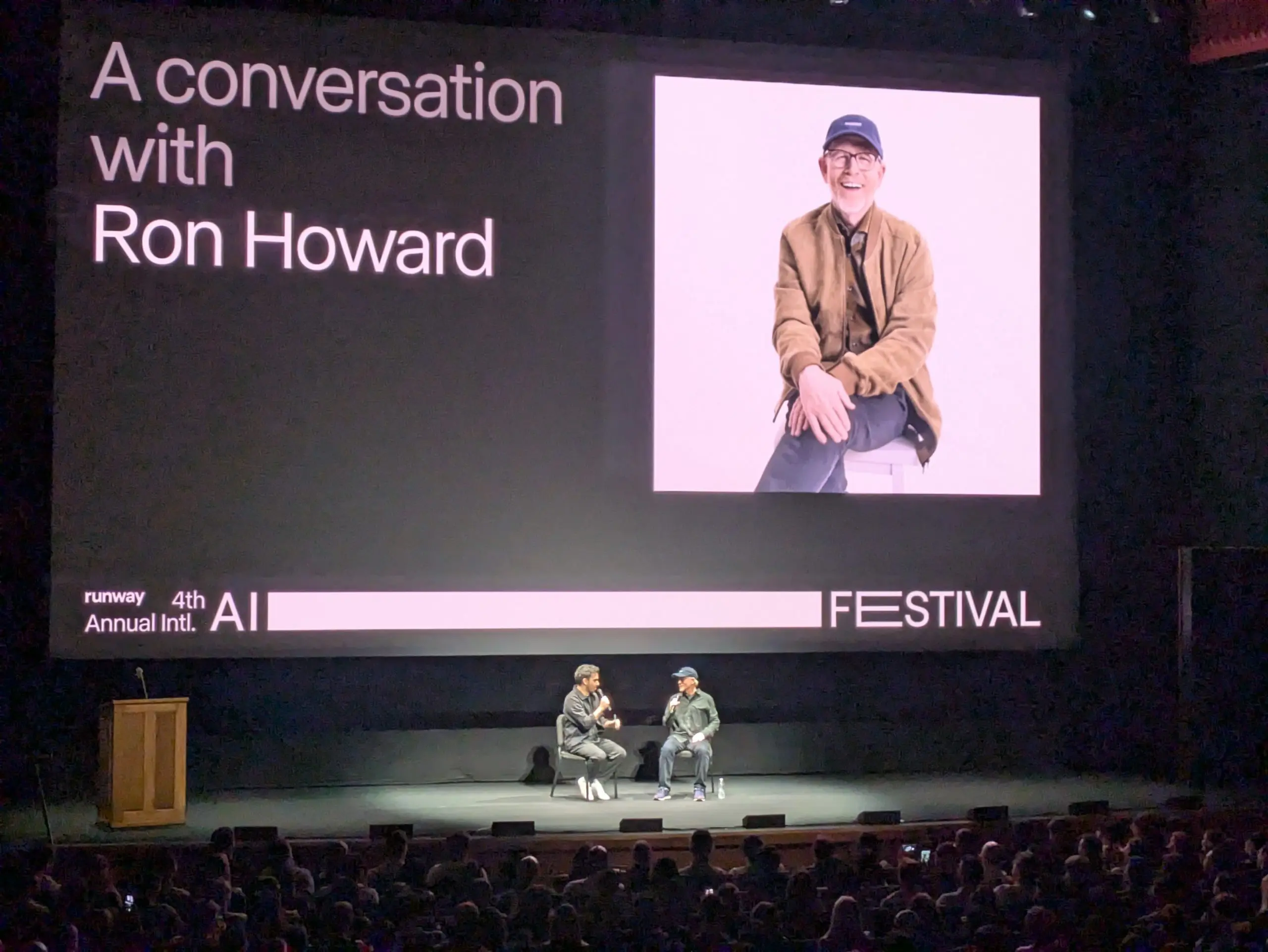
The future of storytelling was on full display as Runway’s fourth annual AI Festival took over New York’s Lincoln Center, and this year, something fundamental had shifted.
Since its founding in 2022, the festival has evolved from a showcase of machine learning capabilities into a celebration of human storytelling. “The quality of the films and the storytelling behind all of them, that’s what it’s all about,” said Runway CEO Cristóbal Valenzuela. “It’s less about the AI models and the tech, and it’s finally, fully about the stories themselves.”
This year’s winner made that case beautifully. A Face Only a Mother Could Love, directed by Robert Gaudette, used AI to tell a moving story about loneliness leading to acceptance and companionship. Valenzuela noted that creators have long carried these kinds of stories in their heads but lacked the tools to bring them to life. “People are finding ways to show us what they have been carrying in their heads for so long,” he said.
The awards ceremony featured a conversation between Valenzuela and legendary director Ron Howard, who brought both enthusiasm and candor to the stage. Howard admitted he isn’t diving deep into every AI tool available, “I’m not going to be that person who’s pouring hours into understanding it,” but what he’s seen has genuinely moved him. “When I start to see it work and help transform and liberate my own sort of imagination as to what’s possible, I get very excited about it.”
Howard drew on a lifetime of watching technology reshape filmmaking, from his days as a child actor witnessing the evolution of cameras, to digital editing, to pioneering the morphing technique with Industrial Light & Magic on his 1988 film Willow. He sees AI as the next chapter in that ongoing story. “The technology is very exciting in terms of its potential to more efficiently, more broadly, allow storytellers to get their ideas out there,” he said.
Howard didn’t shy away from the industry’s concerns around job displacement, but rather than forecasting doom, he offered a grounding reminder, that digital filmmaking was supposed to slash costs too, and instead movie budgets have never been higher. His advice to emerging filmmakers was direct: the tools are accessible, so use them. “Start making stuff,” he said. “Show it to people and get their reaction.”

(Courtesy Runway)
For Howard, no technology changes the fundamental nature of the craft. “Storytelling is about communication. Just like a story you tell about where you went over the summer, the first time it’s rambling and awkward. By the tenth time, people really wish they’d gone on that vacation with you.” He predicted a new visual aesthetic will emerge from AI, one that borrows from cinema but evolves on its own terms, shaped by audiences. “Story,” he was careful to add, “is always king.”
The festival itself is evolving in step with the tools it celebrates. For the first time, Runway expanded the competition to new categories: advertising, design, fashion, gaming, and new media. This reflects how broadly AI has reached across the creative industries. The sold-out crowd at Lincoln Center felt like the opening of something genuinely new.
And it’s not stopping there. The festival heads to Los Angeles on June 18. Valenzuela also shared exclusively that a Tokyo edition is in the works. “We’re going to do a screening in Japan — there will be a special version of the festival.”
