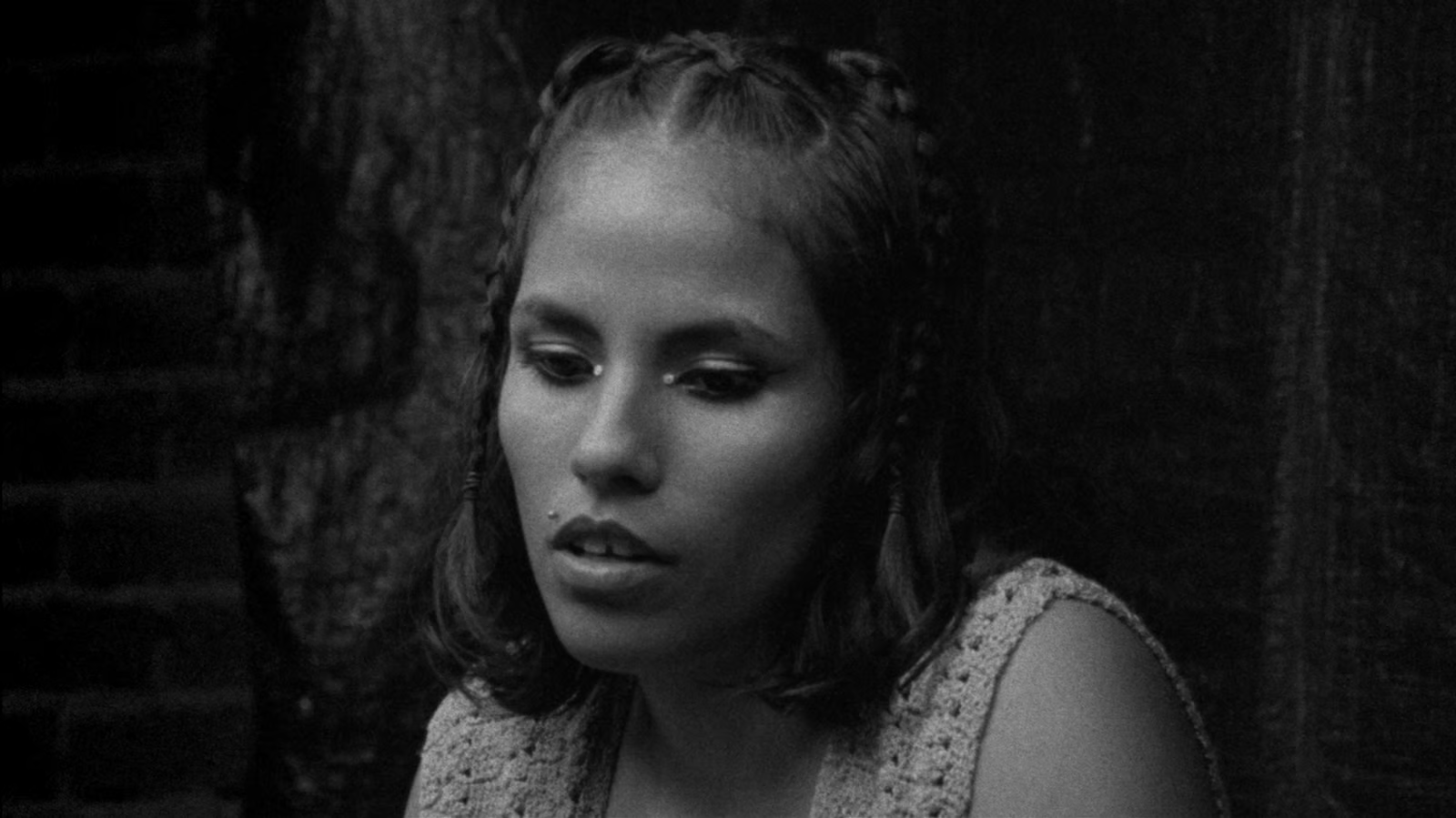
Clemente Castor’s ND/NF debut is a roaming, hazy work of cinematic transmutation.
A film’s essence can be said to exist at a point between the realistic and the oneiric. Insofar as there are any laws of aesthetic physics within the realm of cinema, they may be dictated by and coterminous with these particular parameters. And while some films oscillate between these endpoints, albeit within a range of reasonability so as to preserve narrative integrity or tonal consistency, others find comfort in the creative, deterministic confines of a fixed location.
Clemente Castor’s Cold Metal explodes this dimension entirely, flattening time and space with a blend of forms, gestures, and cinematic vantage points that mark a high point for this year’s New Directors/New Films Festival. The Mexican director’s second feature is imaginatively vast and geographically focused, ensconced in a kind of stylistic esotericism that somehow reticulates the often overlapping boundaries of its thematic concerns.
For Castor, nothing is fixed and everything is in motion. Cold Metal opens with an abstract palette of black and white 8mm, a carnival game of chance with mystic substrates, elliptical beats, and a wandering female voiceover. The camera washes across faces transfixed by a spinning wheel, lights blur with an ambient haze, and droning incantations bely the naturalistic settings with a nod to the occult.
The film is anchored by a spectral story of disappearance and reappearance, brothers who emerge from furtive spaces in the outskirts of Mexico City like spirits haunting the horizon, navigating the alluvial texture of Castor’s winding, poetic logic. Mine shafts and industrial backrooms play host to rituals of unknown extraction, language subordinates itself to the physical, and the landscape dissolves into the unmistakable contours of the human body. The interplay here is rich and somehow coherent, with Castor at the reins of a commanding immersion that eschews elegiac conventions for something more obscure.
Although it couldn’t be further afield from the baroque formality of Albert Serra’s feature work, Cold Metal feels spiritually related to the Catalan auteur’s obsession with the “hidden.” Where Serra mines the malleable “magic” of digital, Castor finds imagistic truth in the silty constitution of film. But there is a profound concern in both artists’ works about what is latent within the cinematic image, and this is palpable throughout the dream-like haze of the Mexican director’s vision.
Each scene is imbued with a yearning for something that exists beyond the material spaces of the film, spaces that Castor described in a post-screening Q&A as being deeply familiar and personal to him. And it is in the familiar and the personal that the artist can discover the depths of what exists beyond our material plane. Cold Metal is dedicated to this novel discovery, wielding bold and experimental images to unearth and excavate what may lie beyond.
