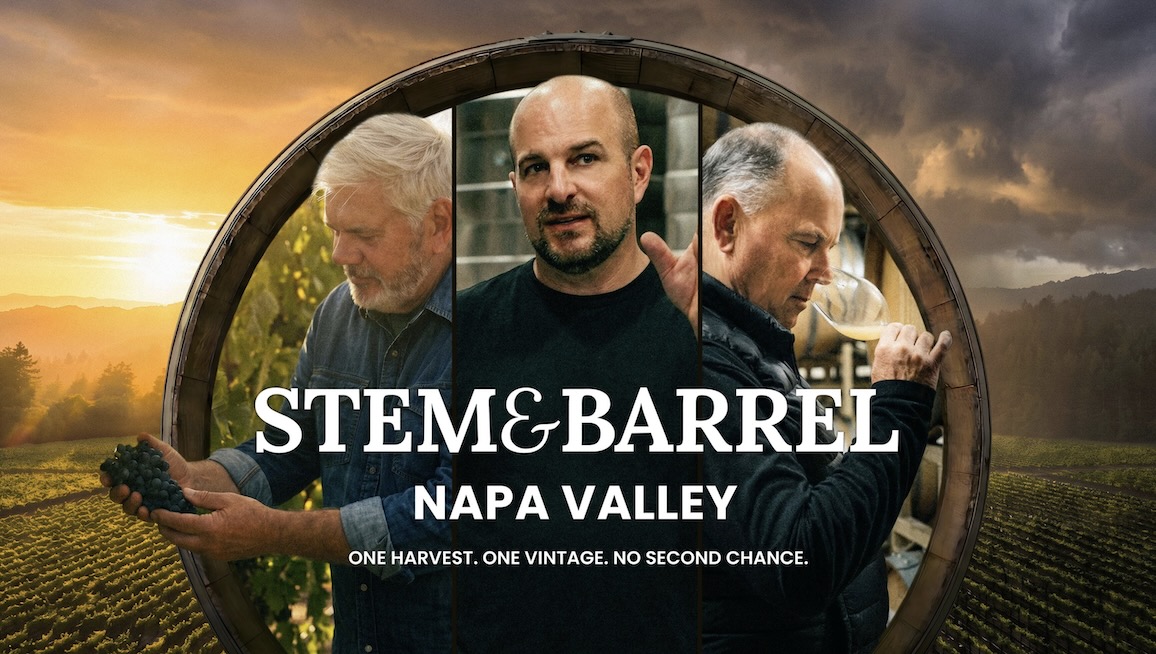
On Wednesday night, ‘Stem & Barrel: Napa Valley’ hosted its New York screening at the Crosby Street Hotel. Guests gathered for an early look at the new Warner Bros. documentary before a panel discussion with director Jason Dundas and representatives from Beaulieu Vineyard, Etude, and Frank Family Vineyards.
Inside the Crosby Street Hotel, wine from all three wineries was poured throughout the evening alongside heavy hors d’oeuvres. Guests were then invited to watch Stem & Barrel: Napa Valley while tasting wines from the wineries on screen. The film opens up a larger conversation about Napa, legacy, and how wine is being experienced through hospitality and heritage. Dundas said that when he first started talking about the project, he immediately thought of it as “chef’s table for winemakers.” During the panel, he explained that he needed “place,” “people,” and “some stakes and drama,” and that harvest gave him all of that. Grapes may take months to grow, but harvest compresses the pressure into a short period where decisions matter more and timing gets tighter.
What makes the film interesting is that it does not stay only in the vineyard. It follows three wineries with distinct identities and lets that contrast tell part of the story. Beaulieu Vineyard is the historic name in the group, the one most closely tied to Napa’s past and a reputation built over generations. Beaulieu Vineyard also stands out because the film catches it at a moment when the winery is balancing harvest, construction, and a new update of the property. The reimagined hospitality center, set inside the historic stone winery and restored over the last two years, signals a version of BV that is leaning into both heritage and a more contemporary guest experience. Etude brings a more vineyard-first point of view, with Pinot Noir, Carneros, and site expression central to the way it talks about itself. Frank Family adds another side of Napa, one built around hospitality, guest experience, and the human side of bringing people into wine.
The film treats legacy as something wineries are still trying to carry forward for a generation discovering wine through travel, storytelling, food, and experience. Frank Family spoke directly to that change. One representative described his role less as a creator and more like a gallery owner, someone who sees the work of artists and helps connect it to a wider public. As a host, he was interested in creating experiences that were not just about delivering information, but about responding to the person in front of him. Some guests arrive with deep knowledge, others are trying wine for the first time, and the job is to pay attention to that difference. “Great hospitality is about listening and responding,” he said. “Who are you? What is your ambition in your vision to this visit, and how do I fulfill that ambition?”
Etude brought the discussion back to the vineyard. Senior winemaker Jon Priest spoke about how everything starts there and prefers to think of himself and his team as “wine growers, rather than wine makers.” He also talked about how quickly the work teaches humility. “As an early young winemaker, I wanted to control every element,” he said. “And you learn very quickly… that the weather is in charge.” For all the discussion of experience and wine culture, the film keeps returning to weather, timing, and the uncertainty built into harvest, showing the labor it takes to produce wine.
Dundas also spoke about Napa itself in a way that helped explain why the film feels larger than a harvest documentary. He said one of the first things he noticed was that “everybody is like family in Napa,” and that once you enter the valley, it does not feel like a place made up of isolated competitors. It feels like a community. Stem & Barrel suggests that its strongest point was not that Napa remains beautiful or prestigious. It was that Napa is still trying to stay current without giving up heritage. The old version of wine culture often leaned heavily on exclusivity. The version presented here felt more open while acknowledging history and craftsmanship. The film’s closing line, “Napa has always been about passion, craftsmanship, and the land, and those things never go out of style,” sums up the idea that Napa still has those things, but it is finding newer ways to share them.
