Governments have often treated Indigenous peoples as a “problem” to be solved through assimilation.
Although epidemic diseases had already devastated their population, authorities used the full force of the state to absorb them into the dominant society while erasing their culture and identity. Their lands were given to settlers, forcing them to abandon traditional ways of life. They were forbidden to practice their religion and placed in schools where their language was banned. Native Americans could point to similar policies imposed by the United States government. The Ainu of Japan could say the same about policies directed at their own people. In both cases, the determination of elders helped preserve what remains of their cultures.
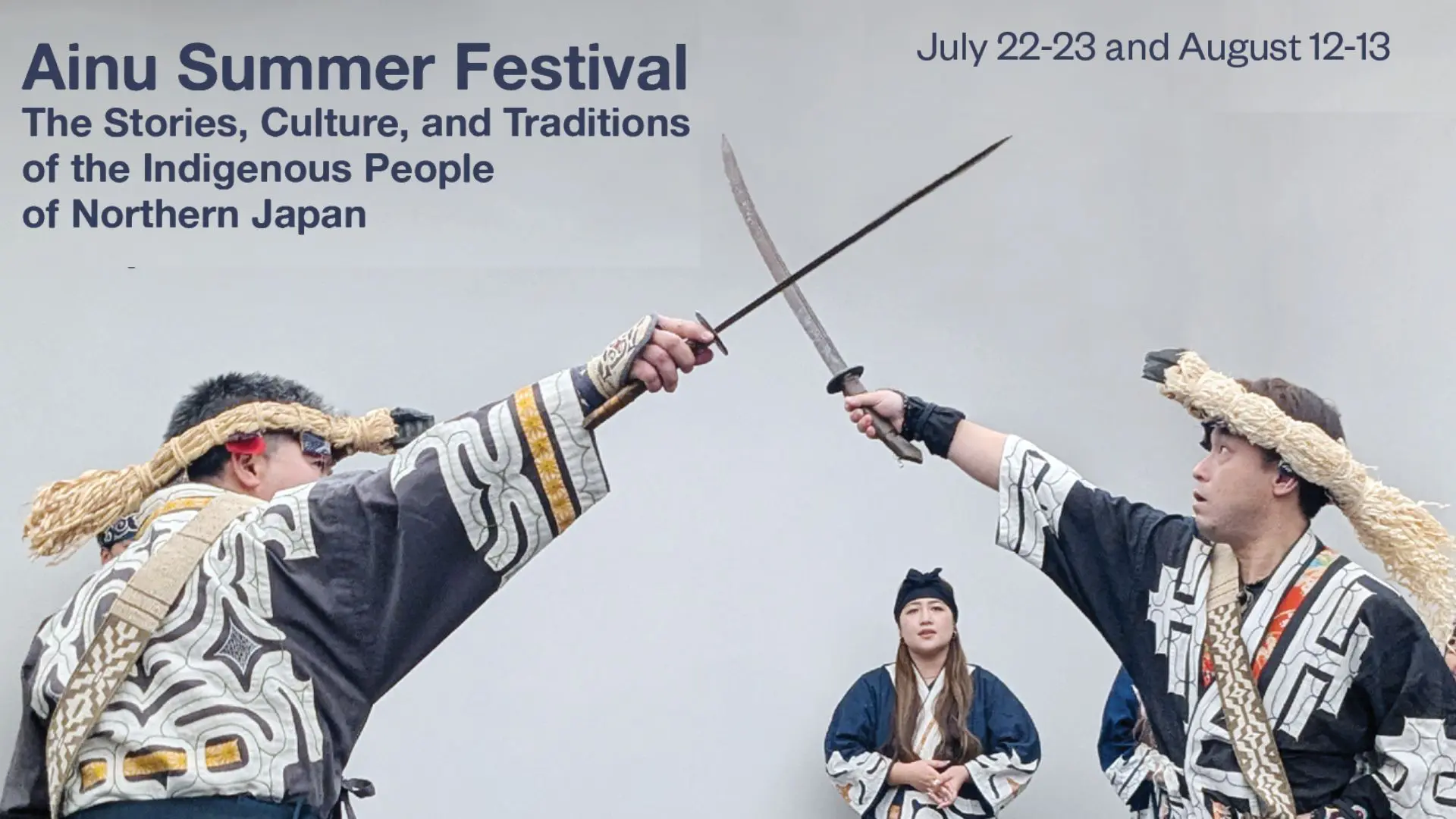
While some current U.S. federal efforts seek to remove references to minorities, including Native Americans, Japan has moved in the opposite direction. Since 1997, Japan has passed legislation to protect and promote Ainu culture, language, and traditions. The 2018 Ainu Promotion Act recognized the Ainu as an Indigenous people and established subsidies to support Ainu communities and tourism centered on Ainu culture. In keeping with this goal, Japan Society is presenting Ainu Summer Festival: Ainu Stories, Culture, and Traditions. The festival reflects Japan Society’s century-old mission to connect New York City and the world with Japanese society, arts, and culture. Supported by the town of Biratori and George and Hillary Hirose, the festival features ten events with 25 artists and educators presenting Ainu history, arts, and traditional dances.
To help preserve Ainu life and memory, Naomi Mizoguchi created a film highlighting Ainu history, rituals, and customs. Ms. Mizoguchi is an Emmy Award-winning filmmaker with more than 30 years of experience. Four Ainu elders—Kazunobu Kawanano, Saciko Kibata, Reiko Kayano, and Tamotsu Nabesawa—speak about their lives. Their experiences reflect the story of a people who were forced to hide their culture. The elders show how they taught younger generations their traditions and share stories that illustrate the importance of preserving Ainu culture. In one memorable scene, they collect bark to make clothing. Because the Ainu practice animism, believing that spirits reside in everything in the natural world, they offer sake to thank the deity for the bark and honor their relationship with nature. Of course, they also share the sake with the deity. This gentle humor appears throughout the film.
Ms. Mizoguchi’s film immerses viewers in the Ainu world, showing animals, plants, weather, and landscapes across the four seasons, from tiny insects to soaring mountains. It is easy to understand why the Ainu believe everything in nature has its own life force and agency. Over the course of an hour and fifteen minutes, she creates an intimate connection between the camera, the elders, and their world while presenting centuries-old Ainu rituals, customs, dances, and songs.
Sinoti: The Dances of Sar River is a separate hour-and-fifteen-minute live performance that highlights varied aspects of Ainu culture. Several dances reflect the Ainu animist belief that spirits live throughout the natural world. The performers present two bird dances reconstructed from old films. In the sword dance, they use dull, rusted blades because an evil spirit struck by such a blade cannot return to life. The performers work earnestly to involve the audience throughout the production. One performer plays the mouth harp, invites audience members on stage, and explains how the instrument is played. The volunteers then try it themselves, with mixed results. The performers also describe the traditions behind their clothing. Even the elaborate embroidery on the men’s garments helps unite the Ainu community: it is made by a man’s mother, wife, or girlfriend, symbolizing bonds of love and belonging. Additional dances and songs reveal other dimensions of Ainu life. Rather than watching as outsiders clinically examining another culture, we are drawn into their world. The final piece is a circle dance accompanied by an improvised song shaped by the singers’ feelings in the moment. Audience volunteers join the performers on stage, with the performers forming an inner circle and the volunteers moving around them. As everyone gives themselves to the dance, the audience claps the rhythm. This brief encounter with Ainu life deepens appreciation for Ainu culture.
We are shown the processes of destruction, preservation and recreating that brings the Ainu and their world to us. The opening screen of Ms. Mizoguchi’s film greets the audience with the word Irankarapte, which means “hello” in Ainu. Its literal meaning is “allow me to softly touch your heart.” Ainu: Indigenous People of Japan and Sinoti: The Dances of Sar River do just that. Together, they offer a moving introduction to Ainu culture and its enduring power.
