
Rather than attempting to imitate a more expensive omakase, Iki Sekai has developed a style suited to its own price point, one built around creativity and technique.
I never try a new restaurant alone. There’s nothing wrong with eating alone, but for my writing process, I use the person I bring as both a lens and a mirror to amplify and better reflect on my experience. Needless to say, who I bring to these tastings is no random ask or last-minute invite. Instead, I’ve assembled a curated list of approximately 20 of my favorite people, loosely ranked by how interesting they are and how easily they can carry a conversation. At the end of the day, some of these dinners are long, and life is too short to waste sitting across from boring or uninterested individuals.
Who makes the cut is about more than simply being interesting. I have rules, especially for the exceptions who aren’t even on my short list. For example: no first dates or people I do not know well, no dining partner twice in a row and, especially, no picky eaters.
For the first time in as long as I can remember, I broke my rules when I brought one of my newest friends, someone I had never actually met before and had only recently connected with over text through a good friend of mine. I hate when people say rules are made to be broken because they’re not. Rules ensure order. But once in a while, breaking one can be a wonderful thing.
Much like my guest, Iki Sekai, a new omakase spot that recently opened on the Upper East Side, broke many of my rules when it comes to selecting an omakase.
For starters, the price point immediately set off sirens in my head. Rest assured, I am not that snobby, but there is a reason a great omakase costs what it does. I’ve reviewed excellent omakases at the $300 price point and great affordable options closer to $150, but at $85, I genuinely did not know what to expect.
The moment I walked in, however, I was taken aback. Iki Sekai is sleek, dark, inviting and intimate, with what might be one of my favorite omakase ambiences so far. From there, I threw away my preconceived notions of what an omakase should cost and sat back for the ride.
Iki Sekai is led by Chef Gary Ke, formerly of Kinjo in DUMBO, alongside Chef Po Shing Ng, who comes from Tribeca’s Ito. Their approach is decidedly more playful than austere. Throughout the meal, smoke, citrus, marinades, aged soy, truffle and char appear frequently, giving the omakase a distinct personality from the very beginning.
Our dinner opened with a small tuna course served in a bowl with a soy-forward sauce. It was simple, savory and effective, functioning almost as an amuse-bouche before the meal began moving into richer territory.

Photo by the Knockturnal
Fatty bluefin followed soon after and immediately raised the stakes. It was rich and soft, carrying the kind of luxurious fattiness you hope for from tuna and serving as an early reminder that affordable omakase does not have to mean unambitious omakase, nor one that cuts corners when it counts.
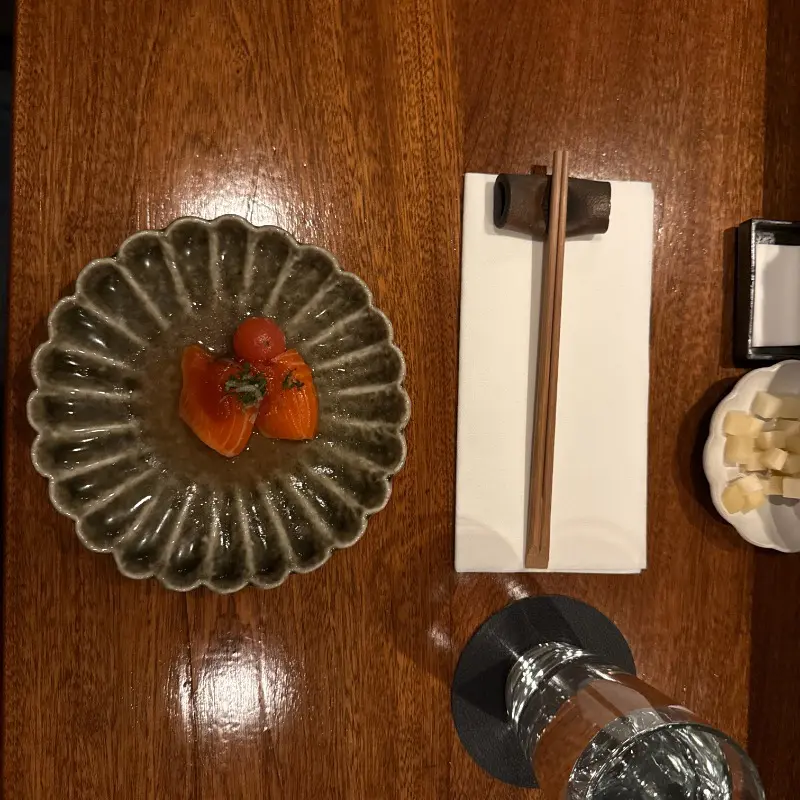
Photo by the Knockturnal
The Hokkaido scallop was even better, especially since scallop is one of my favorite pieces in an omakase. It was creamy, with an almost melting texture, and was among the strongest pieces of the night. The restaurant’s spring menu pairs the hotate with little more than lime zest, and that restraint makes sense. When an ingredient is this naturally rich and delicate, there is very little reason to interfere.
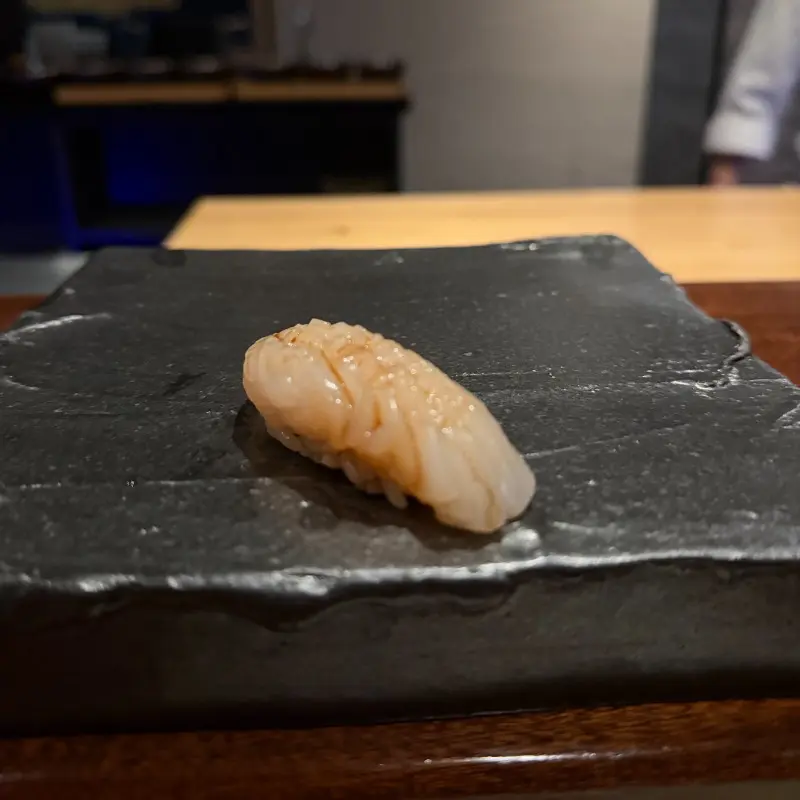
Photo by the Knockturnal
The sawara went in the opposite direction. Salt grilled, the Spanish mackerel arrived with a smoky quality that I particularly enjoyed and did not expect. That bit of char added another dimension to the fish and, more importantly, changed the rhythm of the meal. A procession of sushi can occasionally begin to blur together, but Iki Sekai does a good job of constantly changing texture, seasoning and intensity.
Later came what may have been my favorite piece of the night: the king salmon. It was absurdly creamy. There are more elegant ways to describe fish, but sometimes accuracy is more important than elegance. The salmon was rich, almost buttery and impossibly soft, the kind of bite that temporarily interrupts whatever conversation happens to be taking place around it. Considering I had gone through considerable trouble selecting a dining companion specifically because I expected good conversation, getting both of us to stop talking for a moment was quite an accomplishment.
Another particularly sweet piece of fish followed before the meal returned to tuna, this time with considerably more fire. The aburi toro was one of Iki Sekai’s strongest examples of how technique elevates the experience. The fatty tuna is lightly seared and paired with four-year-aged shoyu, producing a satisfying char on the exterior while preserving the soft richness underneath. The contrast between smoke, fat and aged soy was a nice touch.
Then came one of the restaurant’s more creative preparations: kanpachi paired with truffle maitake, chive and shoyu dashi. Kanpachi itself tends toward a clean, slightly sweet flavor, which makes the decision to bring truffle into the equation a relatively bold one. Truffle can dominate almost anything placed beside it, but here the earthy aroma worked surprisingly well with the fish while remaining a prominent note. The result was richer and more assertive than traditional nigiri, but also considerably more fun.
That course also crystallized what Iki Sekai gets right about operating an omakase at this price point. There is a style of extremely high-end sushi where the ingredient itself is almost entirely the point. Source extraordinary fish, prepare the rice correctly, make the smallest necessary adjustment honed over decades of experience, and then get out of the way.
Iki Sekai is not trying to play that game. At $85, the fish will not always be the kind of near-perfect specimen you might encounter at a counter charging $250 or $300. Instead, the chefs are considerably more interventionist. They cure, grill, marinate, sear and season. They bring in truffle, chimichurri, citrus and aged soy. When a piece benefits from additional flavor, they give it some. That is not a weakness of the experience. In many ways, it is the reason the experience works.
The restaurant understands what it has to work with and seems remarkably good at extracting as much pleasure as possible from every course. Rather than attempting to imitate a more expensive omakase, Iki Sekai has developed a style suited to its own price point, one built around creativity and technique.
The botan ebi offered another good example. Sweet and tender, the shrimp had a richness that made it an easy crowd-pleaser. Later, an A5 Wagyu course at our seating pushed the menu firmly toward indulgence and served as a satisfying final flourish before the meal began winding down.
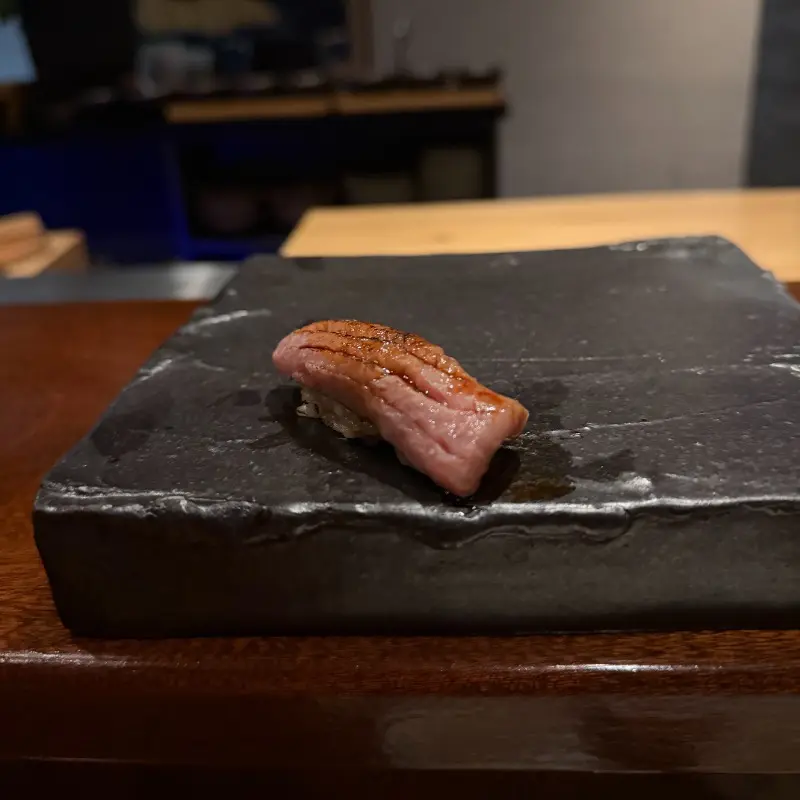
Photo by the Knockturnal
By then, the $85 price that had initially made me skeptical had become the restaurant’s most compelling attribute. There are certainly more luxurious omakase experiences in New York, and most of them cost several times more. Iki Sekai should not be judged by whether it somehow recreates a $300 omakase for $85. It does not, and frankly, it does not need to. What it does offer is an $85 omakase that understands exactly how to make $85 feel like a steal. Rather than approaching every fish with the same philosophy, Iki Sekai seems more interested in asking what will make each individual bite as enjoyable as possible.
That philosophy carried through to the end. A Chilean sea bass miso soup provided a warm, savory break after the richer courses before we were presented with something that left me genuinely confused. That was partly my fault because I was not paying attention and was mid-conversation. Where I expected a tamago course, however, I saw a little piece of what can only be described as egg cheesecake.
I stared at it. I ate it. I remained slightly unsure whether I had just been served an egg dish or a piece of cheesecake. As it turns out, the answer was essentially both. Iki Sekai finishes with a tamago cheesecake, turning the egg preparation traditionally associated with the end of an omakase into something even sweeter, richer and unmistakably dessert-like. It is an unusual little ending to an unusual little omakase, and somehow that makes it perfect.
Which brings me back to rules. I arrived at Iki Sekai having broken one of my own and expecting the restaurant to do the same. Both of my gambles worked out rather well. My guest, despite bypassing virtually every step of my carefully constructed dining-partner vetting process, proved to be excellent company. Iki Sekai, despite bypassing virtually every price threshold I normally associate with a serious omakase, proved to be an excellent meal.
At $85 for 14 courses, it is not merely inexpensive by New York omakase standards. It is one of the better deals I have encountered in the category, or any category for that matter.
I still refuse to subscribe to the idea that rules are made to be broken. That sounds like the beginning of societal collapse. But every once in a while, it seems an exception is worth making.
