What separates humans from animals?
According to paleoanthropologist Dr. Ian Tattersall, the defining human trait is our ability to think symbolically. Humans break the world into symbols, recombine those symbols, and use them to imagine new possibilities, tell stories, and make meaning of their experience. One of the most powerful symbols created across cultures and throughout history is the monster. While monsters often appear frightening or supernatural, they reveal far more about human beings than about the creatures themselves. In his survey of literary monsters, Eric Pederson, Senior Rare Book Specialist at Peter Harrington Rare Books, traces the evolution of monsters from ancient epics to modern fiction and shows how they embody humanity’s fears, values, and changing understanding of itself. Through these figures, literature demonstrates that monsters are not merely enemies to be defeated but symbols through which people define what it means to be human.
Pederson begins his survey with The Odyssey, composed during the eighth or seventh century BCE. One of its most memorable monsters is the Cyclops Polyphemus, a one-eyed giant who devours human beings. He then turns to the older Akkadian epic Gilgamesh, whose monsters include Humbaba, the giant guardian of the sacred Cedar Forest. Pederson also examines Beowulf, the Old English epic written down around 1000 CE. In that poem, the hero Beowulf travels from Sweden to aid the Danes by confronting Grendel, a monster that has terrorized their kingdom for twelve years. After defeating both Grendel and his mother, Beowulf ultimately dies battling a dragon. Although these creatures differ in appearance and origin, they serve a similar function: they embody the dangers and uncertainties that individuals and societies must confront. By overcoming these monsters, heroic figures demonstrate the qualities their cultures admired, including courage, strength, and self-sacrifice.
The werewolf provides another example of how monsters reflect human fears. Although Gilgamesh briefly references the idea when Gilgamesh accuses the goddess Ishtar of transforming a shepherd into a wolf, one of the earliest true werewolf stories appears in Petronius Arbiter’s Satyricon, written in the late first century CE. Pederson notes that the motif reappears in the Brothers Grimm tale “Little Red Riding Hood,” Arthur Rackham’s 1909 illustrations of the tale suggest that the wolf should be understood as a werewolf rather than an ordinary animal. The fear represented by the werewolf differs from that of monsters such as Grendel or the Cyclops. Rather than being an outside threat, the werewolf symbolizes the frightening possibility that something familiar can suddenly become dangerous. This theme also appears in Arthur Conan Doyle’s The Hound of the Baskervilles, where the legend of a supernatural hound is used to manipulate and terrorize members of a family. In these stories, the true danger lies not only in the monster itself but also in uncertainty, deception, and the inability to trust appearances.
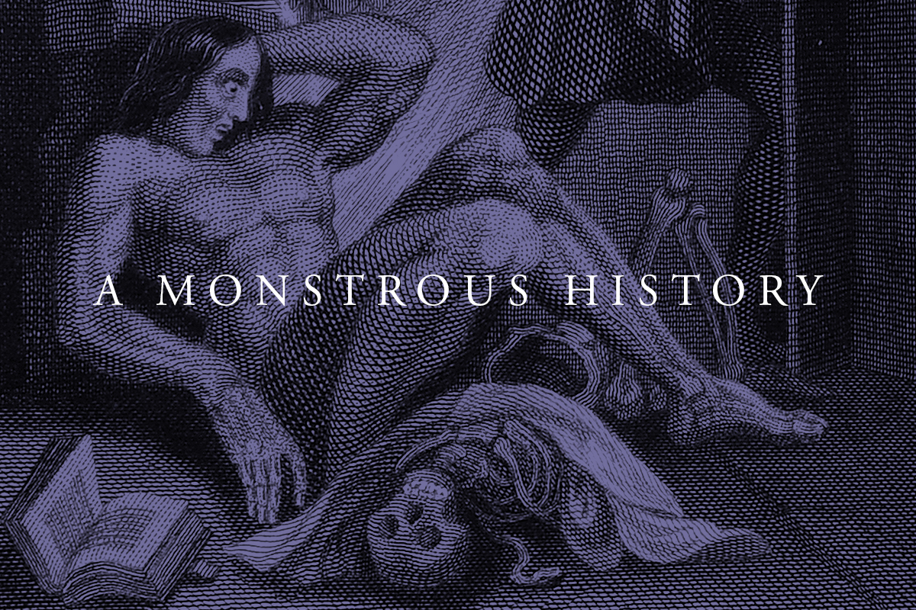
A major turning point in the history of literary monsters occurred in 1816 at the Villa Diodati near Lake Geneva, Switzerland. During a gathering that included Lord Byron, Percy Bysshe Shelley, Mary Wollstonecraft Shelley, and John Polidori, Byron challenged his guests to write ghost stories. The challenge produced two influential works. Polidori wrote The Vampyre, often regarded as the first modern English vampire story, while Mary Shelley wrote Frankenstein. Shelley’s novel transformed the idea of the monster by reflecting Enlightenment questions about science, humanity, and moral responsibility. Unlike earlier monsters, Frankenstein’s creature is not inherently evil. He begins as a compassionate being but becomes violent only after suffering rejection and cruelty from those around him. The novel suggests that society itself can create monsters through its actions. Pederson argues that this idea influenced later works such as King Kong. Like Frankenstein’s creature, Kong lives peacefully in isolation until humans capture him and display him as a spectacle. His tragic death reveals that the real source of destruction may be human exploitation rather than the monster itself.
Pederson concludes by returning to Beowulf through John Gardner’s novel Grendel, which retells the story from the monster’s perspective. Rather than portraying Grendel as a mindless beast, Gardner presents him as an intelligent and philosophical antihero. Through this reversal, readers are encouraged to question whether the distinction between monster and human is as clear as it first appears. Grendel often views human behavior as violent, irrational, and destructive, leading him to wonder who the real monsters are. This idea reaches its climax in Grendel’s conversation with the dragon. When Grendel asks, “Why monsters?” the dragon responds that monsters help define humanity. By confronting monsters, people are pushed to think, create, and explain their place in the world. In the dragon’s view, monsters inspire humanity’s greatest achievements because they provide the contrast through which people understand themselves.
Through his survey of monsters in literature, Pederson illustrates the uniquely human capacity for symbolic thought. From the Cyclops and Grendel to Frankenstein’s creature and King Kong, monsters have served as reflections of the fears, anxieties, and moral questions of their societies. Their evolution reveals a corresponding shift in how people understand themselves, moving from external threats to recognizing the destructive potential within humanity itself. Ultimately, monsters endure because they help us establish the boundaries between the human and the inhuman, the acceptable and the unacceptable, the familiar and the unknown. As Tattersall suggests, humans understand the world through symbols, and monsters remain among our most powerful symbols because they allow us to explore who we are by confronting what we are not.
