
The 2026 Tribeca Festival, marking its 25th anniversary, continues its long tradition of balancing intimate New York storytelling with adventurous indie cinema. But a clear theme emerged across several of the titles this year: the varied, complex experiences of the artist’s life. Whether grappling with creative reinvention, pursuing long-abandoned dreams, or questioning the value of public recognition, these five films chronicled the artist’s journey in rare and riveting ways.

Imani Jade Powers
and Betsey Brown in
Mother Future Self (Issac Banks)
Mother Future Self
Tori Lancaster’s quiet and contemplative story centers on two estranged friends (Imani Jade Powers and Betsey Brown) who find themselves reunited at an experimental dance and movement camp in rural Maine.
What begins as a structured creative reunion slowly destabilizes into something far more fragile, where memory, intimacy, and mistrust begin to blur.
As Sofi and Jordan are drawn back into each other’s orbit, their shared history resurfaces in unpredictable ways, unsettling not only their relationship but the delicate group dynamic around them. The question of whether reconnection is possible begins to fracture into something more volatile: whether certain bonds can ever be safely revisited at all.
Lancaster constructs a film that functions as both a narrative and a lived inquiry. Blending traditional storytelling with documentary-like observation of movement work facilitated by K.J. Holmes, the film resists clean psychological resolution in favor of embodied uncertainty.
Mother Future Self ultimately uses its secluded setting not as an escape, but as a pressure chamber: a space where the past cannot remain buried and where the body itself becomes the site of reckoning.
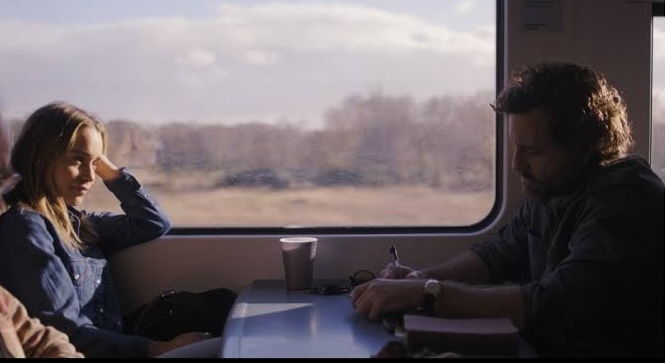
Emilia Clarke and Édgar Ramírez in Next Life (Tribeca)
Next Life
When Ivy (Emilia Clarke) meets a jazz musician (Édgar Ramírez) on a train one morning, her life splits into two parallel paths. In one, a chance encounter leads to an unexpected romance. In another, she never meets this stranger and instead reconnects with her former fiancé. As both timelines unfold side by side, as Ivy, who once dreamed of being a singer, moves between a fleeting, improvisational new love and the pull of a familiar past she once believed was certain.
Director Drake Doremus uses the dual structure to explore how easily key moments in life are shaped by timing, accidents, and fear. With its intimate cinematography, Next Life is a soulful story with performances that enrapture and captivate. Emotions pulsate from the screen like the rhythmic tracks are layered throughout. It reminds us why thought-provoking narratives, which are tragically rare in this era, are so essential to cinema.
Beneath its romantic framework, the film is also about the life an artist leaves behind and the lingering question of whether it’s ever too late to reclaim it.

Zoey Deutch, Ken Marino, Miles Gutierrez-Riley, and Ben Wang in Gail Daugherty and the Celebrity Sex Pass (Sony Pictures Classics)
Gail Daugherty and the Celebrity Sex Pass
One of the most unabashedly funny films to come along in years, David Wain’s Gail Daugherty and the Celebrity Sex Pass is an outrageous depiction of Hollywood.
After discovering her fiancé has acted on his celebrity free pass, Gail (Zoey Deutch) embarks on a trip to Los Angeles with her best friend in hopes of finding her own chosen celebrity: Jon Hamm.
The film really kicks into gear when Gail brings irresistibly appealing characters along on her quest, including a disgraced photographer (Ken Marino) still clamoring for his (literal) shot and John Slattery (as a heightened version of himself).
What follows is an increasingly absurd collision of satire, celebrity cameos, and the most mature tropes inspired by The Wizard of Oz audiences have seen.
Yet beneath the film’s outrageous premise lies an unexpectedly sweet story about friendship and “making it” in entertainment. A welcome send-up of ‘90s comedies, it’s one of the festival’s most unexpected crowd-pleasers.
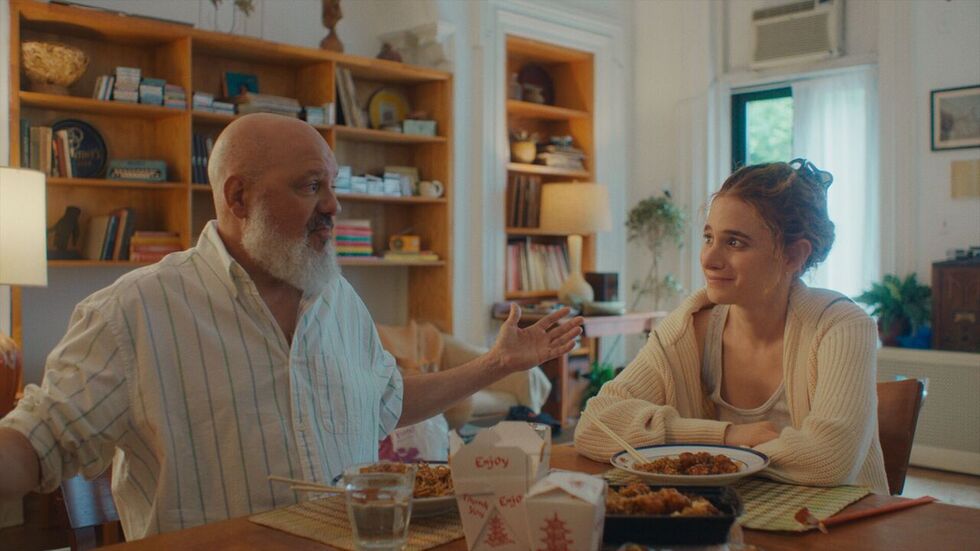
Ellie Sachs and David Cross in Lucy Schulman (Barton Cortright)
Lucy Schulman
After a devastating breakup, Lucy Schulman (Ellie Sachs) moves back in with her eccentric, deeply affectionate father (David Cross) and begins the slow, often funny process of rebuilding her life. Though she spends her days working at a high end bookshop, she dreams of becoming an editor. But there’s a major obstacle standing in her way: herself.
Lucy begins to realize she’s taken the ambitions of the men in her life more seriously than she’s taken her own. As she confronts this, she finds herself untangling not just romantic disappointment but a deeper pattern of identity loss, one in which love becomes a way of disappearing into someone else’s story.
Sachs, in her feature debut as writer, director, and star, builds a film that serves as a tribute to New York and the character-driven dramas that have taken place in the city over the last few decades.
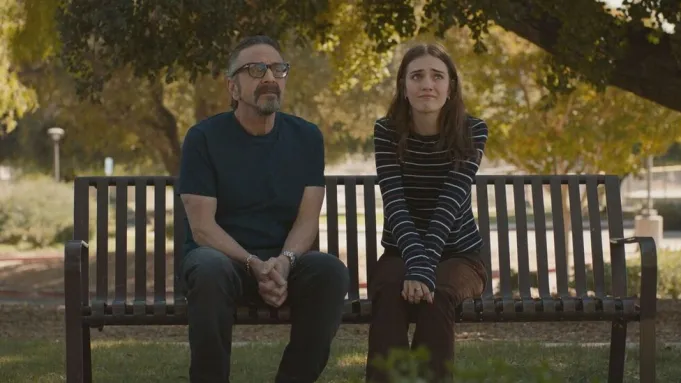
Marc Maron and Talia Ryder in In Memoriam (Independent Film Group)
In Memoriam
Marc Maron delivers a heartbreakingly funny performance in In Memoriam, a darkly comedic yet moving film from Rob Burnett. Langston (Maron) is a fading actor diagnosed with terminal cancer who, instead of seeking treatment, fixates on being featured in the Oscars’ “In Memoriam” segment. But as he reconnects with his estranged daughter (Talia Ryder) and begins seeing a therapist (Lily Gladstone), his seemingly impenetrable arrogance is chipped away at.
What begins as a vapid pursuit becomes something tender and meaningful, sustained by Maron’s layered turn and striking supporting turns from Ryder, Gladstone, and Michael McKean as Langston’s longtime manager.
In Memoriam is an outrageously funny exploration of an artist’s pursuit of public validation. Maron’s performance is so endearing, you can’t help but care deeply for his character, even when he’s at his most contemptible. By the end, as you wipe away tears, you’re left with a powerful message that’s worthy of commemoration.
