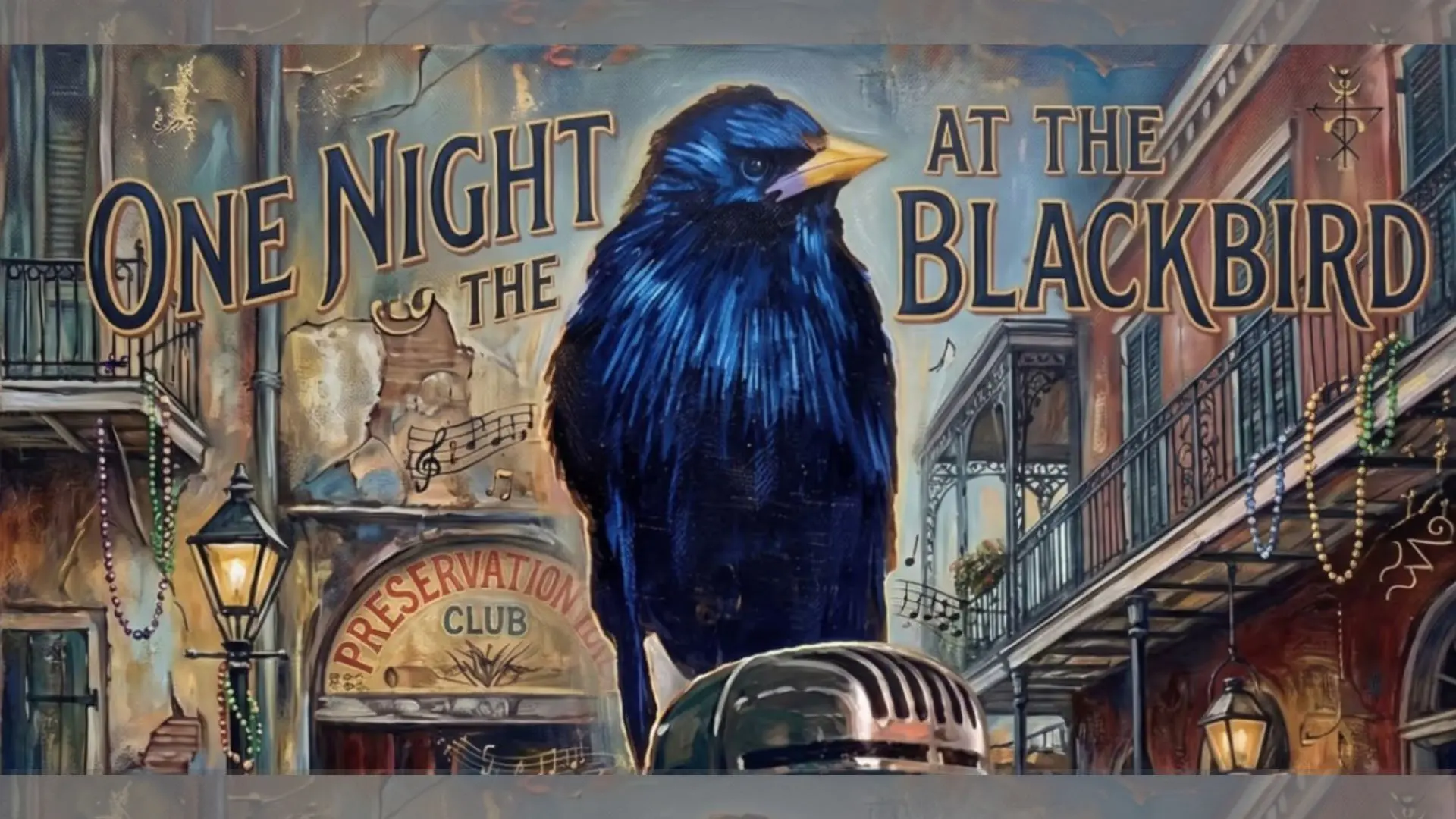
What happens to jazz musicians after the final note? In One Night at the Blackbird, Maria Messias Mendes and Thomas Mullen imagine an afterlife where the music keeps playing inside a New Orleans funeral parlor.
The premise carries extra irony against the fears jazz once inspired. In 1923, the Baltimore Sun quoted Mrs. Martha Lee warning that jazz produced a “fevered physical condition,” weakened self-control, and left the brain “incapable of distinguishing between right and wrong.” A century later, this play answers that alarm with wit, spirit, and affection for the music’s unruly life force.
Mendes, known for female-led stories, and Mullen, who owned and operated community newspapers for more than thirty years, developed One Night at the Blackbird through the NOLA Playwrights Workshop in New Orleans before bringing it to AMT Theater’s Broadway Bound Theatre Festival. Mullen calls the festival “a bootcamp for writers.” Two original cast members, Aria Jackson and KC Wayne Simms, joined the New York production. Mullen praised director Michael Higgins, whose behind-the-scenes work helped pull the production together. Higgins, an experienced playwright, director, fight director, and producer, also handled additional casting. Mullen also credits Higgins with finding the right costume designer in Kat Santomoreno, whose background as a choreographer and actor helped shape the production’s look.
The play is set in a funeral parlor in New Orleans’s Seventh Ward, often associated with the birth of jazz. The Blackbird has become a sanctuary for departed jazz musicians, where performances continue night after night—until Lucy decides to close the club.
Lucy—short for Lucy(ifer), the owner of The Blackbird—is played by Aria Jackson in her New York stage debut. Drawing on her extensive New Orleans acting experience, Jackson gives us a Satan shadowed by regret. Lucy longs to hear Gabriel’s horn again and wants to experiment with new musicians. The problem is that her chosen performers are still alive.
KC Wayne Simms, also from New Orleans, plays Herman Godfrey, The Blackbird’s harried manager. This is Simms debut in New York. Desperate to save the club and the souls who play there, Herman strikes a bargain with Lucy. Simms captures the strain of a manager working for an impossibly demanding boss, and when Lucy and Herman trade roles, both actors skillfully absorb traits from each other’s characters.
Xavier Rodney portrays “Satchmo”—Louis Armstrong—with warmth and humor. A performer with television, film, and commercial credits, Rodney gives us a “Satchmo” who meets the world through music and wit. He remains at The Blackbird because, as he says, “all my friends are here.”
Allen Toussaint, a major figure in New Orleans music, appears here as a gentlemanly spirit played by Duane Ferguson. Known in life as a behind-the-scenes force whose compositions were recorded by many artists, Toussaint continues composing after death. Ferguson, a media professional with stage and screen experience, brings quiet steadiness to a character who engages with the others without being pulled into their drama.
Lucy demands that Herman bring Mahalia Jackson, the great gospel singer, to perform at The Blackbird. The challenge is that Jackson has sworn never to sing in a club. With Satchmo’s help, Herman persuades her to come. Alexandra Thomas, a full-time K–4 elementary performing arts teacher, brings impressive gifts as a singer, actor, and storyteller to the role of Mahalia Jackson.
The play’s richest exchange comes when Lucy and Mahalia Jackson argue over the meaning of jazz. Lucy says jazz was born from grief and pain; Mahalia answers that some voices do not want to be healed. They only want to be heard. Lucy insists she heard joy and has been trying to recreate that perfect sound ever since. Jazz comes close, she says, because it breathes as if it were alive. The argument echoes Dr. Martin Luther King Jr.’s essay for the inaugural Berlin Jazz Festival, where he wrote that jazz “speaks for life” and transforms hardship into hope, strength, and triumph. That is also the heartbeat of One Night at the Blackbird.
At 75 minutes, the production already has a vivid premise, a lively ensemble, and a deep affection for New Orleans music. Mullen says the piece still needs to be “tuned up,” and he hopes to add original music and dance. That would only sharpen what is already most promising about the play: its belief that jazz does not end with death. It lingers, argues, mourns, jokes, and keeps searching for one more perfect sound. Keep an eye out for the next, fuller version of One Night at the Blackbird.
