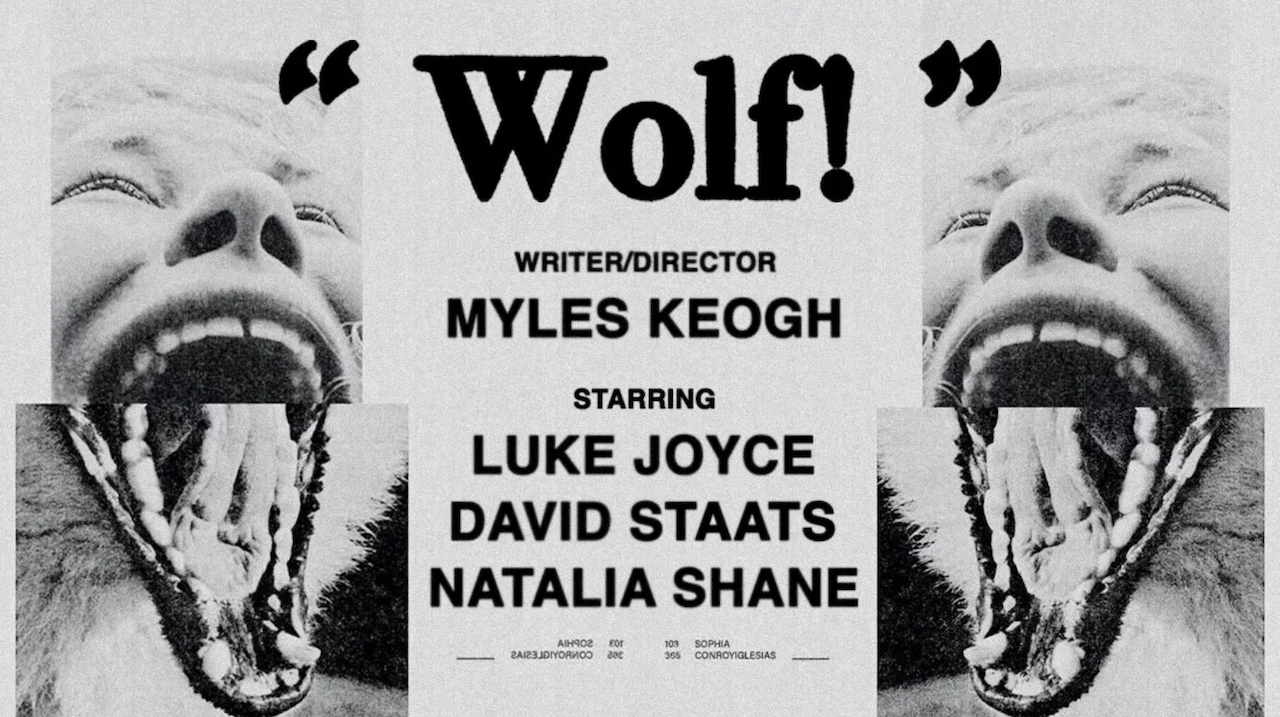
Press describes itself as “a production company against apathy,” and its staging of Myles Keogh’s ‘Wolf!’ delivers on that mission with unnerving force.
Blending speculative science fiction with intimate, character-driven drama, the play confronts urgent questions about technology, power, and human agency. Keogh, who also directs, sustains the psychological tension with taut dialogue and a committed ensemble.
Two prisoners enter an Artificial General Intelligence (AGI) parole program wearing shock collars that compel them to tell the truth. Sol Francis, accused of killing his dog and baby sister, maintains that he was framed. Charles Abner attacked a father who slapped his child on the back of the head. After the man warned Charles not to interfere with how he raised his child, Charles bit his neck so he could no longer speak. Charles insists it was not a crime because the father was not human: he could taste plastic in the man’s blood. To earn their freedom, the prisoners must reenact scenes from the futures the system predicts for them. If they prove they can inhabit those lives, their sentences will be commuted. From this unsettling premise, Keogh probes algorithmic control, mortality, love, and the limits of free will.
New to New York as a playwright, theater maker, and director, Myles Keogh appears poised to gain recognition for writing and directing Wolf! Luke Joyce vividly portrays Sol Francis, a prisoner who hopes to become a missionary. An Emerson College acting graduate with experience in independent film and regional theater, Joyce lends genuine emotional weight to Sol’s search for purpose. David Staats, who trained at the Emerson College Acting Studio and has appeared in Now Be Still and numerous stage productions, depicts Charles Abner as a man straining against the AGI’s control. Staats also plays Shepherd, a neutered AI guardian assigned to multiple families. Natalia Shane, who trained at NYU Tisch’s Experimental Theatre Wing, brings distinctive theatrical energy to Mary, Sol’s wife.
The high-stakes, data-driven parole simulation raises more questions than it answers—and that ambiguity is the source of the play’s power. Keogh challenges both our willingness to surrender human authority to technology and the seductive belief that data can determine the course of a life. At approximately two hours and thirty minutes, including a ten-minute intermission, Wolf! demands patience, but it rewards that investment. Ambitious, unsettling, and insistently human, the production leaves audiences questioning what freedom, responsibility, and choice can mean when an algorithm claims to know us better than we know ourselves.
