Located in Soho, Sushi Ouji is a woman-owned omakase counter making high-quality sushi more approachable through Japanese sourcing, thoughtful hospitality, and a $150 tasting menu.
When I was in Japan a few years ago, one of my top priorities was making the trip to Tsukiji Fish Market. As both a sushi fanatic and someone who spent far too many evenings watching Anthony Bourdain and countless food shows throughout the 2010s, it felt like making a pilgrimage to sushi Mecca. It didn’t disappoint.
Contrary to what many people assume, however, the sushi itself wasn’t dramatically better than what you can find in New York. Better? Absolutely. But only marginally, when compared to the top shops NYC has to offer. The true differentiator, however, was the price. I still remember being served a platter of toro, chutoro, and otoro, around a dozen pieces in total, for roughly forty dollars. It remains the finest tuna I’ve ever eaten, and an equivalent experience in New York would easily cost several times as much.
New York may be half a world away from Tokyo, but how does a sushi restaurant in Manhattan manage to compete with fish served thousands of miles closer to the source? The answer is overnight air freight. Most of the fish is flown directly from Japan, arriving within 24 to 48 hours. It’s an expensive and marvelous logistical undertaking that serves as a testament to modern supply chains. Restaurants that execute it well under the guidance of experienced sushi masters, many of whom also hail from Japan, often charge upwards of $300 per person. Given the work behind the scenes, that price point makes sense.
That brings me to Sushi Ouji, a restaurant that is something of an anomaly. Nearly every ingredient on the menu is sourced directly from Japan, with only two exceptions, yet the omakase comes in at around $150. That price alone makes it intriguing. After spending an evening there, I came away thinking it offers one of the stronger value propositions in New York’s increasingly crowded omakase scene.
After being seated and treated to a wonderful bottle of fresh sake that was aromatic and floral, we watched as the duo of chefs worked to prepare the appetizer courses. A piece of kanpachi, or Japanese amberjack, opened the evening with a clean, delicate bite before a small jelly palate cleanser introduced a bright but restrained burst of fruit. It wasn’t flashy, nor was it trying to be. Instead, it established the rhythm that would define much of the appetizer portion of the meal.
That continued with seasonal tachiuo, finished simply with radish and a squeeze of lime, before one of the meal’s early highlights arrived: a bowl layered with Hokkaido salmon, salmon roe, and uni. If you put three of Earth’s greatest treasures in a bowl, of course it is going to be good. Here, however, they were among the best examples of each that I’ve ever had. It was a perfectly rich and indulgent way to close out the opening courses before we moved on to the nigiri.
Once the nigiri began, the progression became the star of the meal. Rather than chasing increasingly extravagant toppings, Sushi Ouji gradually built from elegant restraint toward richer, more indulgent bites. The sea bream paired beautifully with freshly grated wasabi, while the shima aji showcased the clean, firm texture that makes the fish so beloved. A lightly smoked kinmedai introduced an unexpected hint of spice alongside green onion, gently changing the pace without disrupting the flow.
The richer courses were where the sourcing really began to shine. The soy-marinated zuke akami melted across the palate with a richness that was almost cheese-like, while the otoro, topped with caviar, somehow managed to be both impossibly creamy and satisfyingly meaty, making it easily one of my favorite bites of the year. Even the mackerel, often a polarizing fish, delivered a hearty bite that somehow reminded me more of a finely crafted sausage than the oily reputation it sometimes carries.

Photo by the Knockturnal
If there was one surprise of the evening, it was the kuruma ebi. Japanese tiger shrimp isn’t typically the piece I remember most after an omakase, nor is it one I often see on the menu, yet this may have been one of the sweetest pieces of shrimp I’ve ever eaten. That sweetness carried into the silky hotate before culminating in what was easily my favorite bite of the evening: uni that was rich, buttery, and among the best I’ve had in years. Uni from Hokkaido never fails, but the selection they had that day was exceptionally good.
From there, the meal began to wind down with the miso soup. So often treated as an afterthought, it was deeply comforting and thoughtfully prepared. The main courses concluded with a futomaki, or “thick roll,” which we watched the chefs prepare with great excitement and fascination, as I had never seen anything quite like it, especially not at an omakase. It was a massive roll, just short of being as large as my palm, filled with tuna and yellowtail before being topped with salmon roe. It was a fittingly substantial final savory course that delivered one last explosion of flavor before dessert.

Photo by the Knockturnal
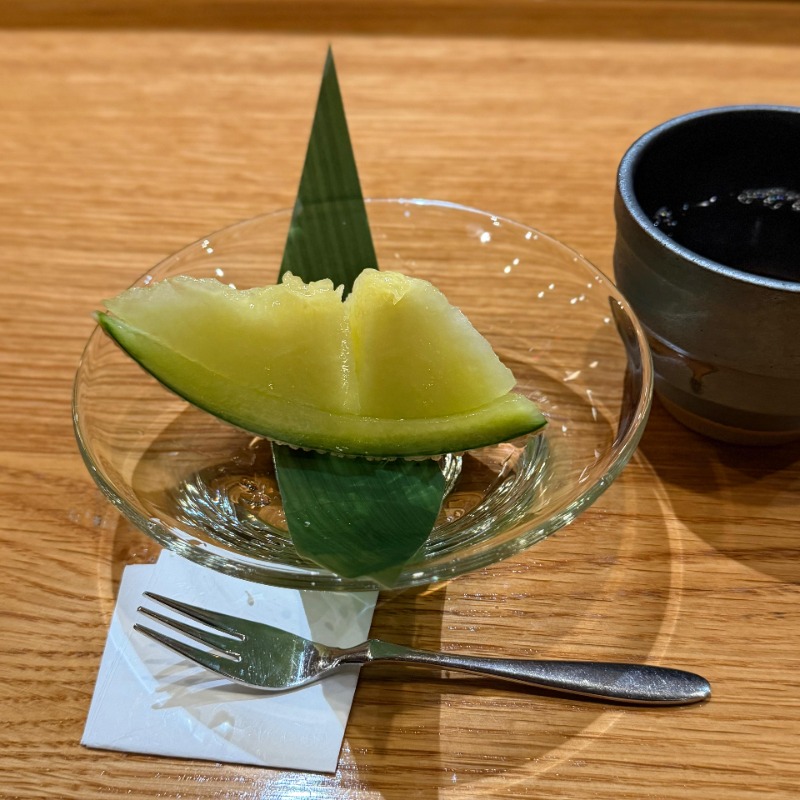
Dessert was no less interesting than the rest of the meal. Roasted hojicha tea and an exquisite Japanese melon were served to close the meal. Interestingly, the melon was cultivated so that each vine produced only a single fruit. The result was a melon with remarkable sweetness and a level of juiciness that almost didn’t seem natural, as if someone had injected it with even more juice. It was a simple ending, but an effective one.

Photo by the Knockturnal
Well, actually, that’s not entirely true. To cap things off, the staff insisted on pouring us one final sake, which they had recently received. They took the time to explain that the freshest sake is often the cleanest, with its subtle flavors speaking louder than anything overly aged or heavy. It was a small gesture, but one that perfectly encapsulated the evening. Throughout the meal, the team never felt rehearsed or transactional. They were eager to teach, answer questions, and share the stories behind what was on the plate, making the experience feel as welcoming as it was informative.
There’s a reason Sushi Ouji made the 2025 New York Times Top 100 list. It occupies a valuable place in New York’s crowded omakase landscape: ambitious enough to feel special, approachable enough not to feel intimidating, and reasonably priced enough to become more than a once-a-year indulgence. It is also, surprisingly, one of the city’s relatively few woman-owned omakase counters.
Omakase can be daunting for the uninitiated, particularly when the experience comes wrapped in unspoken rules and a several-hundred-dollar price tag. Sushi Ouji strips away much of that anxiety without diminishing the sense of occasion. I arrived in a suit, while my friend came directly from work in a dress, as did several of the other diners. Beside us, however, sat a guest in a hoodie, quietly reading manga on his phone. He was welcomed with precisely the same warmth and attention that we were.
Sushi Ouji is not pretending to be the city’s most rarefied or extravagant omakase counter. Its achievement is more practical and, in some ways, more useful: it offers thoughtfully sourced fish, genuine hospitality, and a polished progression for roughly half the price of many comparable experiences. For newcomers, it is an inviting place to begin. For regular omakase diners, it is the kind of restaurant that could realistically find its way into the rotation.