Continuing the fifth annual Defender Service Awards weekend, Jaguar Land Rover brought winners, media, and partners to Manchester, Vermont, for a day of off-roading, camaraderie, and hands-on adventure with the Defender.
There comes a point when a vehicle changes from claims to something you can physically understand. Not a silhouette in a campaign film. Not the reputation you hear about the brand. The drive north in the Defender’s standard on-road setting had already suggested part of the story. After the ceremony and vehicle reveal in Mahwah, we were assigned a Pangea Green Defender 130 and sent toward Manchester, Vermont, under a steady wash of rain. It was an almost four-hour drive that moved from New Jersey through Albany and toward the Vermont border. The Defender felt composed over bad stretches of road and comfortably insulated, thanks in part to the heated seats. CarPlay slipped on without issue as we played Robyn’s top hits in anticipation of her new album. The Meridian audio system carried the drive beautifully. The central console also felt as intuitive as the newest iPhone. Even the rearview mirror, capable of switching from a standard reflection to a camera-fed screen, was a sophisticated touch that made information clearer and let the driver keep moving. By the time we reached the Taconic Hotel, the day had thinned into dusk. Vermont painted a mood board of wet roads, bare trees, the remaining residue of winter, and mountains visible only in pieces through the dimming light. It made it easy to retreat swiftly to bed in anticipation of the off-road activities the following day.
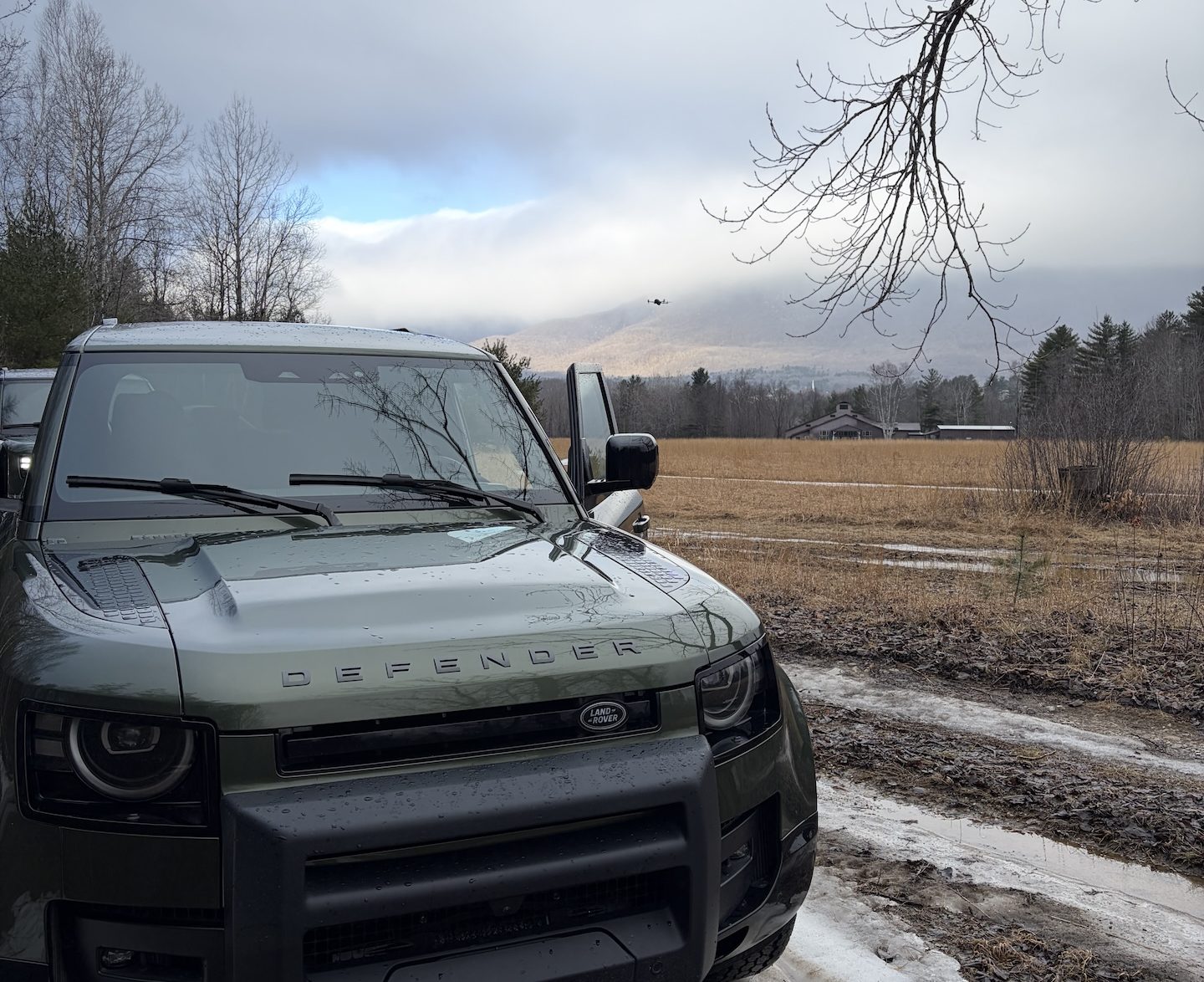
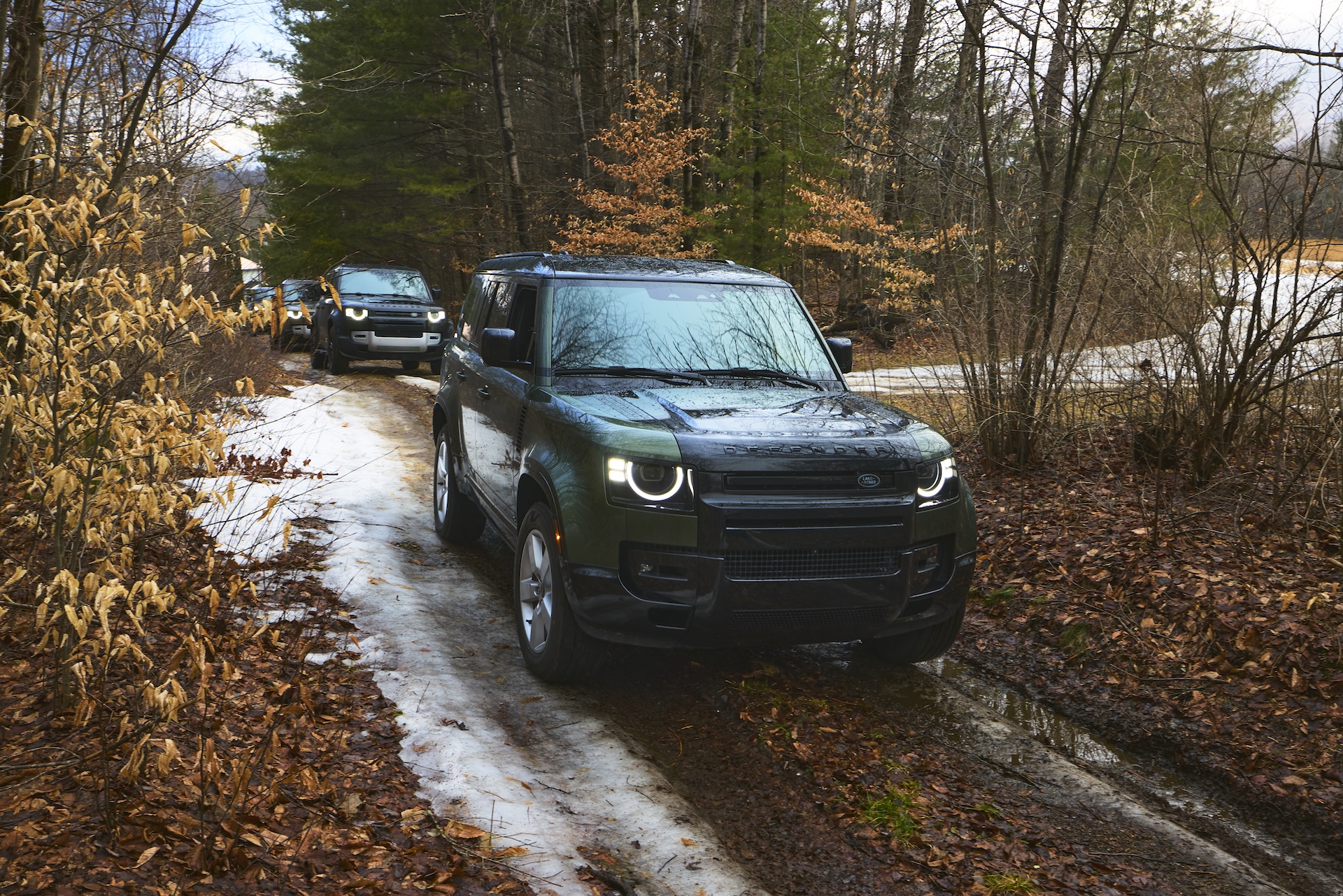
The next morning began early. Breakfast gave way to a line of Defenders gathering outside, their bodywork still carrying the cold sheen of the rain. With each vehicle paired with an instructor, the group departed for the Land Rover Experience Center. If spring had technically arrived, the terrain had not quite agreed. There was snow and ice still lodged in the shade, the ground a churned orange-brown, slick with mud and punctuated by rock. Trees stood mostly bare, leaving the trails exposed and skeletal. Mount Equinox appeared and disappeared through low clouds, its mass hovering at the edge of the experience. Although muddy, uneven, and full of tracks and split paths, it was scenic in a softer way as the sunlight blanketed the sky.
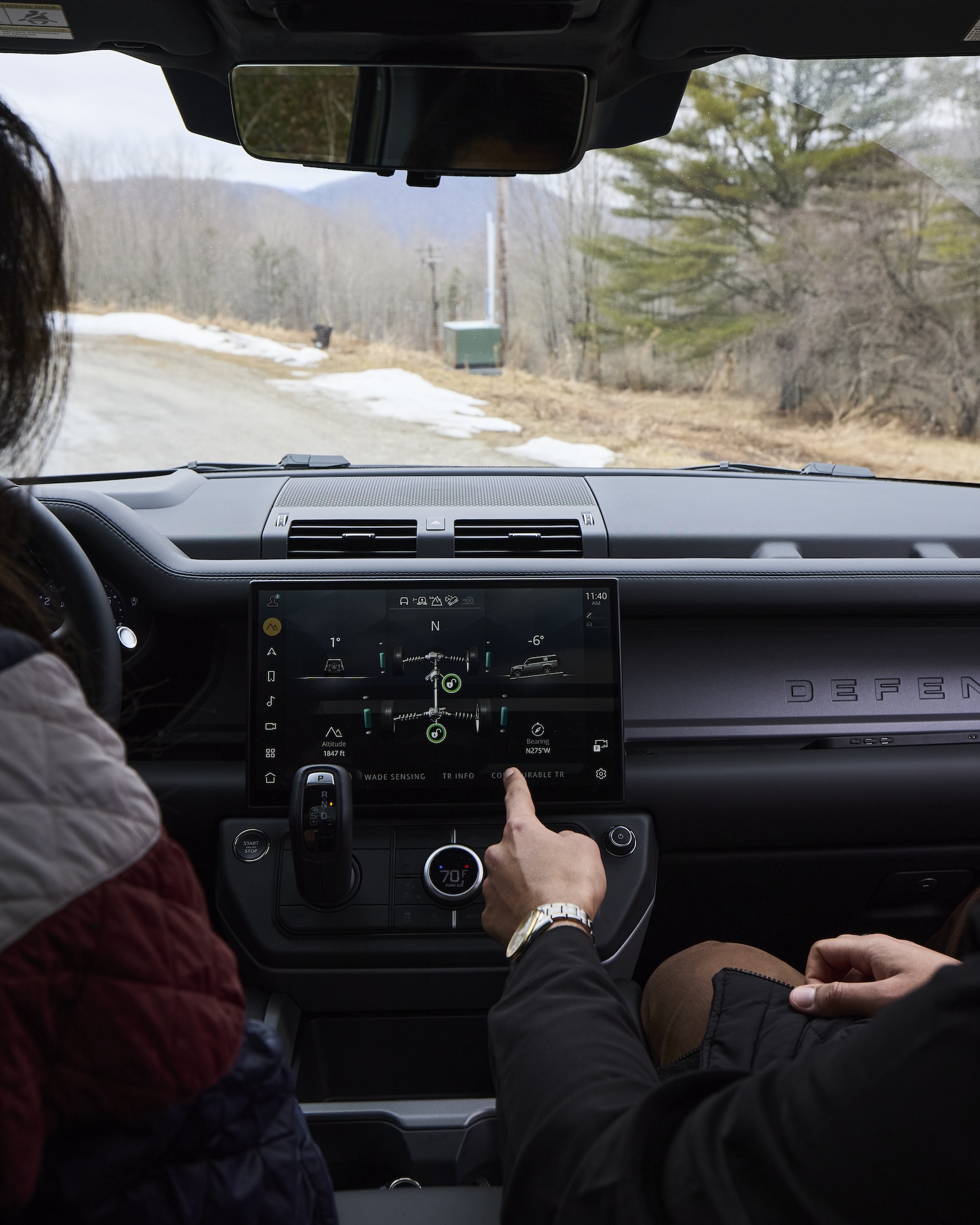
Inside the vehicle, our instructor, David, spoke with the calm patience of someone who understands that confidence is best taught through clarity. “As slowly as possible, only as fast as necessary,” he said at every point while guiding us through a section of difficult ground, and the phrase stayed with me because it quietly dismantled the usual myth of off-roading. This was not about attacking the trail at all. It was about reading it and assessing it. Rocks punish impatience, and low traction changes the value of momentum. Terrain, as he kept reminding us in one form or another, is always situational. Assessment matters. Control matters. We shifted gears in off-road mode and, guided by the car’s cameras, moved the vehicle into more specialized setups for tougher sections. As modes shifted, the feeling of the vehicle itself changed beneath you. The vehicle became more deliberate, more planted, more evidently prepared for specific kinds of difficulty. The technical language David was using could have become oppressive, but in practice it felt surprisingly intuitive because every adjustment had an immediate physical corollary. With every push on the throttle, the screen mirrored which wheels were working.
Courtesy Wave Media Inc.
One of the biggest thrills came during the descent-control exercise. We took the vehicle to the top of a steep drop, released the brake, and let the system guide us down. What was striking was not the steepness itself, but the eerie composure of the descent. No lurching. No theatrical drop. Just a controlled glide downward, as though gravity had agreed to become more civilized. The Defender is a great tool, but the driver still needs to steer and stay engaged. Our car handled the challenge with ease, while other cars behind us had more … emotional responses to trusting the process.
Courtesy Wave Media Inc.
After the morning off-road demo and the drive toward Hill Farm Inn, the day turned outward into a series of team challenges that gave the experience more humor and adventure.

Courtesy Wave Media Inc.
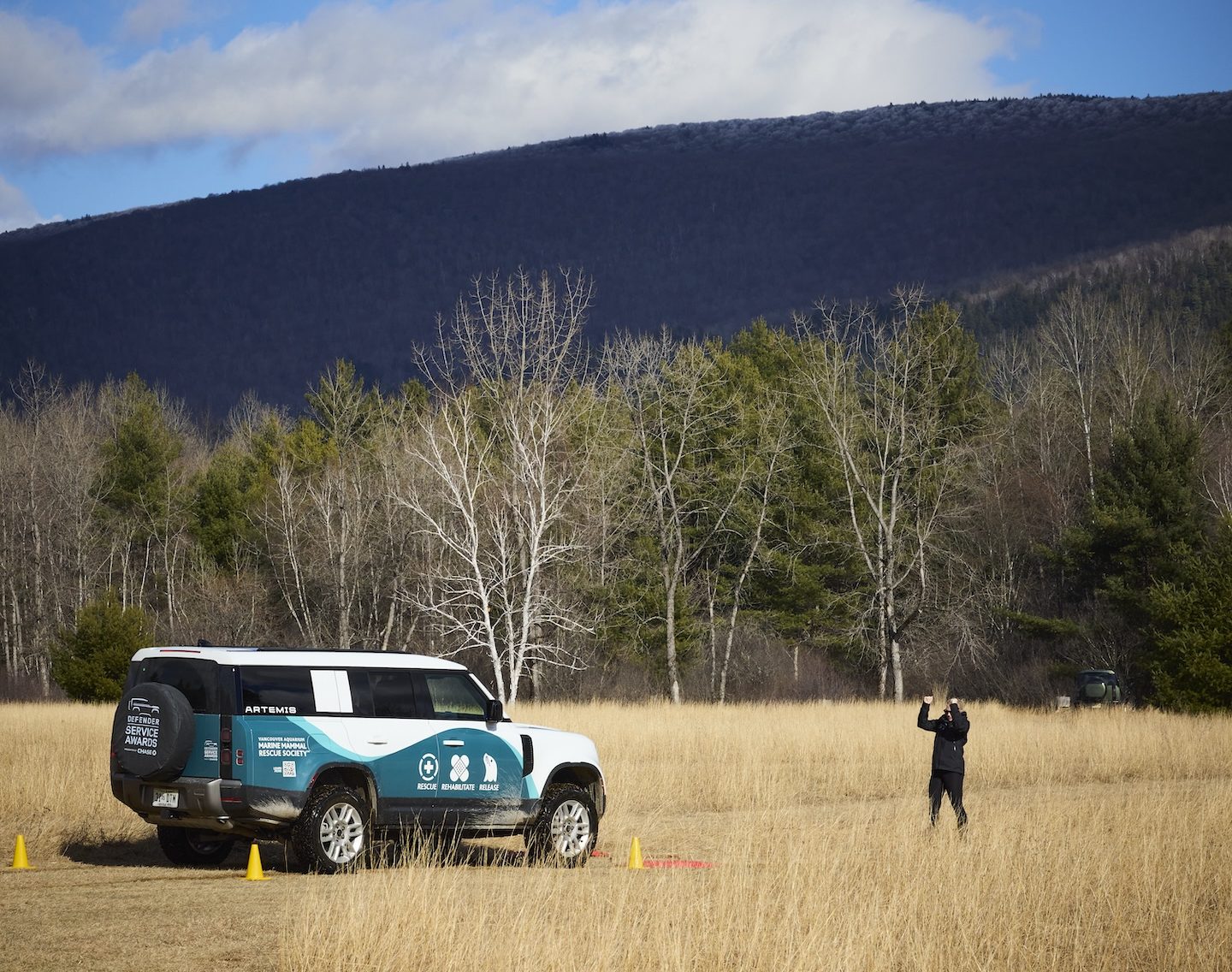
The blindfold driving challenge was the most immediately absurd and, predictably, one of the most memorable. Paired with Feeding Northeast Florida, our team divided into roles: one person outside giving hand signals, one person translating those signals into verbal instructions, and one in the driver’s seat, blindfolded, steering and braking based entirely on other people’s confidence. The surprising part was how disorienting the experience became precisely because the Defender moved so smoothly. It was difficult to tell whether the care was in motion at all. The turns were short and sharp, and we suddenly realized the scale of the vehicle. It is a humongous car. We eventually relied on the onboard cameras to understand where the car sat relative to the cones. We still hit four of them and lost. It made for a better story and, more importantly, a better lesson. No system, however elegant, replaces communication.
Courtesy Wave Media Inc.
Other challenges widened that lesson in more tactile ways. There was a maple sap station that turned into a sticky arithmetic puzzle, requiring teams to measure out exactly two liters using fractional containers while everyone’s hands grew tacky from the sap. There was also a pulley exercise involving an old Range Rover, ropes, and the sort of improvised problem-solving that briefly makes every group feel like it has stumbled into a highly civilized survival scenario.
And there was perhaps the most quietly elegant exercise of the afternoon: driving uneven, muddy terrain with a glass of water mounted on the hood, the goal being not speed, but smoothness. These challenges created a kind of camaraderie, showing how helpful and encouraging everyone was across teams. It showed how readily people cheered and showed up for each other, not just in their organizations, but in real life with strangers.
Later, as the afternoon eased into evening, the group gathered around a campfire. Smoke curled into the cooling air. Marshmallows blistered over the flames. The mountains receded into dusk as the group compared challenge stories and took photographs against the landscape. Dinner that night carried more laughter with trivia, prizes like mini Defenders, Yeti tumblers, bags, and framed photographs of each guest with their Defender.
The following day, riding back with the Vancouver Aquarium Marine Mammal Rescue Society team, we bonded further over their organization, and it made the purpose of the weekend feel even more special. For Lindsaye and Kendra, the weekend was an adventure, but also instructive. They described learning the “ins and outs” of the Defender 130 as an experience that opened their eyes to how much the vehicle will affect their rescue work.
They spoke about snow, ice, mud, steep hills, and rocky slopes not as recreational thrills, but as conditions through which they now felt more comfortable moving. They praised the instructors for their patience, knowledge, and passion, and emphasized the vehicle’s ability to navigate difficult terrain in a controlled and safe way. This matters profoundly when the work involves rescues, live animals, and remote environments. By the end of the weekend, the lasting impression was not just the Defender’s capability, but the experience of discovering it alongside a group of people whose work, generosity, and sense of purpose gave the entire trip its meaning.
