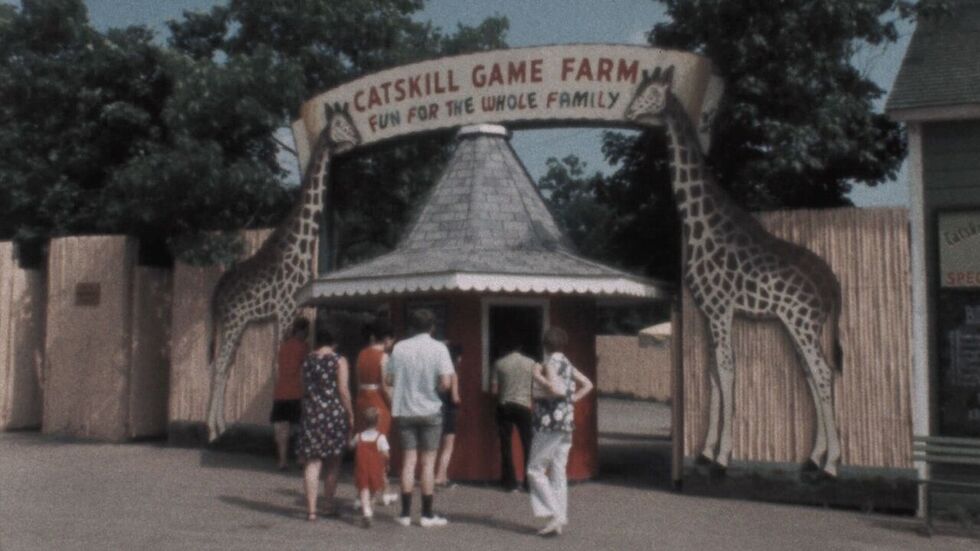
Tim Travers Hawkins new documentary American Zoo is the story of the Catskill Game Farm, America’s first and largest privately-owned zoo.
American Zoo follows the story of German immigrant Roland Lindemann, and his family’s pursuit of opening a private zoo in the foothills of the Catskill Mountains in upstate New York. The documentary unearths thousands of photos and videos spanning the duration of the zoo’s life, from its opening in 1933 to the day it closed its doors in 2006. It is clear from the beginning there is trouble in paradise, as the film’s creepy Norman Rockwell-style title cards roll over creepy music and creepy videos of animals giving birth.
Much of the film is narrated by Roland’s daughter, Kathie Lindemann Schultz. She would begin by describing the slow but steady expansion of her father’s zoo. The Catskills were becoming a vacation destination at the time, and the Game Farm was prime entertainment for the families who would spend their summers in the mountains. As she goes on to describe the means of expansion, however, the audience might get a glimpse into some of the dark history the film will go on to uncover. Alleging that private zoos were not held to the same standards as perhaps a public institution, Kathie spins tales of her family hunting down game in foreign national parks, often mishandling the animals-grabbing them by their horns or tails, or restraining them in unethical ways. She notes in particular the experience of tranquilizing an elephant to bring back to the states. All of this is caught on camera.
It seems pretty straightforward. Kathie’s testimony is definitely interesting, but it doesn’t necessarily jump out as something we haven’t seen before. Just as the audience begins to settle into what they think this documentary is going to be, we are introduced to the man Roland hired as Zoo director in 1956, German geneticist Heinz Heck. He brought with him to the states a convoy of animals he bred while working at the Munich Zoo, including a pair of wild horses known as Tarpans. What makes those animals particularly notable, you might ask?
Tarpans, at the time, were already considered extinct.
Supported by an array of interviews from members of the Lindemann and Heck families, as well as from former Zoo employees, and set to the well of photos and videos documenting both the Zoo’s public and private affairs, what follows is a fascinating social commentary on Zoos, breeding programs, and the ethics surrounding using animals for scientific research. Informed by the historical context of the time, the film also acts as a shockingly astute allegory for the current time that we live in. The small ways in which politics and our values can seep into even the most unexpected corners of our lives.
Photo Courtesy: Tribeca
