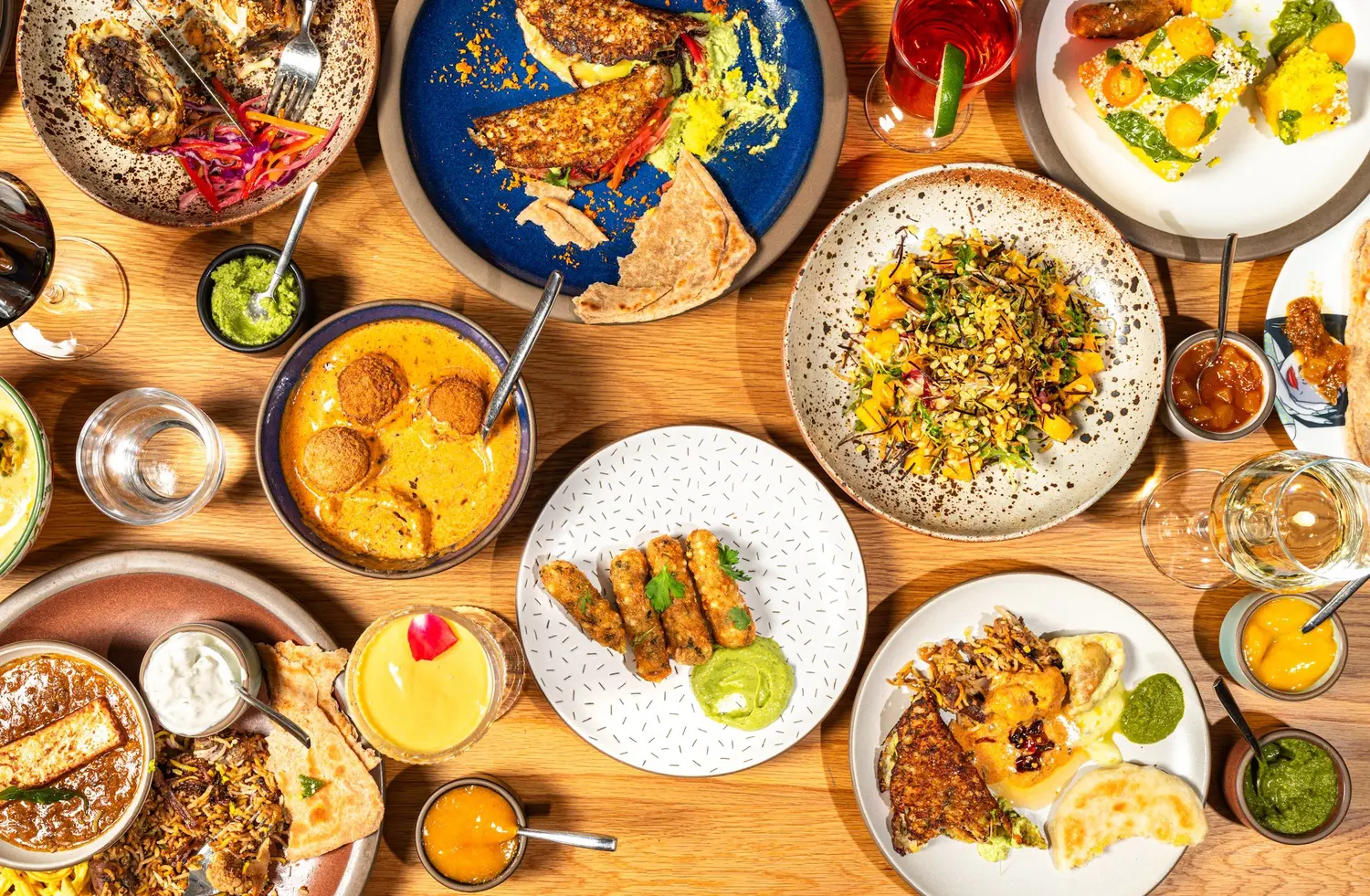
There is a particular kind of anticipation that comes with sitting down at Besharam.
Tucked inside San Francisco’s Minnesota Street Project in Dogpatch, the restaurant initially feels understated. The setting is contemporary and intimate, with the industrial character of the surrounding arts complex softened by the warmth of the dining room. But once the food begins arriving, the experience expands far beyond the room itself.
This is the world of Chef Heena Patel, the self-taught chef and co-founder behind Besharam, whose cooking is as much about memory and identity as it is about technique. Since opening the restaurant in 2018 with co-founder, sommelier, and general manager Paresh Patel, she has built a culinary language around Gujarati food, California’s seasonal abundance and the women and farmers who shaped her understanding of cooking. Now, with Besharam’s new summer menu, Patel is taking that philosophy one step further.

By PhotoEmmaKruch-EmmaKCreative
Rather than arranging the menu around the familiar progression of appetizers and entrées, the new experience is structured as a story—one that moves through India’s markets and food streets while tracing Patel’s own journey from Gujarat to San Francisco. Its three chapters are grounded in ideas that feel central to both her cooking and her story: community, abundance and resilience. “For years, I’ve shared my memories through individual dishes,” Patel explains. “This menu allowed me to tell a much bigger story.” That distinction matters. Besharam isn’t attempting to recreate a version of India frozen in time. Instead, Patel asks diners to see Indian food through her eyes: through migration, family, California, nostalgia and the freedom to reinterpret tradition without abandoning it. And that freedom is exactly what makes the restaurant so compelling.
The Gujarati word Besharam translates to “shameless,” but at the restaurant, the word takes on a deeper meaning. It speaks to refusing the expectation that women should be quiet, restrained or apologetic—and to the idea that food, like identity, can be bold and unapologetic. That spirit comes through immediately.
Our meal began with the Drunken Pani Puri, a playful interpretation of the beloved street snack featuring semolina shells, pea ragda and gin-spiked mint water. It is familiar enough to trigger recognition while still feeling completely of Besharam. The dish manages to be playful without becoming a gimmick, using the restaurant’s modern sensibility to heighten rather than obscure the original flavors.
Then came the Sabudana Wada, tapioca fritters with salty peanuts. For Chef Heena, this dish carries a particularly intimate memory that she shared with us about her mother making sabudana vada every year while fasting, transforming something that might appear simple on the plate into a reminder of family, ritual and home. That personal connection is ultimately what gives the menu its emotional weight. “People rarely remember the order of a meal,” Patel says. “They remember the stories they shared around the table.” At Besharam, those stories are built into the food.
What makes Besharam especially interesting is how naturally Patel folds California into Gujarati cooking. The Pav Bhaji arrived with scallion bread and Amul butter, taking a beloved street-food staple and giving it the kind of indulgent presentation that makes you want to slow down and appreciate every component. The Dal Makhani, meanwhile, was rich and deeply comforting, with slow-cooked black lentils which we enjoyed alongside cumin-scented Jeera Rice.

By The Knockturnal
But the dish that unexpectedly stole my attention was the Kulchas. The cheese bread came loaded with paneer, Asiago, aged cheddar, Oaxaca and Gouda, accompanied by a black bean mole. On paper, it is a pairing I would never have thought to seek out. In practice, it made immediate sense. The kulcha was savory, rich and slightly indulgent, while the mole brought a contrasting depth that somehow tied everything together. After finishing the bread, we asked the team to leave the remaining mole on the table so we could continue dipping other dishes into it. It was one of those combinations that sounds improbable until you taste it—and then becomes difficult to imagine any other way. That is perhaps the clearest expression of Patel’s approach to fusion: not combining cultures simply for novelty, but finding the underlying logic between flavors and letting them speak to one another.
The Chili Paneer Salad offered another refreshing contrast, pairing little gem lettuce with a honey-lime dressing and togarashi crunch. Alongside the restaurant’s cheesy garlic naan, studded with pine nuts, mozzarella, garlic and sunflower seeds, the meal moved effortlessly between bright, crunchy, creamy, and spiced.
There is another element of the Besharam experience that deserves as much attention as the food: the people serving it. The staff were exceptionally warm and knowledgeable, taking the time to explain ingredients and preparations as each dish arrived. Rather than delivering plates with a quick description and moving on, they made the meal feel conversational.
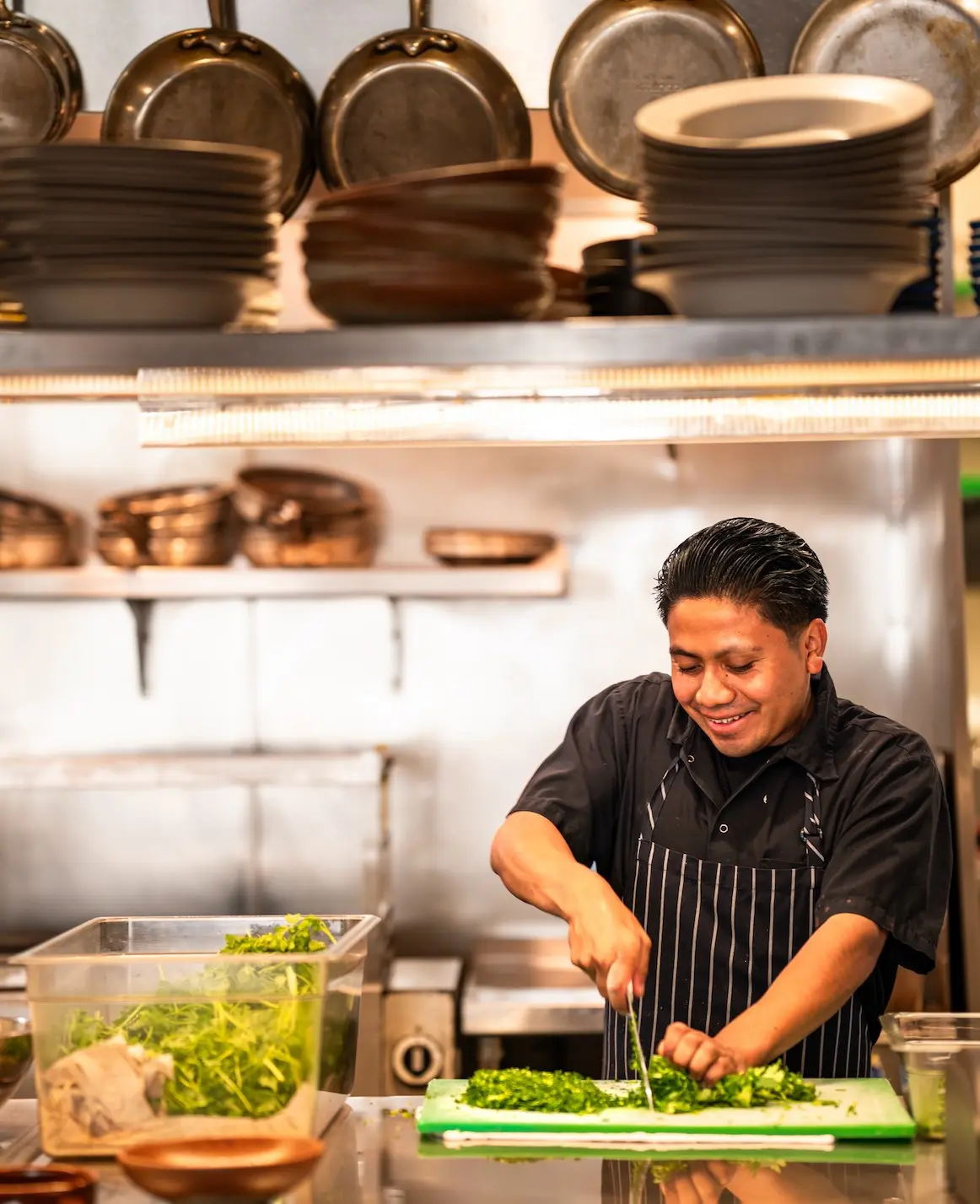
Chef Heena was also visibly involved in the process, checking plates before they left the kitchen. That attention to detail elevated the entire experience. There is a casualness to the setting, but the level of care behind the food and service feels considerably more formal. The result is an experience that, at its best, carries the precision and thoughtfulness you might associate with a fine-dining restaurant without the stiffness that can sometimes accompany it. It feels celebratory without feeling precious.
The cocktails followed the same philosophy. We tried the Mango Margarita and Cucumber Gimlet, both of which complemented the food rather than competing with it. Besharam’s beverage program, led by Paresh Patel, is similarly driven by spice, herbs and aromatics, with an emphasis on making drinks that work alongside the menu.
By PhotoEmmaKruch-EmmaKCreative
If the savory courses were an exploration, dessert felt like coming home. The Carrot Halwa was a polished interpretation of the classic dessert, built around grated carrots, milk, sugar, and cardamom. But the Ras Malai was the moment that stayed with me. Ras malai was one of my favorite childhood desserts, so approaching a restaurant’s interpretation of it comes with a certain amount of skepticism. Some foods are so connected to memory that refinement can actually take something away. Here, it did the opposite.
Besharam’s version—paneer, rose, pistachio and milk—was creamy, delicate and beautifully restrained while still retaining the emotional familiarity of the dessert I grew up loving. It was easily the star of the meal for me. We ordered another one to take home. That probably says everything.
As an Indian American, dining at Indian fusion restaurants can sometimes be a difficult proposition. There can be an uneasy line between innovation and losing the essence of the food that makes it meaningful in the first place. Besharam understands that tension. Patel isn’t asking diners to choose between tradition and innovation. She is demonstrating that the two can exist together. Her cooking feels intentional because the experimentation comes from a place of familiarity. These aren’t ingredients and dishes being reinvented by someone standing outside the culture and looking in. They are being reconsidered by a chef carrying those flavors with her—from her family, her childhood and her Gujarati heritage into a new chapter of her life in California.
That perspective is particularly evident in the restaurant’s vegetable-forward cooking. Patel’s grandparents were farmers who primarily cooked with what they grew, and that relationship with seasonality continues to influence the restaurant. Gujarati cuisine provides the foundation, while California’s produce becomes part of the ongoing conversation. The result is food that can be nostalgic without being stuck in the past.
Besharam’s story also extends beyond the dining room. Patel launched her career through La Cocina, the San Francisco culinary incubator supporting women, immigrants and BIPOC food entrepreneurs, and she now serves on the organization’s board. Mentorship and community remain an important part of her work. That context makes the restaurant’s name feel even more powerful. Besharam’s philosophy is essentially a refusal to shrink.
The restaurant describes its ethos plainly: “We turn shame into flavor, survival into joy, and contradiction into a feast.” After spending an evening at the restaurant, that sentiment doesn’t feel like marketing copy. It feels like an accurate description of what is happening on the plate.
Besharam is not simply modernizing Indian food. It is expanding the conversation around what Indian food in America can be. There is Gujarati heritage. There is California produce. There are childhood memories, family rituals, street food, fermentation, fire, cocktails, fine-dining technique and dishes that refuse to fit neatly into a category. And there is joy.
That may be the most compelling part of Chef Heena Patel’s new summer menu. It doesn’t ask diners to understand every cultural reference before they can appreciate the food. It simply invites them to sit down, share a table and experience the story one bite at a time.
For anyone who considers themselves besharam enough to eat boldly, Besharam is ready. Located at 1275 Minnesota St. in San Francisco, Besharam serves dinner Tuesday through Saturday from 5 to 9 p.m. Learn more at besharamrestaurant.com or follow @BesharamSF on Instagram.
