For 77 years, the Gene Frankel Theatre has been part of New York’s theater community. Its mission has always been to build an audience that shares the thrill of live theater.
Owner and artistic director Thomas R. Gordon continues to expand that mission through his commitment to artistic excellence.
The Gene Frankel Theatre Festival presents 27 short plays selected from nearly 200 submissions. The productions reinforce the theatre’s reputation for cultivating groundbreaking independent voices, and audiences are invited to welcome these writers as their works premiere in New York City. Outside the building, an art installation by Bruce Williams features golden dancing figures climbing the façade, evoking the dreams and ambitions of the festival’s playwrights and actors as they reach for success.
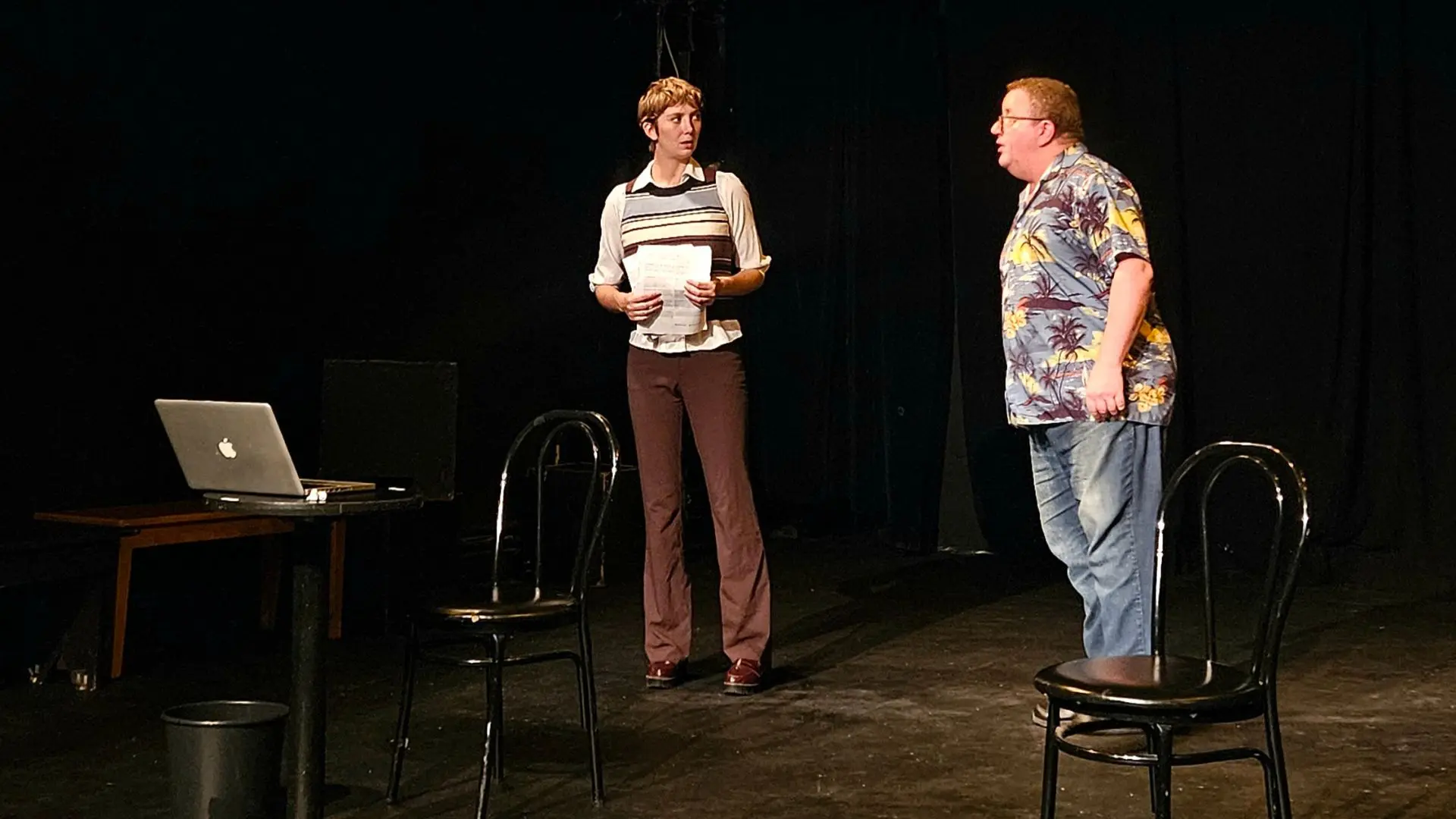
Block 1 includes three very different productions: Ten Plagues – No Substitutions, Burnt Toast, and Three’s a Crowd. Although the works differ in style and subject, they share a common goal: reaching and engaging the audience. Because the judges sit among the audience, the only information provided is the names of the works, playwrights, and actors.
In Ten Plagues – No Substitutions, written by Matt Saunders and Ariel Aliza Sanders, two food critics review themed restaurants. Travis Bergman plays the first critic, while Jonathan Beebe plays the second. They have already visited a restaurant where everything served was purple and another set in an abandoned garage that preserved every detail, including the original bathroom odors. Their next stop is an Egyptian-themed restaurant, where the waiter, played by Nicholas Chiofalo, explains how each course is based on one of the ten plagues inflicted on the Egyptians when Pharaoh refused to free the Jews. Bergman, Beebe, and Chiofalo work smoothly together as the critics learn about the menu. By the end, the chef’s secret is revealed. This very short skit is amusing, especially in the actors’ interactions.
Mathew Gilleece’s Burnt Toast is also brief. Parnassus Funk plays Allison Considine, an interviewer waiting for Teddy Simpkins, played by Gilleece, who arrives forty-five minutes late to a job interview at a firm that prizes punctuality. Teddy’s résumé shows he has never stayed in a position for more than nine months, and his recommendations are positive but vague, each noting his chronic lateness. Teddy explains that when he is on time, disasters follow; by being late, he prevents catastrophes ranging from spilled coffee to an asteroid striking Earth. He suggests that small inconveniences, like burnt toast, may be the universe’s way of protecting people from larger disasters. He lists several calamities he has averted through lateness and describes what happened when he arrived at Fukushima on time, causing the nuclear accident. He convinces Considine that the disaster was not caused by the earthquake and tsunami. Teddy has also seen a vision of what would happen if he were always punctual: a wasteland where survivors struggle to stay alive. Considine comes to see Teddy as a hero. Gilleece and Funk work well together, making this brief skit surprisingly believable.
Anthony Welch’s longer script, Three’s a Crowd, explores what happens when people return to modern dating after years away. Nica Buescher, Mauricio Bustamante, Anthony Welch, and Ginger Kipps perform the barroom scenario. Two men sit at a table: Frank McMurphy, recently widowed after thirty-three years of marriage, has asked his gay friend, Gabriel Montez, to serve as his wingman. Welch plays Frank, and Mauricio Bustamante plays Gabriel. While they wait, they try to clarify what Frank means when he says he is seeking companionship. Miranda, played by Buescher, overhears their conversation and joins the discussion, helping them define the kind of relationship they both want. Overseeing the wide-ranging exchange is a bored bartender, played by Kipps, who has seen and heard it all before. The play raises thoughtful questions about modern dating expectations, and Buescher, Bustamante, Welch, and Kipps are believable in their roles.
Together, these three entries in the Gene Frankel Theatre Festival offer insight into the festival’s thoughtful curation and rigorous selection process. The original works introduce new playwrights and fresh stories, making Block 1 a thoroughly enjoyable experience.
