Theater is continually expanding its audience. We encounter history through hip-hop. Shakespeare comes to Central Park, making his plays accessible to people from all walks of life.
Actors in wheelchairs take on major roles. Ancient Greek themes are reimagined as modern problems. Cats now features humans competing in a vogue ball. Together, these innovations broaden the range of people drawn to theater.
Yet deaf audiences are still often excluded. Within this group are Deaf people who belong to a distinct linguistic and cultural community who often use American Sign Language (ASL). In many spaces, this entire population is ignored. Donald Trump ended the practice of providing ASL interpreters at press conferences and other public events. A federal judge has ordered the White House to restore ASL interpreters, stating that closed captions and transcripts are not adequate substitutes for people whose primary language is ASL. Just as Trump has ignored that injunction, we too continue to overlook Deaf audiences.
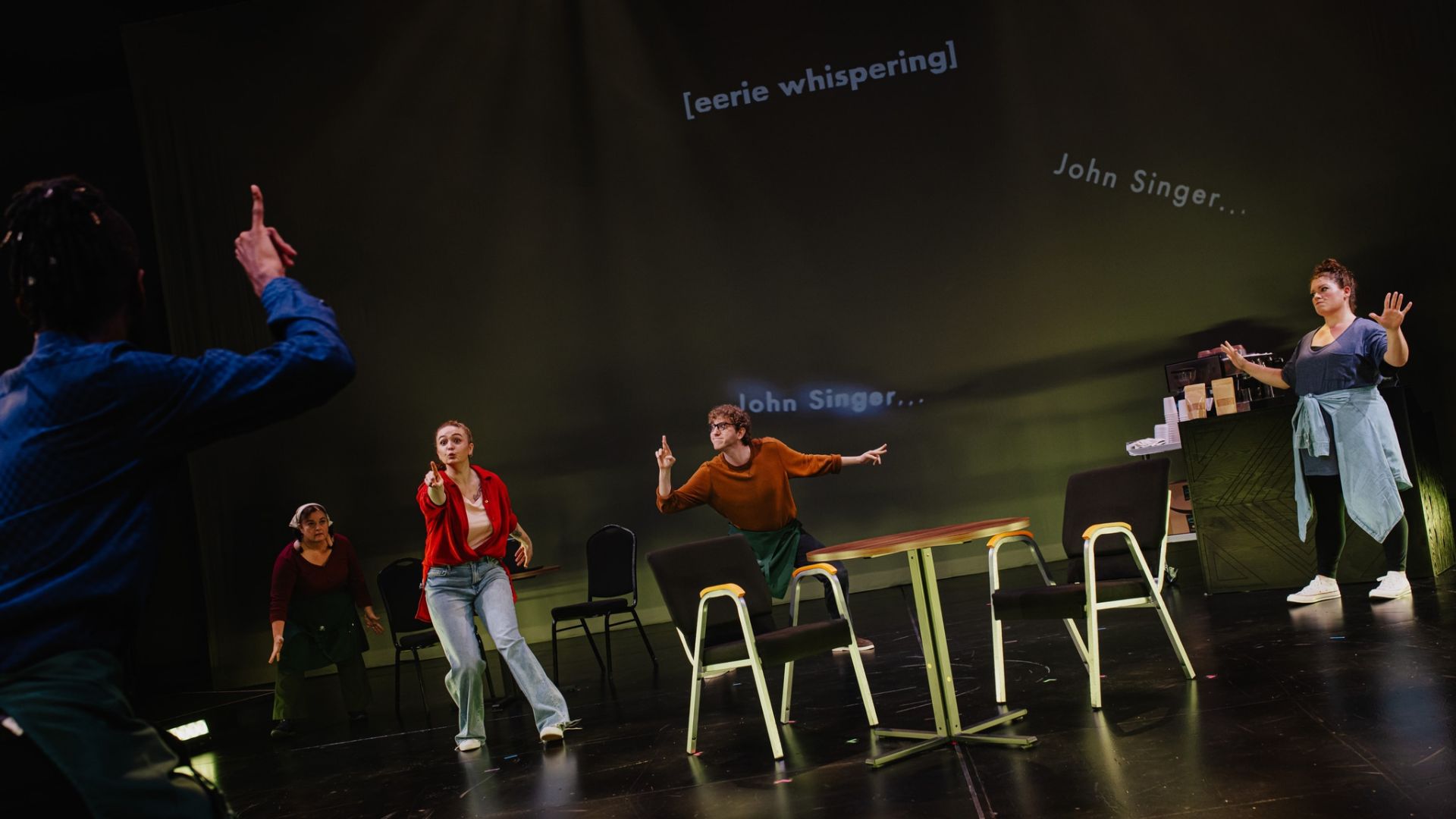
In a reversal of that exclusion, James Caverly and Andrew Morrill invite us to experience Thank You Ryan For a Clean Microwave. The show is performed in ASL, with captions available for audience members who do not sign. By centering the Deaf community rather than hearing audiences, the production offers a new form of storytelling as two internal narrators struggle to write a story about love, trauma, and who controls the truth. The play shifts between a writer’s imagination and a Deaf-run coffee house.
James Caverly is the director of Artistic Sign Language and an actor, playwright, and director. Andrew Morrill is an actor and Obie-winning theater maker. Together, they wrote and directed Thank You Ryan For a Clean Microwave. Their work combines humor with raw emotion while raising questions about celebrity, authorship, and representation in Deaf theater. The production also reveals the many possibilities that theater can offer Deaf writers and actors.
Voice and Heart embody the writer’s imagination. Amelia Hensley plays Heart. Best known for her role in the Broadway production of Spring Awakening, Hensley has also appeared in films. Rebeca Spigelman, who comes from off-Broadway, plays Voice. As Spigelman explains, the production tells a story in a visual language for an audience that may still need auditory stimulation. Voice provides that bridge.
Heart and Voice are choosing which story to tell about three Deaf baristas. Pamela Decker-Wright plays Marianna, an experienced woman older than the other two. A Deaf performer, director, and acting coach, Decker-Wright moves easily from calm leadership to painful memories of childhood trauma. Wade Green portrays Thomas. With more than 20 years of experience as a dancer, choreographer, and performer, Green uses the role to question who owns a story. Thomas passionately describes how a white Deaf actor became famous for portraying Andrew Foster, a Black American known as the “Father of Deaf Education in Africa,” and demands that “whites give back what they took from us.” Samual Langshteyn plays Otto, capturing the frustrations faced by a Deaf person who can speak. As Voice and Heart write and delete scenes involving these characters, the play shows how stories are shaped, revised, and contested.
Toward the end, Leigh, a thirteen-year-old, enters. Alona Jane Robbins portrays a young person impatient with the adult hesitations and revisions. Leigh reminds them, “My teacher says that it is not important if the story is good or not. You just have to tell the story.”
ASL is a visual language that uses hand shapes, facial expressions, and body movement to communicate. It conveys events and concepts visually. Rather than distracting from the acting, ASL strengthens the actors’ performances.
The Shed, a cultural center in Hudson Yards, aims to introduce audiences to new forms of art and experience. With Thank You Ryan For a Clean Microwave, it fulfills that mission. In ninety minutes, the audience encounters a new theatrical form that is amusing, challenging, and deeply engaging.
