When I first opened Lidia Yuknavitch’s memoir, The Chronology of Water, I could not get myself to stop reading. I felt like I was gulping down each chapter, and wouldn’t feel satiated until I had finished them all. I had never read anything like it; nonlinear, feral, unflinchingly honest, poetic, raw, dark as hell, and fascinating, both in the life it chronicled and in the way Yuknavitch chose to tell it.
Without giving too much away (because I believe everyone should read this book), the memoir follows Yuknavitch’s life in no particular order, toggling between memories of her childhood as a competitive swimmer, raised by an abusive father and a passive, alcoholic mother, her later struggles with drugs, alcohol, and the many ways she tried to reckon with her upbringing, and throughout it all, her enduring relationship with water and writing and art, and the ways these things ultimately saved her.
Her style is inventive and deeply experimental. The story unfolds as fragments of memory rather than a linear narrative, more a collection of moments than a traditional arc. She writes about sex in a visceral way I have never encountered before, almost unapologetically gross and human and animalistic? Long passages appear often with little to no punctuation, intensifying the experience so fully it feels as though you are inside the scene itself. It’s the kind of book that seems nearly impossible to translate to screen. I closed the book pretty convinced it shouldn’t be adapted at all.
So when I learned that Kristen Stewart’s directorial debut would be an adaptation of The Chronology of Water, my interest was immediately piqued. This would be a formidable challenge for even the most seasoned director, but every time Stewart spoke about the project, it was clear how profoundly the book had affected her. I knew she had wanted to adapt it to screen since 2017, and as she once remarked of the memoir: “There are voices that help you find yours. This became a sacred text to me overnight.”
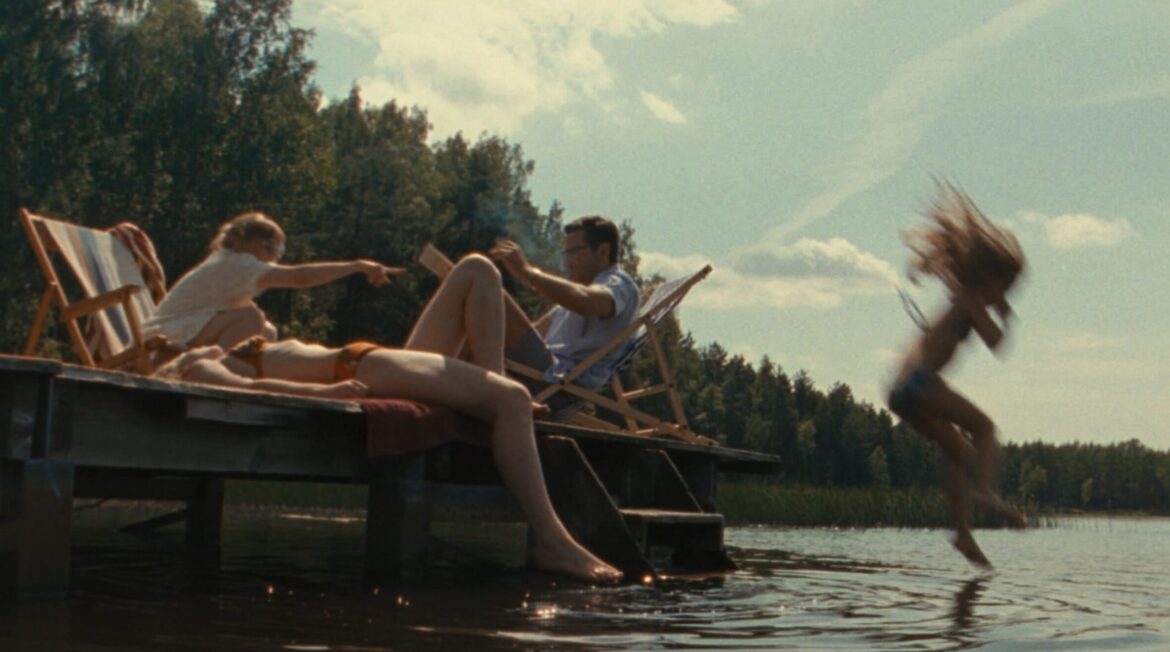
I was lucky enough to attend the Los Angeles screening of The Chronology of Water on December 11, 2025, at the Laemmle Royal, followed by a Q&A with Stewart and Thora Birch, who plays Lidia’s older sister and role model, Claudia, in the film. The movie was, indeed, a masterpiece, one Stewart later revealed she had spent eight years trying to make. Shot on 16mm over the span of just about a month, the film stars Imogen Poots as Lidia (and I’ll interject here to say her performance is stunning.) Structurally, it mirrors the memoir itself: quick cuts, dreamy imagery, time jumping forward and backward, and many moments that rely purely on immersive sound rather than explicit visuals, specifically many of the most disturbing and sexual scenes.
What followed the screening was a long conversation about creative trust, adaptation, and the necessity of letting something die in order for it to go on and live. Below are some of my favorite moments from Stewart and Birch’s conversation:
Stewart about trust and the development process: “I was working with someone for a really long time and it started to feel like the death of anything truly creative. They were just full of no. Full of impossible. All the plans I had over many years suddenly went out the window. It was like don’t try to fucking plan anything. You can rely on your instincts, sure, but having everything on lock? The answer was no.”
She explained the film was only able to open up once she found collaborators who were willing to be flexible and respond to the environment rather than control it. “We finally found the person who became my true brother, an angel man, who could hold Imogen by the throat, metaphorically, like one foot under the fire. Because that’s what it took. But he was gentle and beautiful and observational and could really dance with her. And I was like, thank God. Because suddenly all the reasons I wanted to make the movie, all the tent-pole images, became possible. Whereas before, after six weeks of shot lists, everything just felt diluted. We discovered more life with someone who was open to the world they lived in, versus someone trying to nail things down and dilute them.”
Stewart on working with Thora: “There are people you just know. You have developed relationships with them in some invisible way. I had that with Thora. So it would’ve been shocking to hit any kind of blockade. I basically projected everything I needed onto her and was like, please come now. Be her big sister. Be the sister who can hold the strength of the mother. And I was like, well, obviously Thora can do that. And then on set, she just arrived with this concrete presence. Like, I got you. And I was like, that’s why the fuck you’re here.”
When Stewart was asked about working with Imogen, she explained, “I can’t tell you how to do what you’re going to do. I knew she wasn’t coming here to do something full of shit. To watch someone arrive at a destination you thought you carved, by a completely different route, was incredible. She had to be the emotional backbone of the entire movie when none of us could hold it. She would fully immerse herself while we were shooting and then drop it. That kind of self-preservation is rare. Only now are we unpacking why it worked.”
One of the most compelling moments in the conversation centered on Stewart’s relationship to Lidia, and her approach to adapting the memoir. “We corresponded before we even met. And she was such an easy get. I just came to her with a genuine response to the book.It felt obvious at the time and now I look back and think, fuck. She really could’ve done this with anyone. This wasn’t an easy movie to make. I told her all the obtuse reasons I wanted to protect the thing, be the thing, transmute the thing. The movie uses her story as a starting point, not an endpoint,” she explained.
“It’s about multiplicity; how you can take one idea and make it ten. Lidia divorced herself from plot and synopsis and leaned into the neurological experience. She hasn’t even seen the movie yet but she told me, ‘I feel like I’ve seen it, because we know each other.’”
Stewart closed the conversation by reflecting on finally watching the finished film for the first time. “All of a sudden the movie stood up and became itself. I thought I had destroyed something I loved. But you have to let the things die to find the new thing. I was so addicted to what I thought the movie had to be. You need to have a healthy dose of ego to say, ‘Get over yourself. Look at what’s in front of you.’”
Trailer Here