The Knockturnal
  • Home
  • Entertainment
  • Music
  • Lifestyle
  • News
  • Videos
  • Covers
  • Merch
Tag:

e-prix

Automotive

A Winning Weekend at the Miami E-Prix with Jaguar Racing

by Tristen Yang February 3, 2026
written by Tristen Yang

On Saturday, race day at the Miami E-Prix didn’t announce itself with chaos or spectacle in the way motorsport often does. It unfolded slowly, deliberately, demanding viewers’ attention. A soft drizzle lingered over the Miami International Autodrome, the sky an even wash of gray, and the track still damp from overnight rain, intensifying the race to come.

From the race suites, perched above the circuit with a clear sightline across the grandstands and down onto the grid, the atmosphere felt focused. Guests inside moved between conversations, drinks, and decadent bites throughout the day, while large screens tracked the evolving conditions on track. The Jaguar Racing team and spectators gathered with quiet confidence, waiting for Formula E’s return to Miami. From the balcony, the view stretched across the teal stadium seats, dotted with spectators in rain jackets and ponchos, and down to the slick ribbon of asphalt where the GEN3 Evo cars lined up.

The light shower added texture to the scene, softening the edges, muting the colors, amplifying the hum of anticipation. Formula E races are shorter than their F1 counterparts, but they demand a different kind of attention, where energy management replaces brute force and strategy outweighs speed. The cars regenerate energy under braking, drivers constantly balancing performance with conservation, racing not just each other, but the clock, the battery, and the conditions beneath their tires. It became clear how much of Formula E happens invisibly. On the screens, graphics illustrated energy usage and attack modes, while radio chatter filtered through quietly. On track, the cars moved in tight packs, everyone waiting for the right moment.
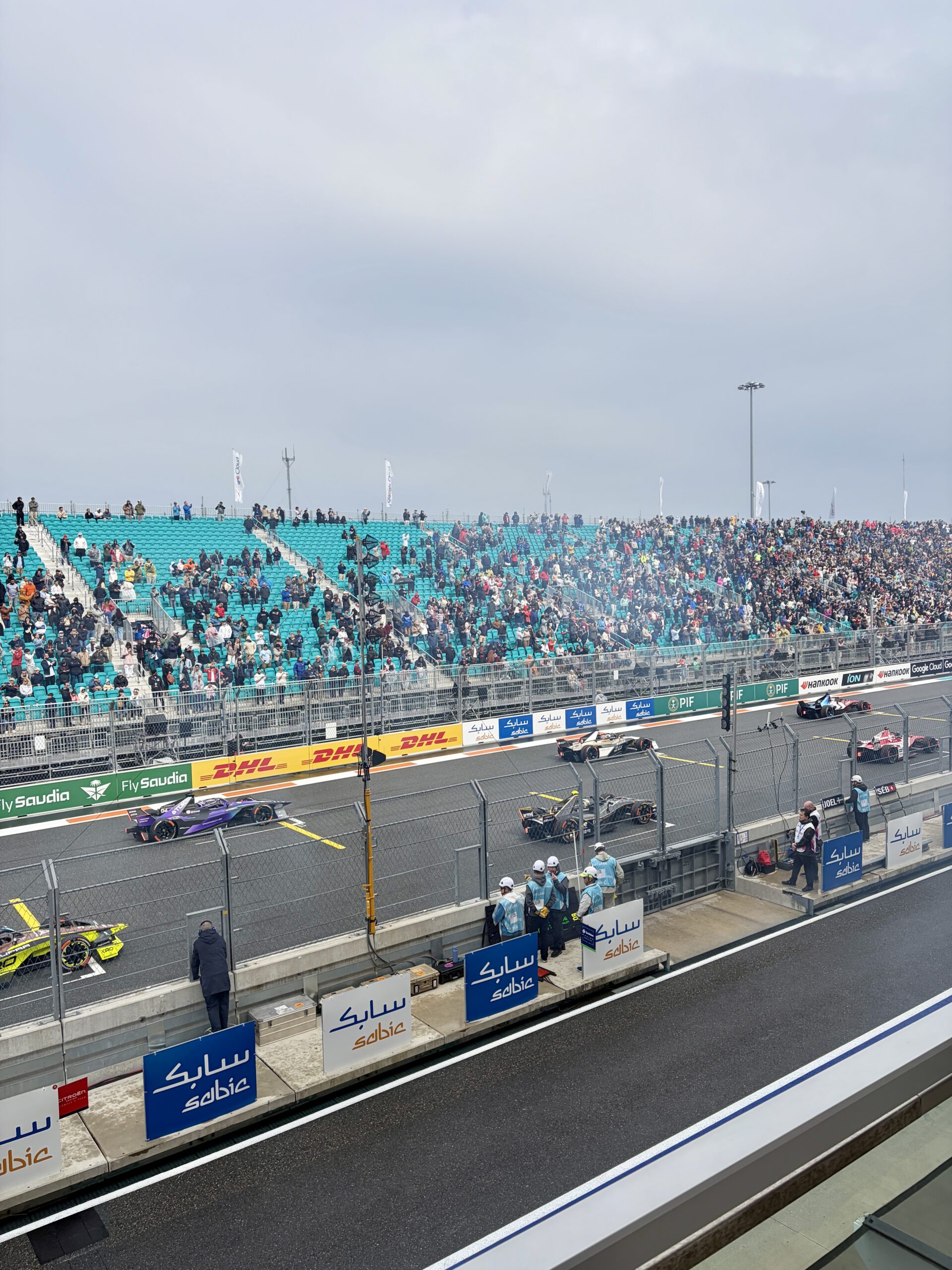
Before the race began, we were ushered down for the grid walk, one of the most electric moments of the day. A grid walk in motorsport offers rare proximity: cars lined up nose to tail, mechanics making final adjustments, engineers conferring quietly, drivers focused inward, and eyes forward. The drizzle persisted, light but steady, beading on the cars’ bodywork and darkening the tarmac beneath our feet. It heightened everything from the smell of wet asphalt, the whir of cooling fans, to the tension hovering just beneath the surface. This moment bridges the gap between racing and the viewer, as the technology becomes tangible and the people behind the performance become visible. And the stakes, suddenly, feel firsthand and real.
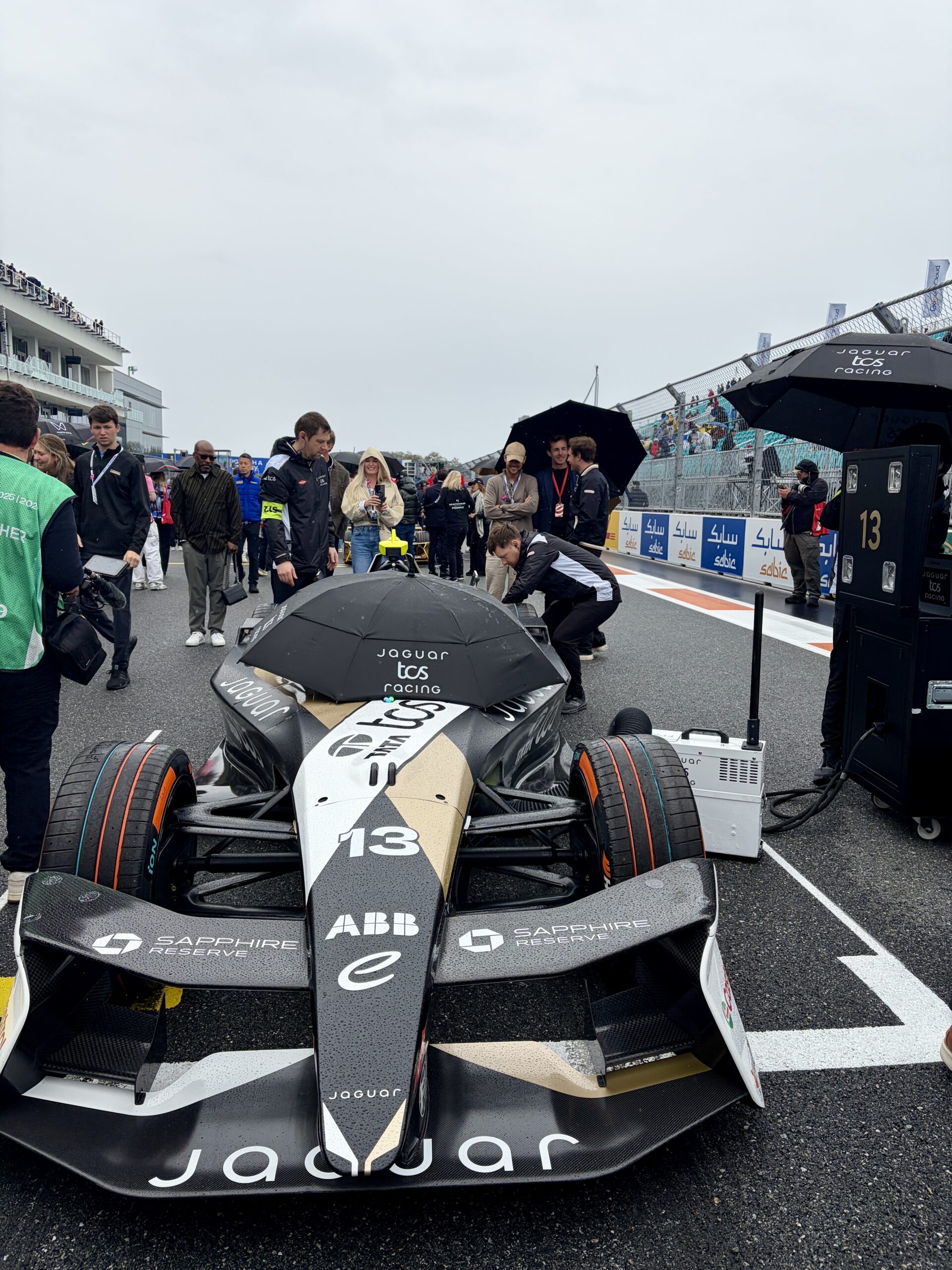
As the race got underway, drivers navigated cautiously in the early laps, aware that pushing too hard too soon could compromise everything later. From the suites, the ebb and flow of the race felt almost choreographed. Energy levels fluctuated, attack modes deployed with intention. Unlike other motorsport series, where dominance can be established early, Formula E keeps the field compressed, the outcome uncertain until the very end.

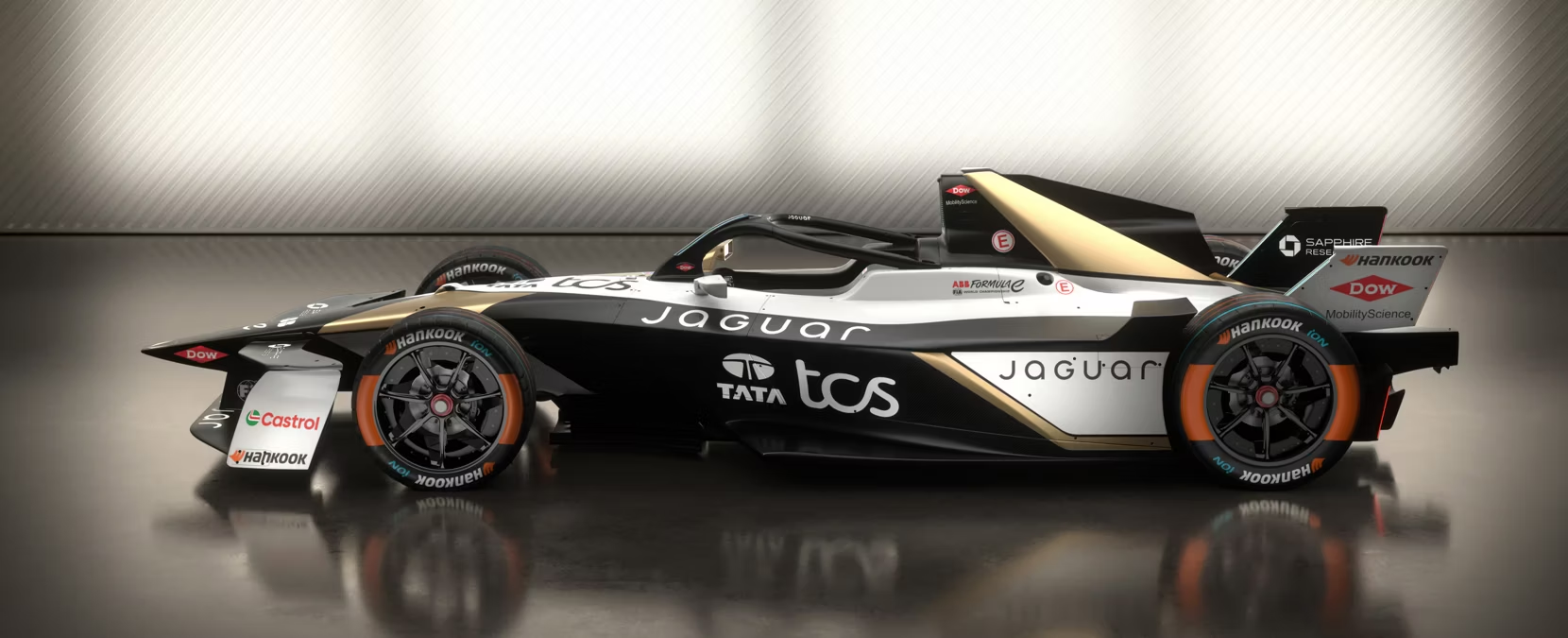
For Jaguar Racing, this uncertainty wasn’t unfamiliar. Mitch Evans, known for his consistency and race intelligence, remained composed throughout, managing energy with precision as the race evolved. Nothing about the moment suggested inevitability, but there was a sense that the pieces were aligning. What becomes clear when watching Formula E up close is how much the championship mirrors the realities of electric mobility more broadly. Range anxiety, energy recovery, efficiency versus performance, these aren’t abstract concepts here, they are the race itself. This is part of what makes Formula E compelling, particularly for sustainability-curious audiences. It doesn’t pretend electric racing is identical to combustion-era motorsport. It embraces difference, turning constraint into creativity, limitation into strategy. Both Jaguar drivers moved decisively through the field early on, with Mitch Evans and António Félix da Costa running nose-to-tail as they battled Porsche at the front. The momentum briefly fractured when Andretti’s Felipe Drugovich made contact with da Costa in the final corner, sending him wide and ultimately relegating him to an eighth-place finish despite continuing the race.

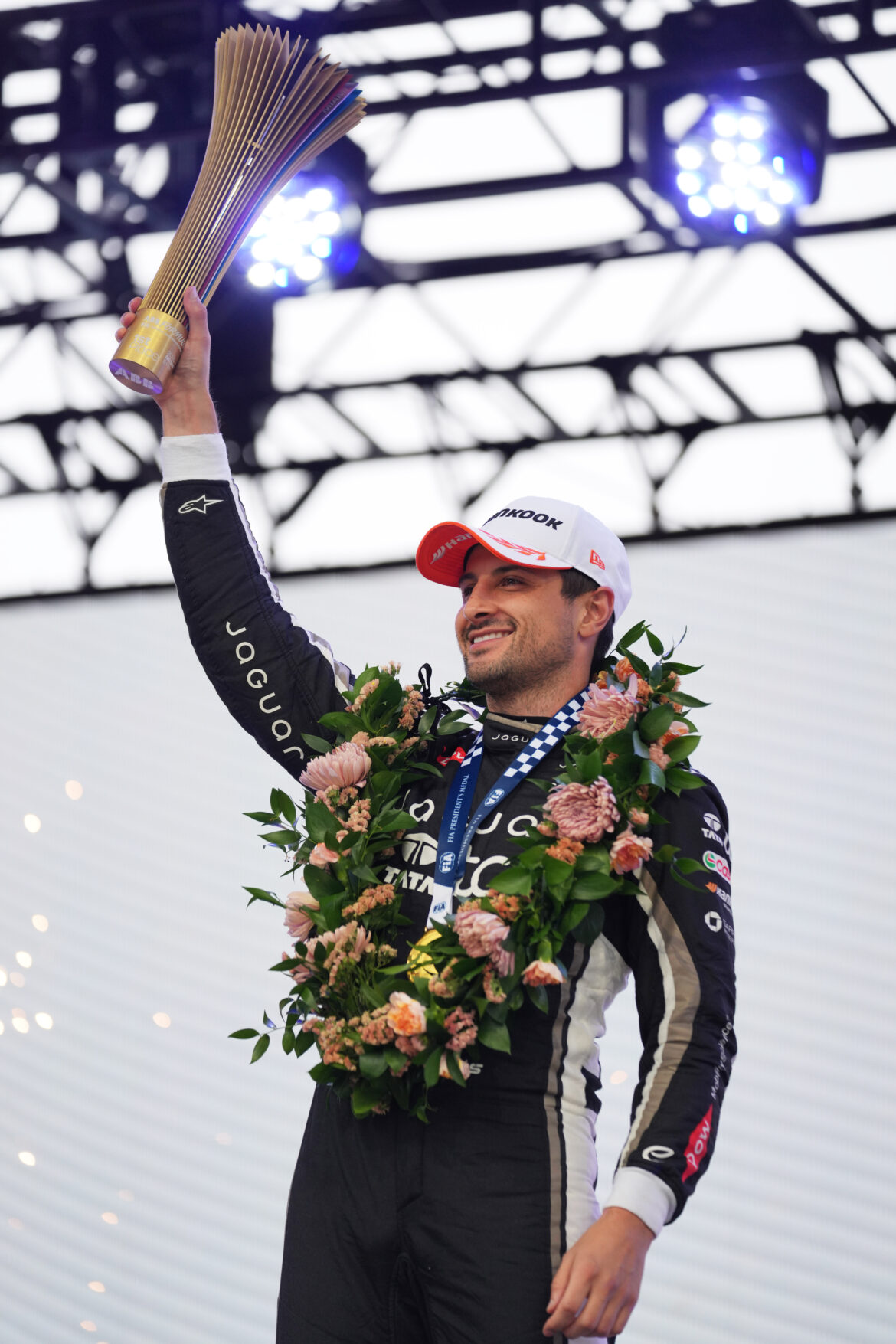
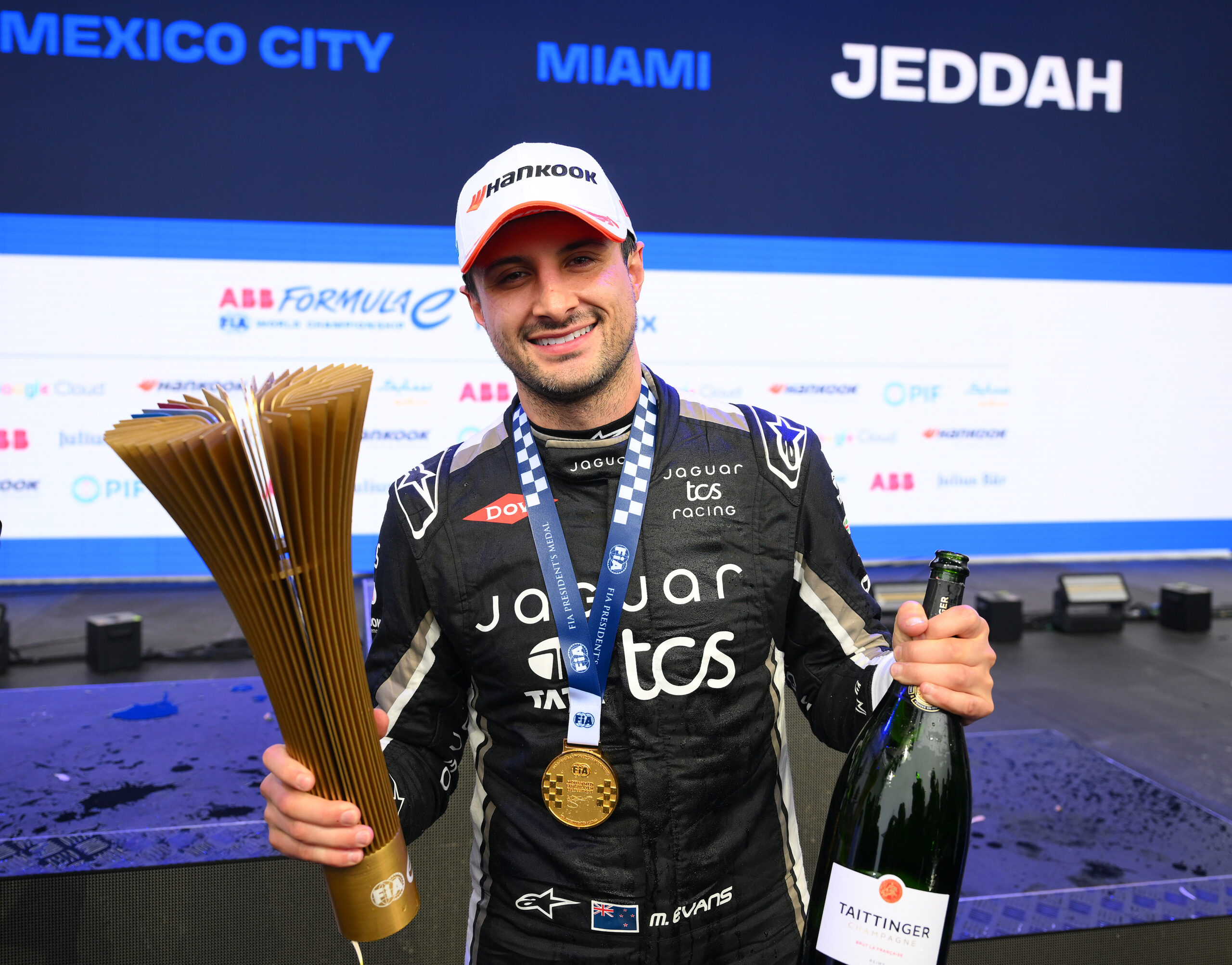
As the race continued, tension sharpened. The drizzle had eased, but the track remained slick in places, unforgiving of mistakes and positions shifted rapidly. Evans timed his second Attack Mode to near perfection, overtaking race leader Nico Müller on lap 27. And then, almost suddenly, it became clear that Jaguar Racing was in contention for something more. Mitch Evans surged forward with control, navigating traffic cleanly, deploying energy at precisely the right moments. It seemed assured, the kind of driving that looks almost understated until you realize how difficult it is to execute. Evans charged to victory, a win that marked his 15th career Formula E triumph, officially making him the most successful race winner in the championship’s history.
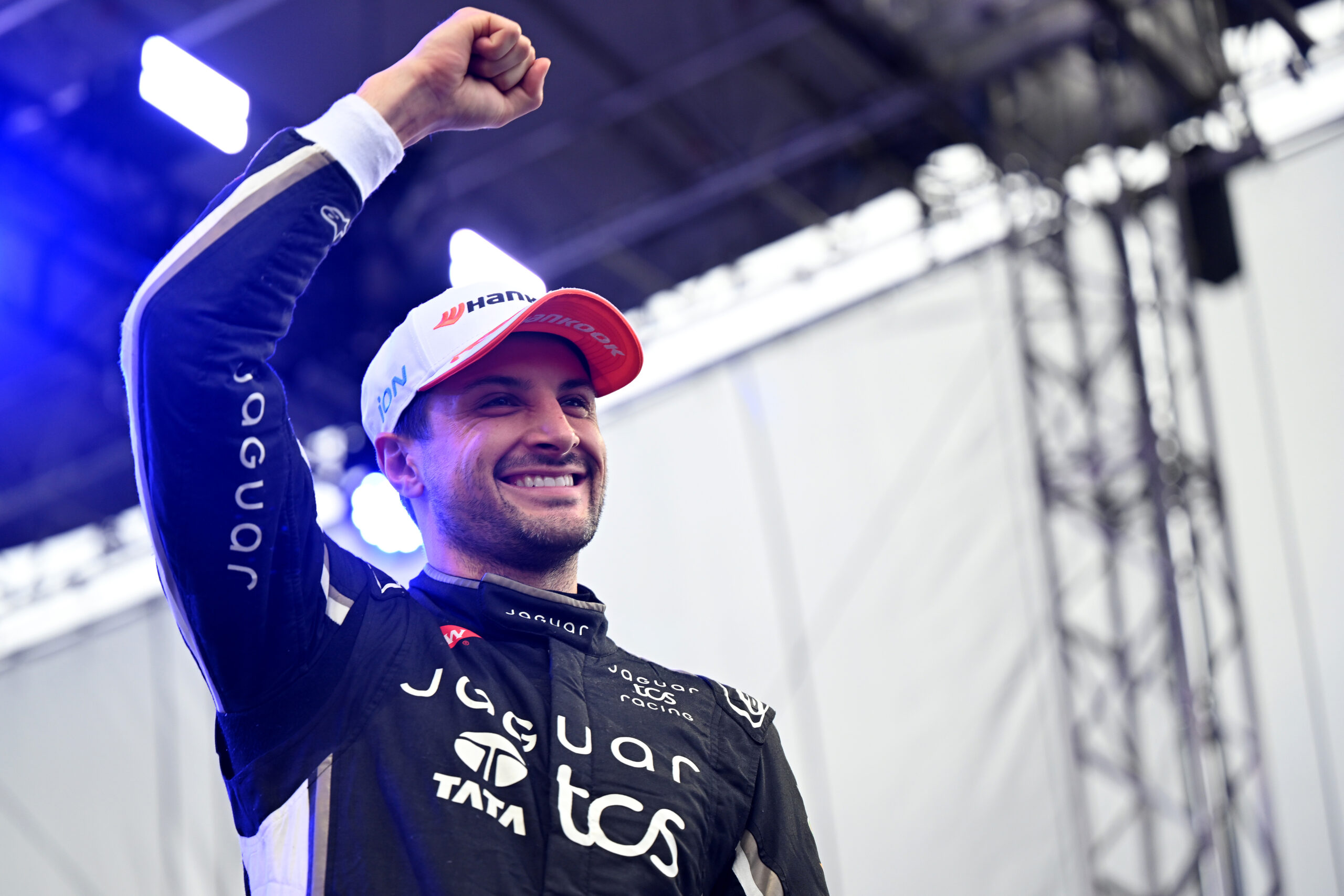
When Evans crossed the line to secure victory, the reaction wasn’t explosive at first. It was a beat of disbelief, then recognition, then celebration. Applause rippled through the suites. Post-race, the mood shifted from focus to release. On the podium, champagne flowed, sprayed skyward in celebration, the rain now replaced by laughter and relief. The imagery felt almost cinematic with the wet track, gleaming cars, champagne mist catching the light. The Jaguar Racing team celebrated together, drivers and engineers, media and brand partners, sharing in the culmination of months of work. Being part of a winning team, even peripherally, carries a distinct energy. No one knew with certainty that Evans would win, but in hindsight, it made sense. His background, his familiarity with the series, his calm under pressure, all of it converged at the right moment.
As the day wound down, it became clear that what set this race apart wasn’t just the result, but the rhythm of the experience itself. Formula E doesn’t overwhelm, it invites and asks you to observe, to listen, to understand the layers beneath the surface. From the race suites to the grid walk, from the drizzle-soaked start to the champagne-splashed finish, the Miami E-Prix was an exciting chapter in Jaguar’s motorsport story. It balanced innovation with heritage, performance with sustainability, competition with community. In a motorsport landscape often defined by excess, Formula E offers a glimpse of what racing could look like in the future and a vision that acknowledges the realities of our time, that treats efficiency as a skill rather than a compromise.
February 3, 2026 0 comments
0 FacebookTwitterPinterestEmail
AutomotiveUncategorized

Inside Jaguar Racing’s Formula E Mindset Before the Miami E-Prix

by Tristen Yang February 3, 2026
written by Tristen Yang

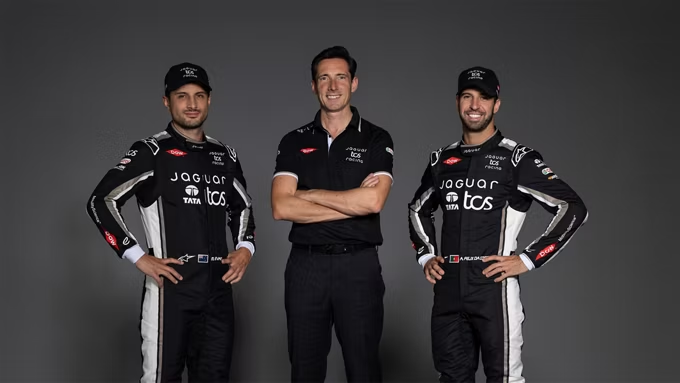
On Friday morning, ahead of practice sessions and race-day, we sat down with Jaguar TCS Racing drivers António Félix da Costa and Mitch Evans, alongside team principal Ian James, for a roundtable conversation during media day. The discussion offered a moment to understand how the team thinks about performance, energy, and competition before the race.

Miami, despite its reputation, did not feel like a holiday backdrop that morning. The air was unexpectedly cool, more winter than vacation, and the track had yet to assert itself as the dominant presence of the day. For the drivers, location operates less as spectacle and more as a variable. Da Costa, now in his first season with Jaguar, spoke about the ocean as a mental reset rather than an escape. Being near water, he explained, offers a subtle recalibration that sharpens focus.

Outside of racing, both drivers turn to physical movement not as training in the strict sense, but as a way to stay balanced during a season defined by constant travel. For da Costa, surfing and golf occupy the margins of an already crowded calendar. Evans, who grew up in New Zealand, pointed to rugby as a formative influence, less for its tactics than for the rhythm and discipline it instills. Neither framed these activities as escapes, instead, they function as anchors, ways of staying connected to their bodies while living in near-constant motion.

Ritual came up early in the conversation, though not in the way one might expect with no rigid superstitions. Da Costa described a simple pre-race sequence: stretching, skipping rope, twenty minutes of physical readiness before stepping into the car. Evans emphasized visualization over routine, constantly replaying the track in his mind and adapting to schedule changes rather than resisting them.

The ease between da Costa and Evans surfaced repeatedly. Although new to the team, da Costa is not new to Evans. The two have known each other for years, competitors who understand each other’s instincts without needing translation. They mentioned a philosophy of different experiences, different approaches, but a shared willingness to learn with a goal on alignment. This dynamic becomes especially important in Formula E, where races are not won by pushing flat out from start to finish. Da Costa explained it plainly. If drivers were to race at maximum output for the full duration, the battery would not last. The challenge is not speed alone, but energy management. Regeneration, timing, positioning, and restraint all shape the outcome. Drivers cycle between attack and conservation, sometimes literally following one another closely to minimize energy loss, a comparison da Costa likened to the peloton in the Tour de France.

This is where Formula E diverges most sharply from other forms of motorsport, and where it can be hardest to read from the outside. It is engineered because no one runs away with the race early. Strategy unfolds in layers, and the margin between winning and finishing mid-pack can be measured in decisions made minutes, or even seconds, apart. Evans described it as a form of art, a balance between performance and patience that rewards awareness as much as aggression.

For fans accustomed to Formula 1, where dominance can stretch across seasons, Formula E requires a different way of watching. The sport has been around for over a decade now, and its core audience understands the language. What remains is translating that experience to a broader public, particularly as sustainability moves from concept to constraint across motorsport. Da Costa noted that Formula E has effectively been living the future for years. That framing carried into the second half of the roundtable, where team principal Ian James joined the conversation. Where the drivers spoke about flow and instinct, James spoke about systems. Pressure, he explained, exists everywhere in the organization, not just in the cockpit. James has moved fluidly between disciplines. In Formula E, the role is far more active. The team is constantly responding, adjusting, supporting. Influence is not about overriding expertise, but about creating the conditions for it to operate effectively during simulations.

In terms of team culture, James spoke at length about the importance of collaboration, particularly between drivers. Talent alone is not enough. In a championship where the car is constantly evolving, drivers must be able to articulate what they feel, translate instinct into feedback, and work together rather than against each other. When garages split, development suffers. Alignment, even without friendship, is non-negotiable.

Behind the scenes, much of that alignment is built long before race weekend. Simulation plays a central role in preparation, not just for drivers, but for the entire team. Engineers, strategists, and performance staff are brought into the process, rehearsing scenarios, stress-testing decisions, and effectively gamifying strategy. While no simulation can account for every variable, the confidence it builds carries into the race. By the time the cars arrive at the circuit, most of the work has already been done. This is where sustainability becomes less of a talking point and more of a framework. Operating under cost caps has reshaped internal dynamics, bringing finance teams into direct conversation with performance goals. Where spending was once viewed as a limitation, it now becomes a strategic tool. Knowing where to allocate resources, where to extract the most value from each decision, creates competitive advantage.

The conversation eventually widened to Jaguar’s broader motorsport legacy. Drivers and leadership alike referenced Le Mans, the Silk Cut era, and the visual language that once defined Jaguar on the world stage. James recalled an early experience at Jaguar’s headquarters, driving an E-Type from 1960, followed by modern performance vehicles and future concepts. Across generations, he noted, the throughline remained tangible. The cars moved like Jaguars and they felt like Jaguars. That continuity matters as the brand moves deeper into the electric age. The question is no longer whether electric racing can be exciting, but how to carry identity forward within new constraints. Engagement, James suggested, will increasingly depend on how well that story is told, not just on track, but through experiences like this one. As the roundtable wrapped, the schedule pressed on. Formula E, viewed through Jaguar Racing, reveals itself as a sport built on awareness, energy, people, and limits.

February 3, 2026 0 comments
0 FacebookTwitterPinterestEmail
AutomotiveUncategorized

Inside Miami Formula E’s Pre-Race Day With Jaguar Racing

by Tristen Yang February 3, 2026
written by Tristen Yang

Pre-race day at a Formula E weekend doesn’t begin with speed. It begins with structure, timing, and preparation. In Miami, that rhythm started early. Outside, the air was cooler than expected for Miami, and the city still subdued in the morning light. On Friday morning, the brand and press group gathered in the lobby of the Andaz Miami Beach, moving together into a line of Range Rover Sport models that would carry us across the city toward the Miami International Autodrome track. Media day has its own atmosphere, distinct from race day energy. It’s slower, more conversational, built around access and insight rather than adrenaline.

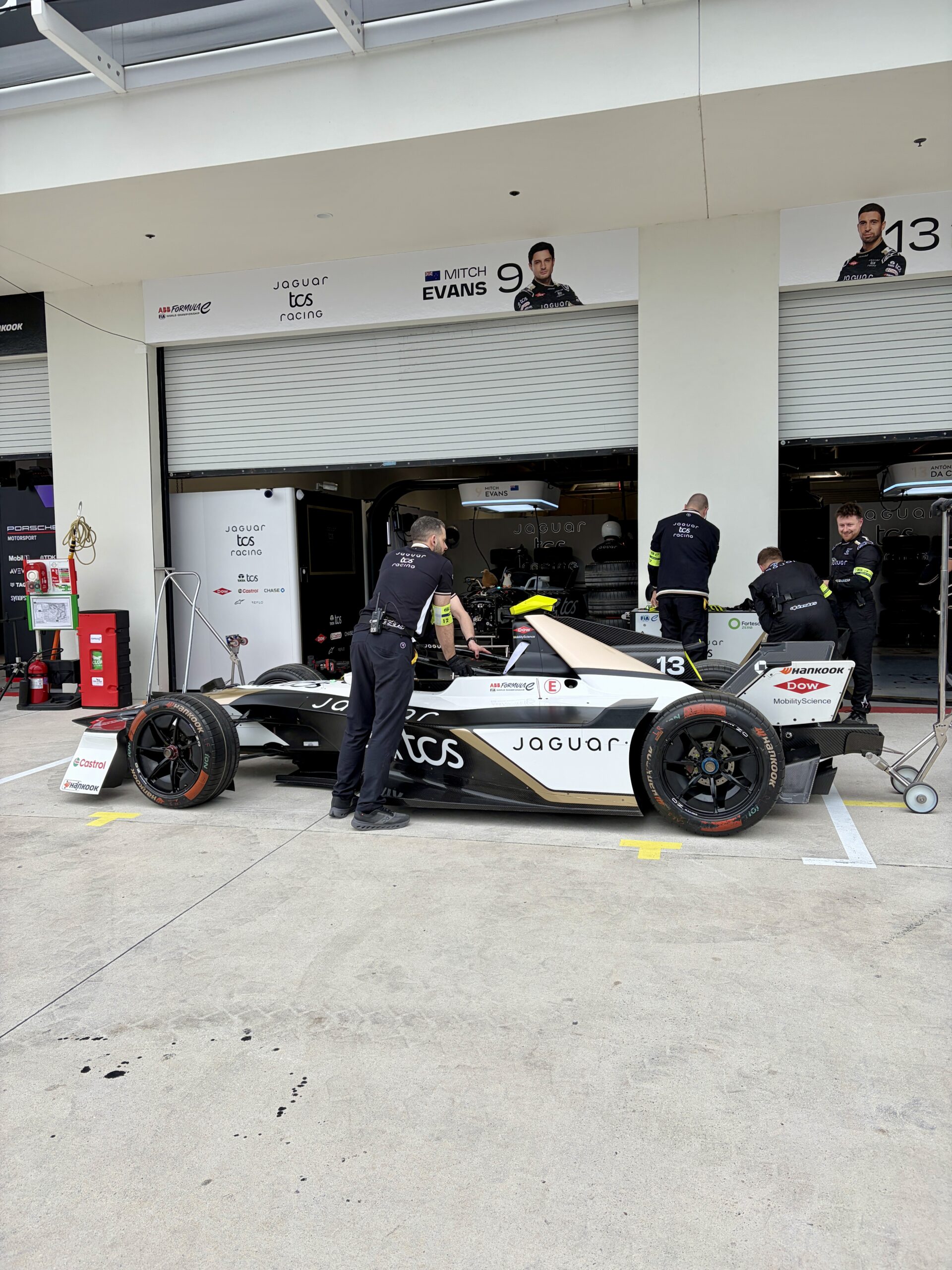
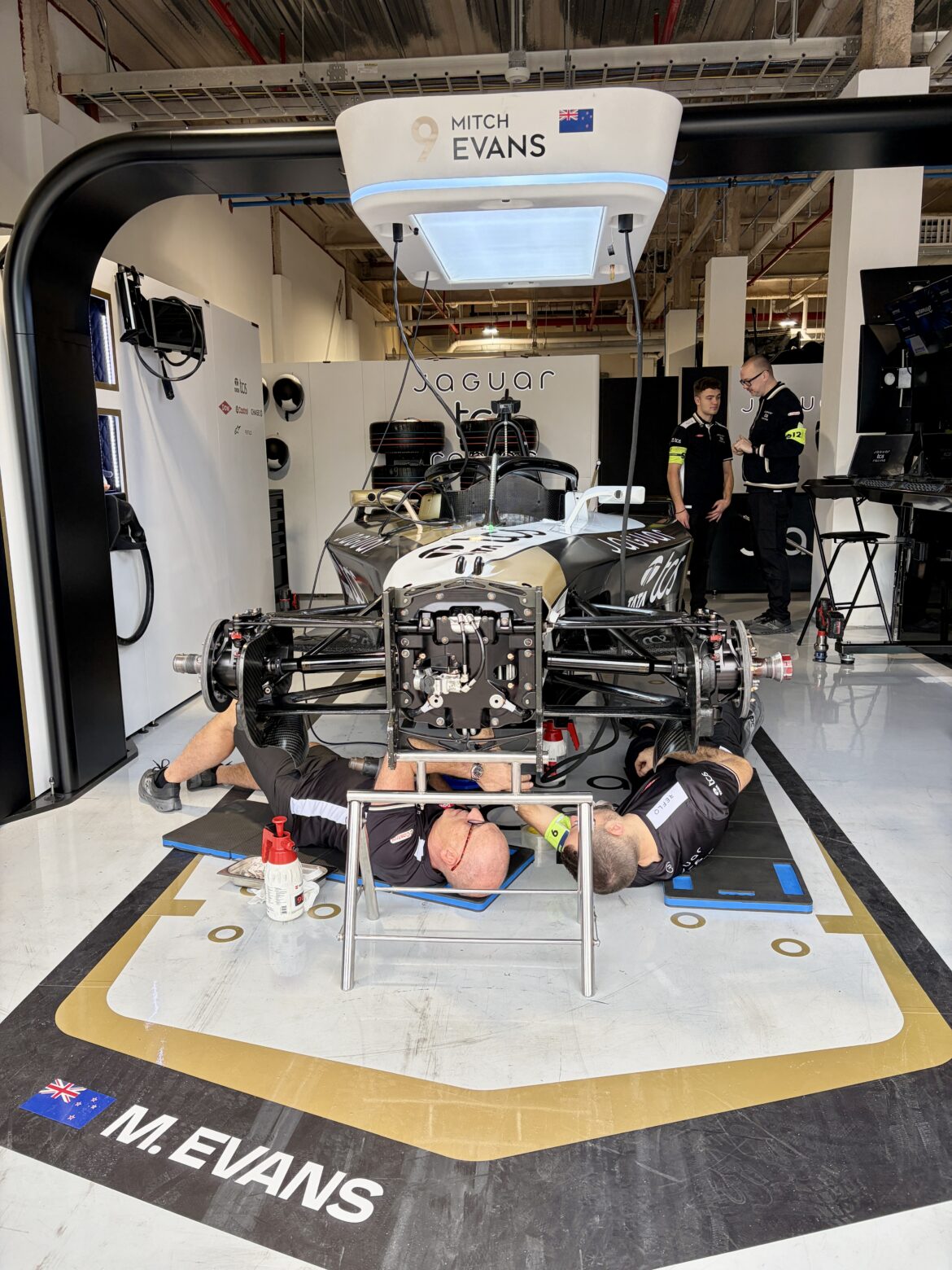
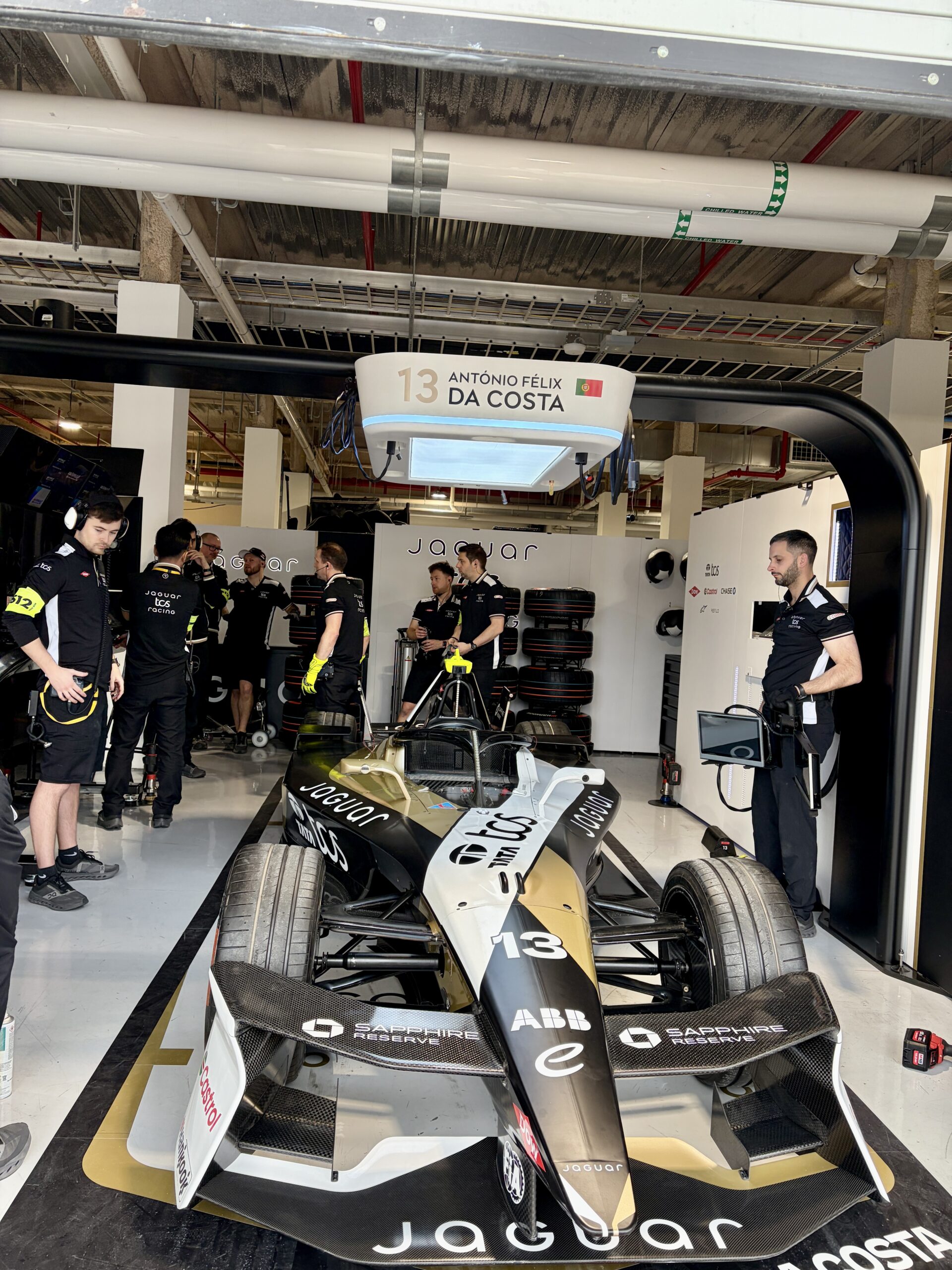
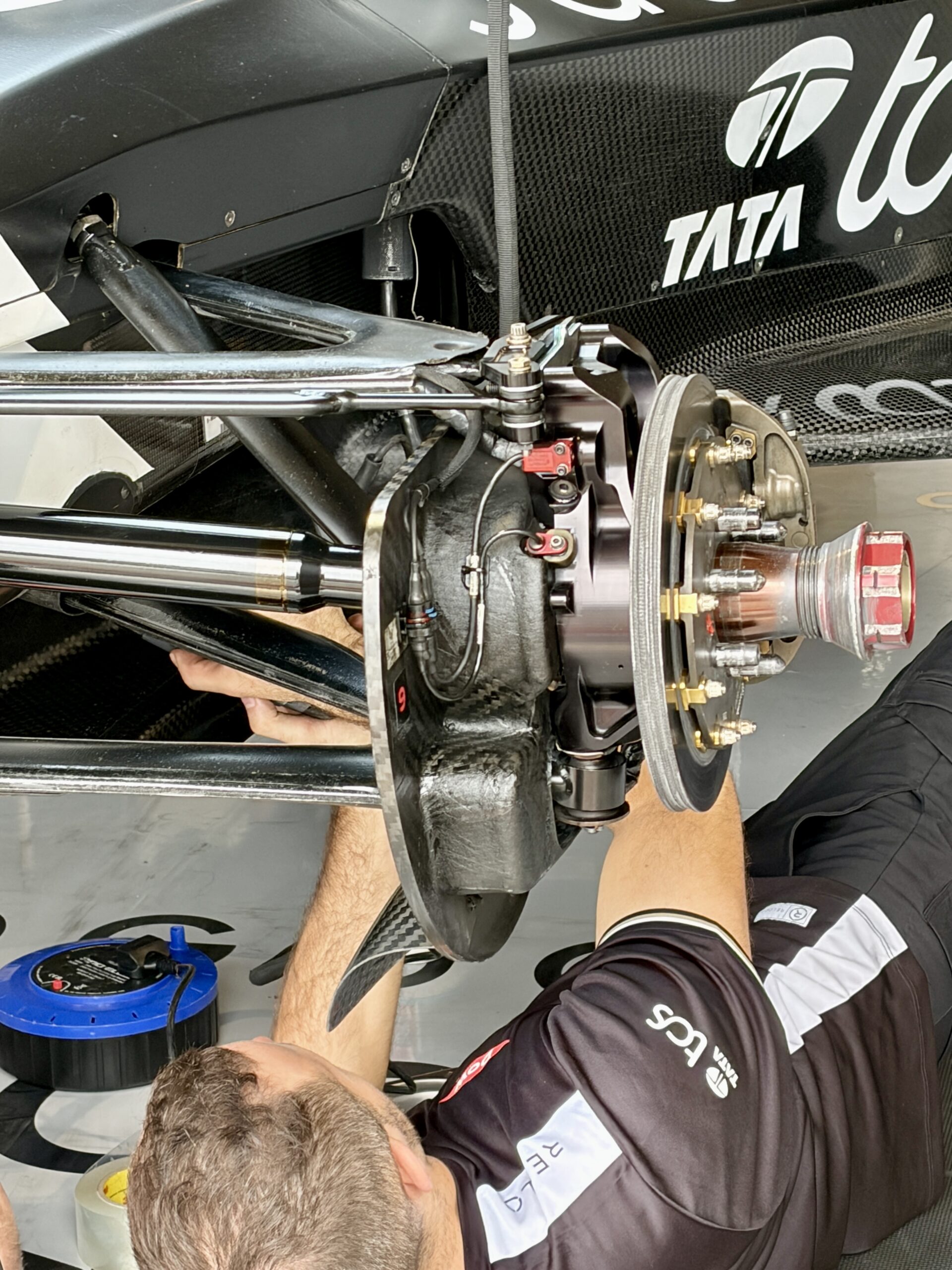
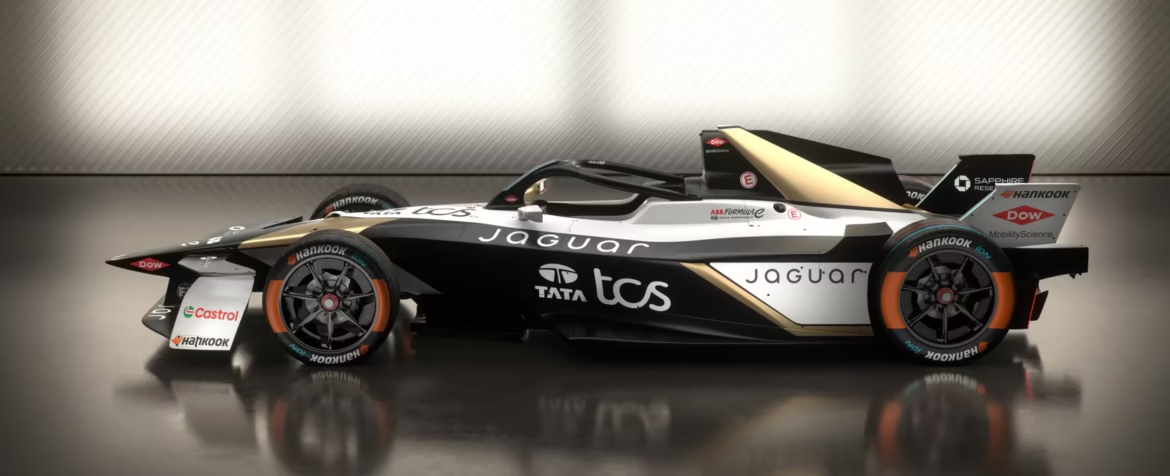
The first stop was the Jaguar Racing garage: Jaguar’s position within the paddock reflected championship order from the previous season, placing the team in the second garage. Inside the garage, the GEN3 Evo car sat prepared, surrounded by engineers, laptops, and neatly organized equipment, with remarkably little excess. What stood out was how much wasn’t there. As the team walked us through the space, it became clear that what happens in the garage is only the visible layer of a much larger operation. Formula E cars are developed on long cycles, not race by race, but year by year. Jaguar is in the second year of the current homologation period, with major powertrain elements locked in and refined over time. The motor, inverter, gearbox, and suspension are developed within strict regulations, then frozen. Between races, Jaguar’s engineers don’t rebuild the car, but constantly rewrite it. Setup begins virtually, long before the car arrives in Miami. Digital models simulate braking behavior, corner entry, regenerative energy recovery, and how the car responds to the unique demands of each track. These simulations don’t require a driver and they don’t require a physical car. They exist in parallel, running continuously back at Jaguar’s UK headquarters while the race team travels.

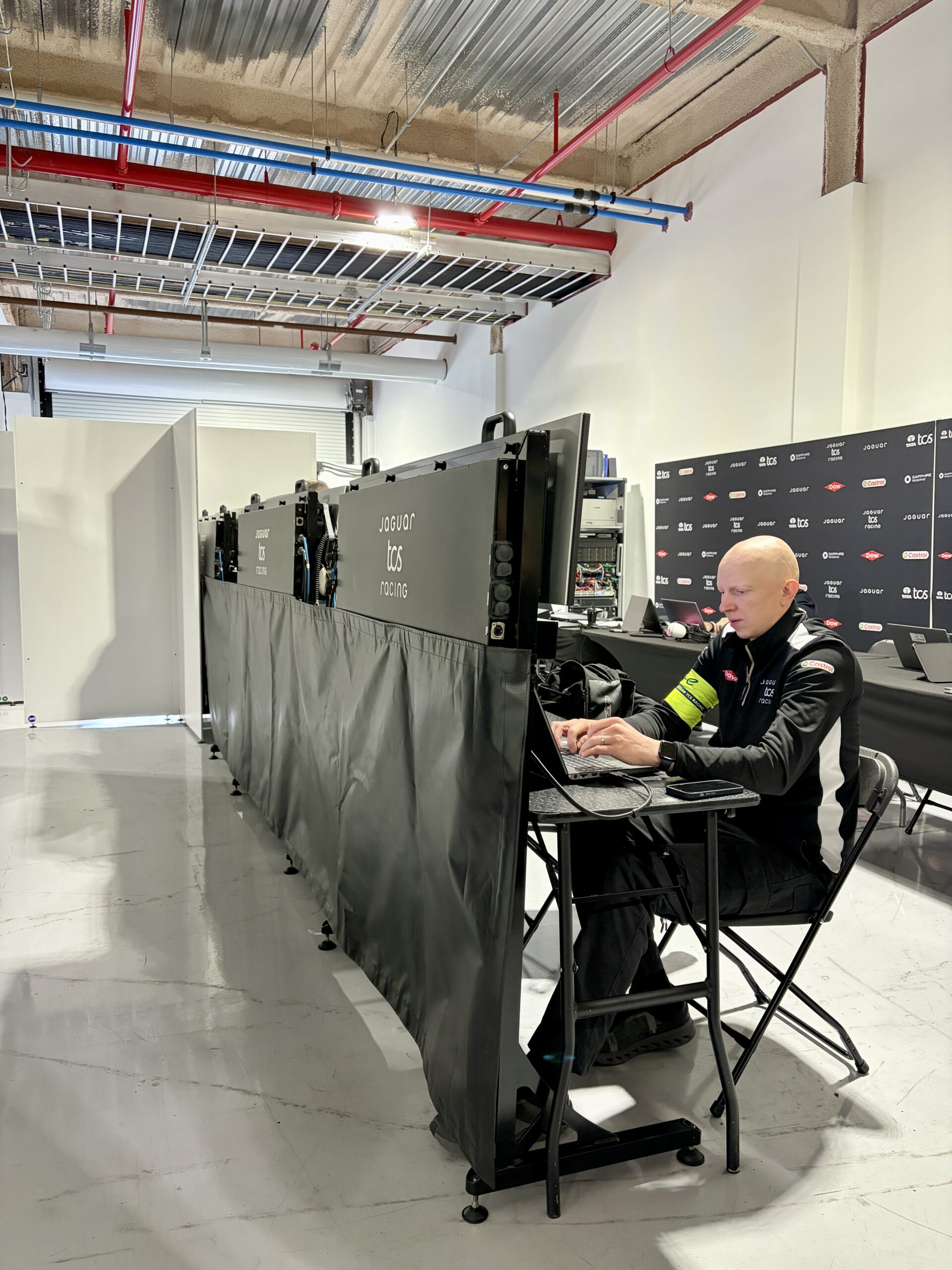
Formula E is a data-led championship by necessity. Physical testing is heavily limited and track time is precious. There are only so many days a year when the car can be run in the real world and everything else happens digitally. Engineers work through thousands of scenarios, adjusting parameters virtually, then delivering software updates that are uploaded to the car when it arrives at each race. So what appears trackside is the final expression of weeks, sometimes months, of invisible work. Logistics follow the same logic. Freight doesn’t return to base between races. Instead, it moves continuously from city to city in a global loop, handled by a centralized logistics partner. Once the season begins, teams may not see certain components again unless something goes wrong. Repairs happen within tight windows and updates must be planned long in advance. The moment the cars arrive at the circuit, the scope for change narrows dramatically. Standing inside the garage, watching engineers move with practiced efficiency, the scale of the operation became clearer. Formula E may look quieter than other forms of motorsport, but the intensity is compressed because decisions are made earlier and margins are tighter.

From the garage, the day transitioned into conversation. Roundtables with drivers António Félix da Costa and Mitch Evans, followed by team principal Ian James, added a human layer to what had just been seen. Their discussions about preparation, collaboration, and energy management framed Formula E as a championship where restraint is not a limitation, but a competitive advantage.

Lunch passed quickly, functional and efficient, before attention returned to the garage for rookie practice. Held ahead of traditional sessions, the rookie run exists in a space between opportunity and utility. For young drivers, it’s a rare chance to experience GEN3 Evo machinery. For teams, it’s early access to real-world data from the track. Alessandro Giusti took the wheel for Jaguar Racing during the 40-minute session, finishing sixth with a fastest lap of 56.278. The data on braking zones, regeneration patterns, grip levels, and energy usage fed directly back into Jaguar’s preparation. In Formula E, information gathered on Friday can quietly shape what happens on Sunday. Engineers watched screens more than lap times, tracking variables that would influence strategy later. At the time, there was no visible hint that Mitch Evans would go on to win a rain-affected Miami E-Prix with a composed, assured drive. On Friday, that outcome was still theoretical, but what mattered was readiness.

As afternoon softened into evening, the track receded and the schedule shifted again. Dinner brought the group together away from the circuit, creating space for conversation. Over a relaxed meal, members of Jaguar Land Rover’s media, brand, and motorsport teams spoke openly about travel, pacing, and the realities of sustaining a global season. The tone was warm and unguarded, a reminder that this highly technical sport is still powered by people. By the time pre-race day came to a close, Formula E had revealed itself not as a spectacle waiting to erupt, but as a system already in motion. For Jaguar Racing, Friday was not about spectacle, but about ensuring that when conditions changed, whether through weather, strategy, or pressure, the foundation would hold.

February 3, 2026 0 comments
0 FacebookTwitterPinterestEmail

Digital Cover No. 19

The Knockturnal Merch

Follow Us On The Gram

Follow on Instagram

About The Site

We are a collective of creative tastemakers made up of fashion, music and entertainment industry insiders. It’s all about access. You want it. We have it.

Terms Of Use

Privacy Policy

Meet The Team

CONTACT US

For general inquiries and more info on The Knockturnal, please contact our staff at:
info@theknockturnal.com
fashion@theknockturnal.com
advertising@theknockturnal.com
editorial@theknockturnal.com
beauty@theknockturnal.com

  • Facebook
  • Twitter
  • Instagram
  • Linkedin
  • Youtube

© Copyright - The Knockturnal | Developed by CI Design + Media

The Knockturnal
  • Home
  • Entertainment
  • Music
  • Lifestyle
  • News
  • Videos
  • Covers
  • Merch