
The words from Noah Kahan’s “Pain is Cold Water” once reverberated at storied Fenway Park in 2024. Two years later, complete with rain-soaked pyrotechnics and elaborate sets, Kahan lights up the historic Fenway Park in a different, poetic way.
“Pain’s like cold water, your brain just gets used to it. I try to keep swimming and keep Dad’s good word.”
On Tuesday, July 7, there was no shortage of cold water in Boston. No amount of precipitation would deter New England fans from the first of four sold-out evenings; the aquatic elements fluttering like the butterflies on Noah Kahan’s denim jacket. Ever present. Colorful even.
Taking something sad and turning it into poetry is a Kahan specialty. It is fitting, then, that Kahan’s stronghold of the northeast region managed to translate a New England summer special (July rain) into something collective and artistic. The Last of the Bugs has met the first of the homecoming shows. The glitter of rain gives it a little something extra.
In poetry, every word is purposeful. Every included element is intentional. Here, every lyric is sung full-bodied and fully committed, with full meaning. Every moment of Noah Kahan’s The Great Divide Tour is deliberate: the set pieces. The song order. The winks and smiles. The phone call from Drake Maye. The lights. The countdowns. The pulsing of bracelet lights. Every choice is intentional, like a poem hoping to land poignantly like the New England rain. Or perhaps the last of the bugs upon someone new.
Kamand Kojouril reminds us that “Poetry isn’t an island, it is the bridge. Poetry isn’t a ship, it is the lifeboat. Poetry isn’t swimming. Poetry is water.”
In this case, we welcome the full poetic anthology. We are drenched in the experience.
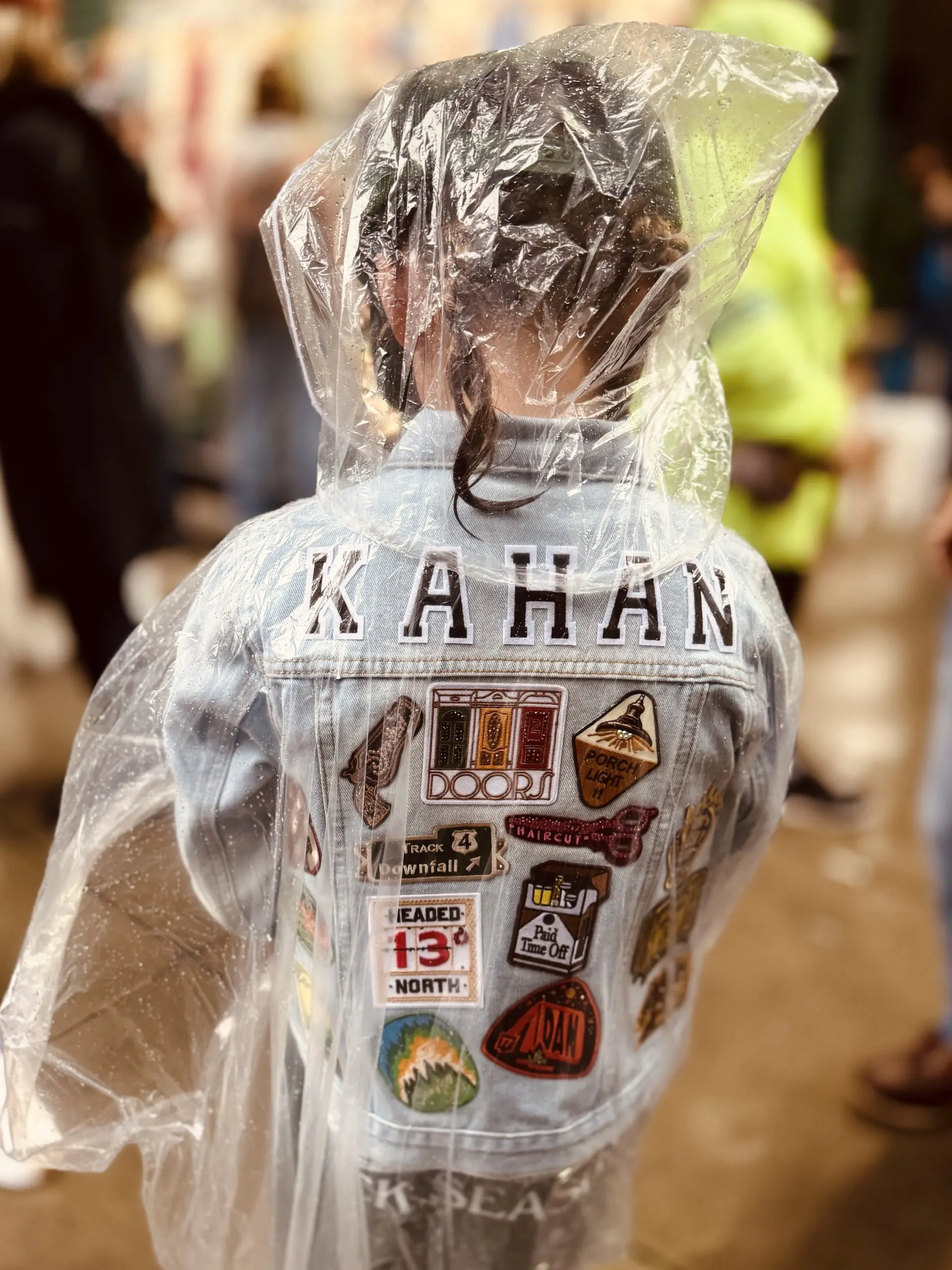
A young Noah Kahan fan shows off her homemade jacket.
“Genuine poetry can communicate before it is understood.” – T.S. Eliot
Tuesday’s show prompted two immediate questions for most people: How was the show? And, how was the rain?
The first answer comes with confusion. Binaries no longer exist here. We are not wet or dry, but various stages of damp. We are not new fans or old fans, just in various stages of discovery and rediscovery. The descriptive words come with caveats: The show is wonderful and loud but not raucous. Meaningful, but not pretentious. Kahan’s a genuine rock star, but not showy. The show is well-resourced but not ostentatious. Moments are frank, but not demeaning. Kahan is far less surprised at his own success, unlike his 2024 visit, but is still surprised regardless. He’s just gotten better at hiding it, except for a few, escaping mini smiles when everyone sings along; a recognition that nearly 40,000 people in your hometown arena are singing every lyric to every song with you.
At least, I think that’s what I wrote. I lost feeling in my thumbs long before Kahan took the stage, courtesy of the rain. A wet phone means ghost buttons and accidental presses.
And how might I describe the weather? I’ll let Annabelle Dinda jump in: “This is insane,” Dinda noted during her set, but acknowledged the audience participation: “Let’s go rain dancers in Boston! Let’s rip it in the rain.” A short time later, Dinda herself danced to Gigi Perez, her (many) guitars relaying haunting echoes as patrons rang out soaked socks (or chose to forego them altogether). Perez’s chords seem eager to call for sunlight. Indeed, on the television screens inside, illuminating the anxious faces of those delaying their park entry, it seemed like nothing amiss on stage. The spotlight mimicked sunlight. Harmonies from “Sailor Song” beckoned you into the rain, if you dared to go out and celebrate Perez’s own homecoming: The singer-songwriter briefly attended Berklee College of Music.
“I would define, in brief, the Poetry of words as The Rhythmical Creation of Beauty.” – Edgar Allan Poe
When Fenway still has empty seats, the drums rip through your chest to reset your internal rhythms. The thumping starts you back at zero, like a clock or a stopwatch. The Great Divide tour is all about timing: Fenway feels like one giant line. Show-goers wait for up to 90 minutes to buy Boston-specific Kahan merch. One patron arrived at 3:00 am to ensure she was at the foot of the stage. She managed to nab a set list and could be seen on screen singing “Stick Season.” The bee outfit made her instantly recognizable.
The Fenway waiting room, or rather, the hallways before the entry, filled with millennial women in brand new brown The Great Divide Tour sweatshirts covered in flimsy ponchos, flanking cowboy boots, and flashing ladybugs painted on fingernails with homemade “sad bug summer” shirts. Some wore rain boots. Some wore Converse. Others wore no shoes at all. “I accept my fate,” noted one patron waiting at the B gate line, covering her head with her flannel shirt, the only protection against the elements. Speaking of lines, there was only a short one at the Fenway box office, where, at 5:30 pm, the only offering was turf seats for $300.
How does one prepare their timing and instill their concert rhythms with a musician as big as Noah Kahan? The food and the merch and the bathrooms and… wait…did my phone lose 40% of its charge in one hour? My timing suddenly included a Fuze battery rental, too. I swing my arms to get my thumbs working again, not unlike the motion to warm up before a Fenway Spartan I tackled eight years ago in this very location. I want both my iPhone and my head to stay stable. I want to learn how to swim in mellow but anticipatory water.
“A poem begins as a lump in the throat, a sense of wrong, a homesickness, a lovesickness.” – Robert Frost
Twenty minutes before Kahan-time, the nerves gather like an anticipatory rain cloud. Building condensation with the promise of a release. A deluge of fans descends like the storm at 7:50 pm, overloading the ballpark entrance and overwhelming the workers struggling to stamp “turf” on every passerby. The red mark washed off in 30 seconds.
And suddenly… a countdown. Yellow bugs crawl in a line around the screen. We are greeted first with “Wild One.” And then, with Kahan. And then, with “American Cars.”
What starts as a scream coming from that lump in the throat has transitioned through states of matter into singing. The cloud is releasing. And suddenly I am singing too, on behalf of everyone in New England, not in Fenway with me.
It turns out rain provides the perfect opportunity for tears. Even the concert cameras look like they’re weeping. The lenses carry unique touches of beauty from the raindrops, framing Kahan in golden flecks like fireflies.
Every song, every lyric, is met with voices. We are suddenly aware that we, too, play a role in the rhythmic creation of beauty.

Noah Kahan at Fenway Park, in Boston , MA.
“Dear Reader, beware. You think you’re reading my poems, but in truth, they are reading you. My words are mirrors and windows. Your reaction is merely a reflection of your own nature and experiences.” — John Mark Green
“It feels good to be home,” Kahan shared with the hometown crowd. He acknowledged that many shelled out inordinate sums to see him, amounts that are “more than a donut at Common Man, so we’re going to play things we don’t normally play,” including “Paul Revere.”
Kahan’s lyrics certainly stand alone, but they also stand with you. 24 hours before the concert, I am flying out of Sun Valley, Idaho, listening to “The Great Divide,” letting the chords ripple through my own anxious mind, which is running amok in its own obsessive thinking. It has found not a great divide but a grand rapport, newly forged, in the lyrics and approach of Kahan’s work.
17 hours before the concert, I land back at Logan Airport, the hatred of which is made apparent in “Standing Still.”
Four hours before the concert, I can hear Kahan’s sound check from my office. I field requests from friends for merch.
When Kahan smiles during his set, it’s a moment of recognition. A “common” man taken to great heights through the exploration of his soul and his struggles, which results in not a great dividing, but a great uniting. Kahan’s reputation and approach may have a gruff exterior, made harder still by his request to “root for someone’s loss” as “that’s the Boston way.” But the opposite rings true at his concert. Humanity and community continue to win over “assholes.” Moms embrace daughters who find their own experiences mirrored in Kahan’s words. Smiles exchanged between strangers. Borrowed hair ties. There are few annoyances, which is a poetic miracle at Fenway.
“Poetry: the best words in the best order.” – Samuel Taylor Coleridge
Concerts have a predictable and mappable rhythm. The moments oscillate between high-energy rockers and slower ballads. There are moments when you might think, “Now is a good time to use the bathroom.”
Kahan’s show leaves no such room. Every moment is cared for, supported, and fully and successfully willed into existence. Most patrons never dared to leave. If so, you may have missed the porch house elevating, the ambient interstitial music, the phone call from Patriots quarterback Drake Maye, the video of the northeast timed to “The View Between Villages,” or the money shot: Noah Kahan highlighted at the front of the stage as the rain pours, elevated by the spotlight.
My notes get shorter and shorter. “’She Calls Me Back’ is a banger live,” I struggled to input. “I am cold, just like ‘Northern Attitude.’” “Singing ‘Dashboard’ with people is magical.” I slide-type with an index finger. It feels like my nerves are severed. My brain ponders if I’ll ever get full functionality back. As if on queue, the rain falls harder.
“Poetry is just the evidence of life. If your life is burning well, poetry is just the ash.” – Leonard Cohen
If two years ago was a trial run, this year, Kahan is cemented into history in a city that lives for it, one raindrop at a time. In a town known for stories and legacies, we still manage to find a new side to a story and a new way to present history. When the well-known ethereal piano notes of “End of August” float down from the stage, they somehow reassemble in a brand new way in my brain. The rain frames the stage lights in a way I have never seen before. All four Fenway shows will be different, like a film photo, or the snap of a memory. Two years ago, “Stick Season” descended with foliage confetti. Tonight, it comes with a surprise set of fireworks.
And suddenly, in the haze of the fireworks, the ash of living, the lights come up. “Sweet Caroline” serenades the night. I drop my shoulders, which I didn’t even know were up by my ears. I buy a “Noah Kahan Made Me Cry” shirt. No comment on the truth of that.
And as the sun comes up on Wednesday, my feet have phantom puddles. The wet stays with me, not as weight but as a gentle reminder: We’re going to be alright. Maybe I’m just “burning well.” The “End of August” reverberates along with the tinnitus, and yet I am attuned to the connections created by the ethereal strings strung by bugs in the air, the lights on bracelets, and the lyrics that hit different when sung with velocity. I wear my bracelet like a tattoo.
While Kahan’s lyrics carry hints of sadness, this morning, I am full of the opposite, approaching my own Busyhead and busy life with a sort of kindness I didn’t have yesterday. Something washed away. Or something sinking through.
I walk to run errands in the back of my building, and my neighbors are playing “Dial Drunk” on their cell phones, sharing their own experience. Recently, Boston is no stranger to shared viewing experiences, having just hosted a storied selection of World Cup matches. It reminds me of the Olympics, where we might gather together to cheer on athletes tackling their dreams. We may watch triumphs. We may watch tears. We may watch, well, swimming.
So now here we are, stroke after stroke. Swimming forward together, to keep Dad’s good word.
If poetry is water, consider us soaked.

Photo by Patrick Mccormack
