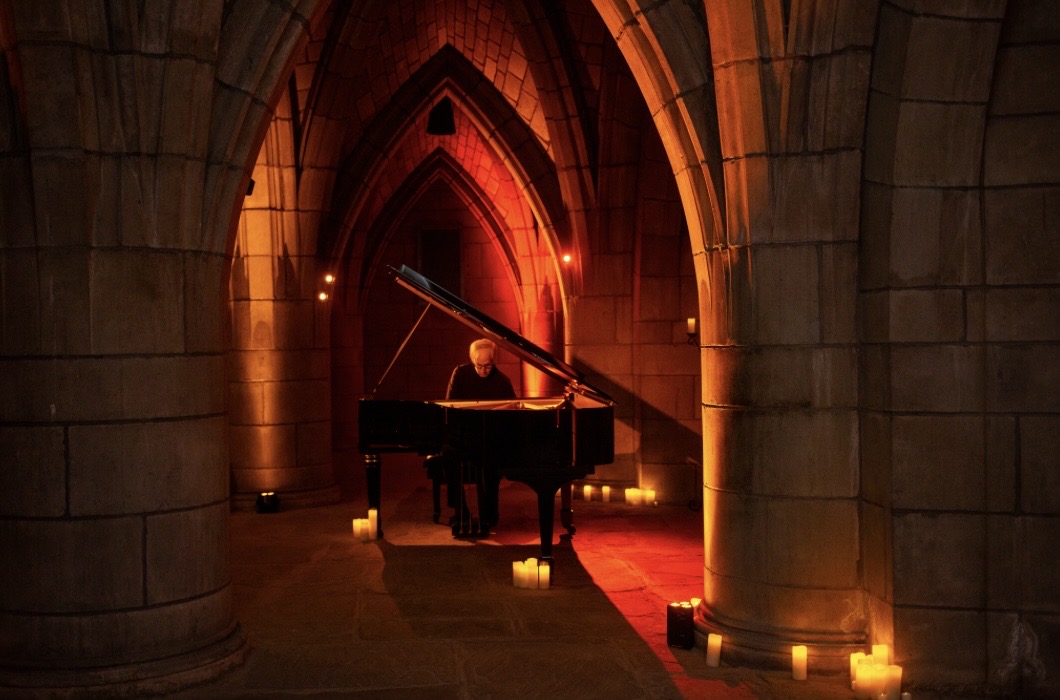
Composer Jeff Beal welcomed a small audience to an unlikely venue last weekend: a crypt.
After a brief reception hosted by nonprofit organization Death of Classical in the Church of Intercession on the Upper West Side, an audience of around 50 descended underground for the world premiere of the Emmy winner’s latest collection, New York Etudes, Vol. II The 10 new piano songs explore Beal’s grief, growth and hope, written during a time of intense loss.
Widely recognized for his film and television work — including House of Cards, Rome, and Blackfish — Beal often relies on highly produced, complex orchestrations. Here, he proved just as compelling alone at the piano. In fact, he considers live performance a gift.
“I’ve had a great career, but through screens,” Beal said. “This is my first love: Music making in a room full of people.”
Following a brief introduction from Death of Classical’s artistic director Andrew Ousley, Beal took to the stage, vulnerably sharing that he lost his mother in-law and both his parents in quick succession after the COVID-19 pandemic. He channeled his emotions through writing this solo project, which serves as the follow-up for New York Etudes, Vol. I, released in April 2024.
“Where do I come from? What about these people makes me who I am?” Beal said, reflecting on the central questions of the collection.
The opening piece, “All Good,” draws listeners in with light, fluttering high notes, heightened by the crypt’s resonant acoustics. Its simple, repetitive melody creates a meditative calm before ending in a moment of dissonance that gently disrupts the spell. Beal later shared that he wrote the piece about his mother near the end of her life. In one of their final conversations, she told him, “we had a good run,” inspiring the title. His love for her — whom he described as “simple and humble” — comes through in both the composition and his storytelling.
In “New Leaf,” Beal quite literally changes his tune with a melody that subtly evolves with each repetition. Quick, intricate runs rise and fall over a steady middle line, grounding the listener amid constant change. The piece captures a swirl of emotion — confusion, panic, and ultimately hope — as Beal expertly transforms grief into motion.
Unsurprisingly, the entire collection feels cinematic. “Summer Spring” feels as though it could be right out of a Jane Austen adaptation with its ebbing and flowing tempo. This effect was only amplified in the crypt as sound ricocheted softly off stone walls, creating an immersive, almost surround-sound effect.
Despite the weight of the past few years for Beal, these pieces offer a sense of calm. Listeners can deeply feel his losses, but also see how he shapes them into something resonant — music that honors the lives behind it.
“What makes life beautiful is that it is finite,” Beal said. “That’s what makes it precious.”