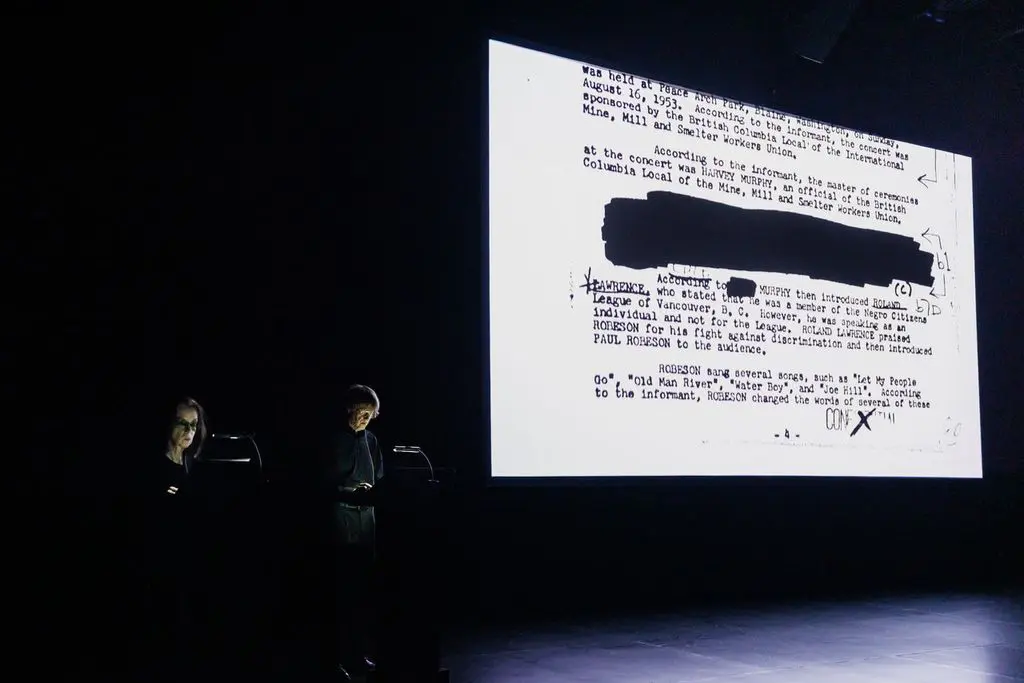
As agencies such as ICE and the Department of Homeland Security cast immigrant communities as threats to the nation, ‘End Credits’ confronts an earlier abuse of state power whose logic remains chillingly current.
Academy Award-winning artist and director Steve McQueen reconstructs the FBI’s sweeping surveillance of Paul Robeson and his wife, Eslanda Goode Robeson, under J. Edgar Hoover. Operating with little oversight, Hoover transformed the FBI into a centralized national security apparatus and pursued Robeson for decades as a major threat. The campaign—among the most extensive surveillance operations in American history—blacklisted Robeson and ultimately destroyed his career.

Photo Credit: Marc J. Franklin
The son of a formerly enslaved man, Robeson felt compelled to confront the nation’s failures. He championed racial equality, labor rights, anti-imperialism, and spoke favorably of the Communist Party. From the 1920s through the 1950s, the Communist Party USA mounted forceful anti-racist campaigns and provided legal defense to Black Americans, commitments that distinguished it from other predominantly white political organizations. Abroad, the Soviet Union opposed Nazi-backed forces in the Spanish Civil War and later suffered more casualties than any other nation in World War II, reinforcing its image as an anti-fascist power. Robeson admired its stated commitments to racial equality and anti-imperialism, but he was never officially identified as a party member. Hoover branded him one anyway.
Under Hoover, the FBI targeted labor unions, left-wing radicals, and suspected communists. Robeson’s solidarity with working people was public and sustained: he joined picket lines, sang in union halls, and held honorary memberships in more trade unions than any other public figure of his time.
In 1946, Robeson founded the American Crusade Against Lynching and led a national campaign for federal anti-lynching legislation. Hoover refused to treat lynching as a federal crime, and throughout his tenure the FBI remained reluctant to intervene in racial violence.
These competing visions of America drove the FBI to surveil Robeson from the 1930s until his death. End Credits exposes that decades-long scrutiny, along with the parallel targeting of Eslanda Goode Robeson. Together, the Robesons advocated for civil rights, labor, anti-fascism, and anti-colonialism. After Robeson’s file was declassified in 1980, McQueen obtained it through the Freedom of Information Act. The file draws on a vast network of “trusted” confidential informants, people swept up in McCarthy-era Red Scare hysteria, wiretaps, and physical surveillance. Although the Robesons, Hoover, and most others named in the file are dead, it remains heavily redacted, with much of its contents still classified on national security grounds. Its blacked-out pages become a visual metaphor for state-sponsored erasure, revealing how far the government went to silence Robeson.

Photo Credit: Marc J. Franklin
From this heavily redacted file, thousands of pages long, McQueen fashions a contemporary warning about the consequences of government agencies abandoning democratic principles. This version condenses his 72-hour installation into a one-hour live performance by Laurel Lefkow, Jeff Mash, Eric Myers, and Regina Reagan, whose voices give the work its emotional force. Lefkow is known for Black Mirror and The Boys in the Boat; Mash has appeared in Dark Shadows and Assassin’s Creed; Myers’s voice and film credits include Snatch and Woman in Gold; and Reagan works across stage, screen, and voice performance. Drawing on a decade of collaboration, the four actors deliver a presentation of remarkable concentration and intensity.
At once a historical document and an urgent warning, End Credits makes the machinery of repression impossible to dismiss. In tracing the campaign against Paul and Eslanda Goode Robeson, the work shows how surveillance can criminalize dissent, silence advocates for justice, and corrode democracy from within. Its warning extends far beyond the Robesons: civil liberties endure only when the public defends free expression and holds government power to account.
