
Each January, The Winter Show returns to the Park Avenue Armory with a familiar mix of museum-quality antiques, fine art, and design. Long known for its scholarly rigor, the fair has typically rewarded historical fluency. This year from January 23rd to February 1st, the experience feels slightly recalibrated. Alongside connoisseurship, there is a greater emphasis on atmosphere, narrative, and how visitors move through the space. Two presentations in particular help define that: a design-led collectors lounge by frenchCALIFORNIA and a literary showcase by Peter Harrington Rare Books that treats books as both cultural artifacts and sculptural objects.
This year, frenchCALIFORNIA has designed the VIP Collectors Lounge, titled The Modern Salon. Rather than functioning as a branded pause point, the lounge reads as a fully realized interior. Furniture, lighting, sound, and spatial rhythm are treated as equal elements, creating an environment that feels composed rather than decorative. The installation brings together contemporary Italian design through Dexelance, featuring works by Meridiani, Saba, Turri, and Davide Groppi, unified by an emphasis on proportion, material quality, and human scale.
The lounge responds directly to the architecture of the Armory’s Veterans Room, originally realized under the artistic direction of Louis C. Tiffany. Instead of competing with the room’s historic presence, frenchCALIFORNIA works in dialogue with it. Modern silhouettes and restrained palettes sit comfortably against the building’s ornate bones, creating a quiet tension between past and present. Seating arrangements are intentionally relaxed, encouraging conversation without formality and reinforcing the salon’s role as a place for exchange rather than display.
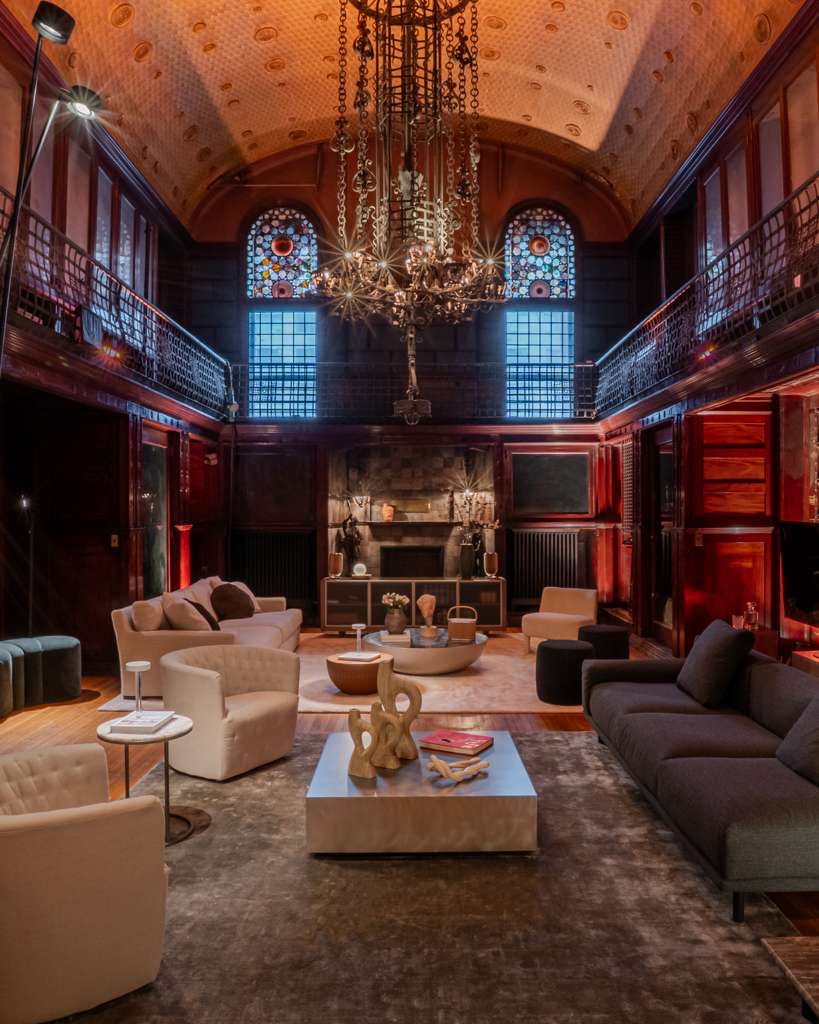 Sound also plays a central role in shaping the environment. An immersive audio program by Bang & Olufsen is integrated throughout the space, with speakers treated as sculptural components rather than visible technology. Audio functions as a material in its own right, influencing the pace and mood of the room. The effect is subtle but deliberate. The lounge feels lived in rather than staged, offering collectors and guests a moment of pause that remains fully in conversation with the fair.
If frenchCALIFORNIA’s presentation centers on how design is experienced in real time, Peter Harrington Rare Books offers a counterpoint grounded in history, craftsmanship, and intellectual legacy. One of the world’s leading antiquarian book dealers, Peter Harrington arrives at The Winter Show with a tightly curated selection that favors depth over volume. The display encourages lingering, inviting viewers to consider books as objects shaped by labor, time, and cultural context.
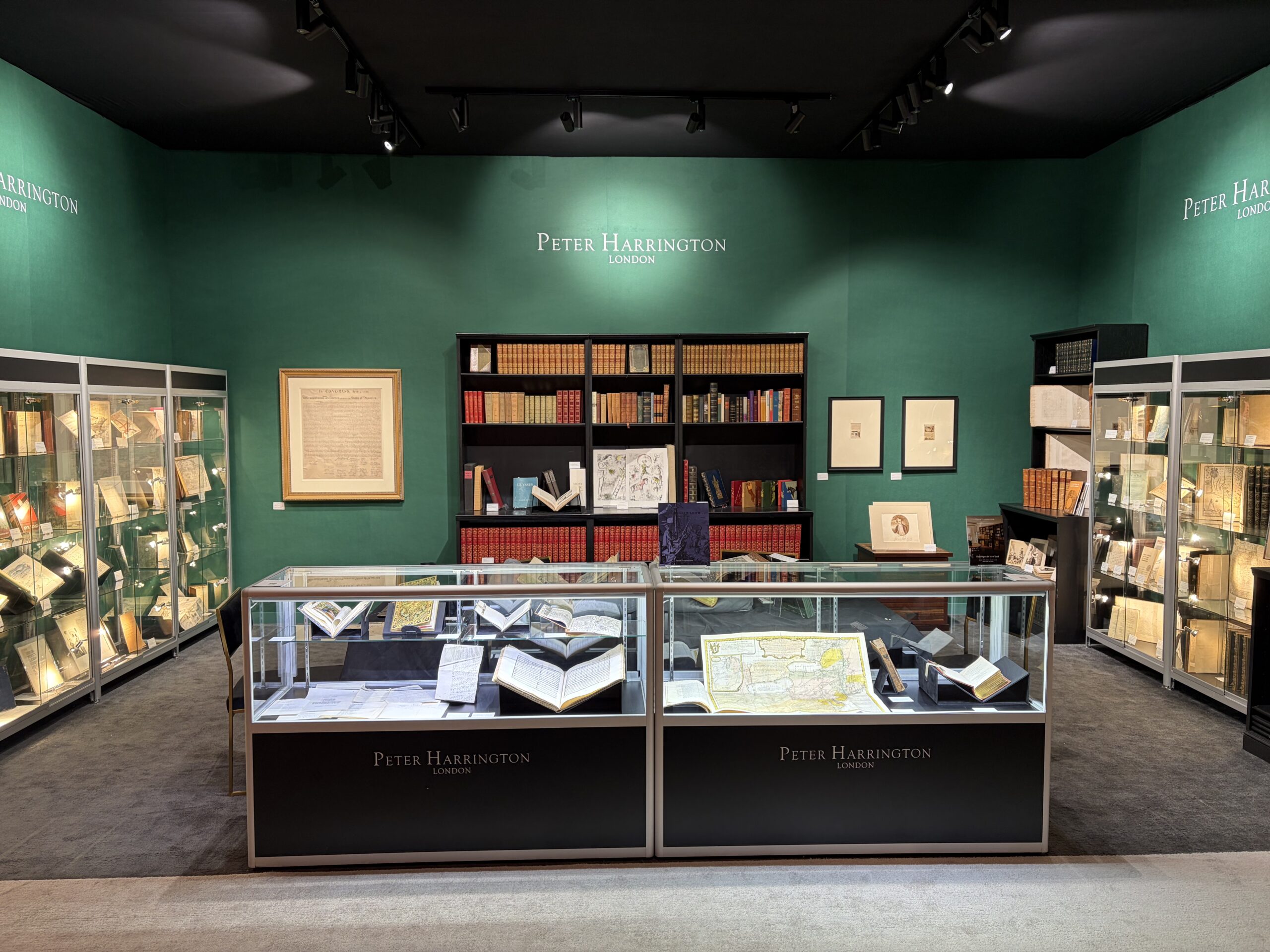
Among the most significant highlights is The Science of Climate Change, a landmark collection assembled over more than a decade by collector David L. Wenner. Tracing the evolution of climate science from the fifteenth century to the present, the collection includes incunabula, handwritten observational data, and foundational research papers where ideas such as the greenhouse effect first appeared in print. Presented together, the works form a restrained but powerful narrative about how scientific knowledge accumulates over centuries and how long it can take for evidence to enter public consciousness.
Another focal point is a unique illuminated manuscript of Dante Gabriel Rossetti’s The Blessed Damozel, produced between 1910 and 1929. Illuminated by Alberto Sangorski and bound by Rivière & Son, the manuscript represents a high point of Arts and Crafts bookmaking. A full-page miniature inspired by Rossetti’s painting anchors the volume, while a certification leaf confirms the work “will not be duplicated.” The manuscript is presented less as a literary document and more as a singular artwork, blurring the boundary between book and fine art.

The booth also offers moments of levity. An archive of letters from P. G. Wodehouse to his American editor reveals the author’s humor and vulnerability late in life, touching on everything from royalties to adaptations and aging. Nearby, a complete set of first editions of The Chronicles of Narnia, bound in custom morocco with designs reflecting each volume’s themes, reframes a familiar series as a cohesive sculptural library.

Together, these two presentations point to what feels newly resonant about The Winter Show this year. The fair continues to reward expertise and close study, but it also opens itself to a wider range of entry points. Design-minded visitors are drawn to the lounge’s sensory intelligence and spatial restraint. Literary collectors and history enthusiasts can engage deeply with manuscripts and archives that connect past debates to present concerns. Even casual attendees encounter moments that invite curiosity rather than intimidation.
