An engagement should bring a family together, but in ‘The Blue Violinist Over West End Avenue’, it exposes the fault lines that threaten to pull the Steins apart.
Identity, memory, and loyalty collide as a family shaped by the Holocaust confronts the price of assimilation. For the generation that fled Europe and rebuilt its life in the United States, acceptance promised a future. For its children, belonging raises a different question: how much of their Jewish heritage must they keep—and how much can they leave behind? The Steins share a past, but not a vision of what it demands.
After decades in documentary and narrative filmmaking, playwright Debbie Goodstein brings her exploration of family, identity, and historical trauma to the stage. The daughter of a Holocaust survivor, she links the political divisions on college campuses to the generational conflicts of Fiddler on the Roof.
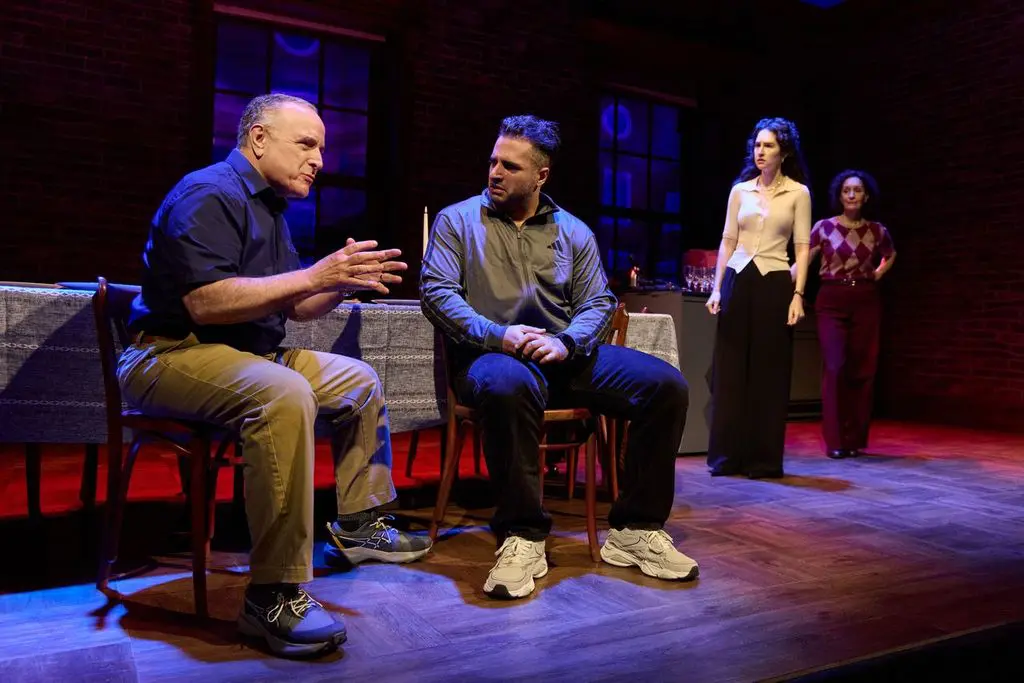
Photo Credit: Jeremy Daniel
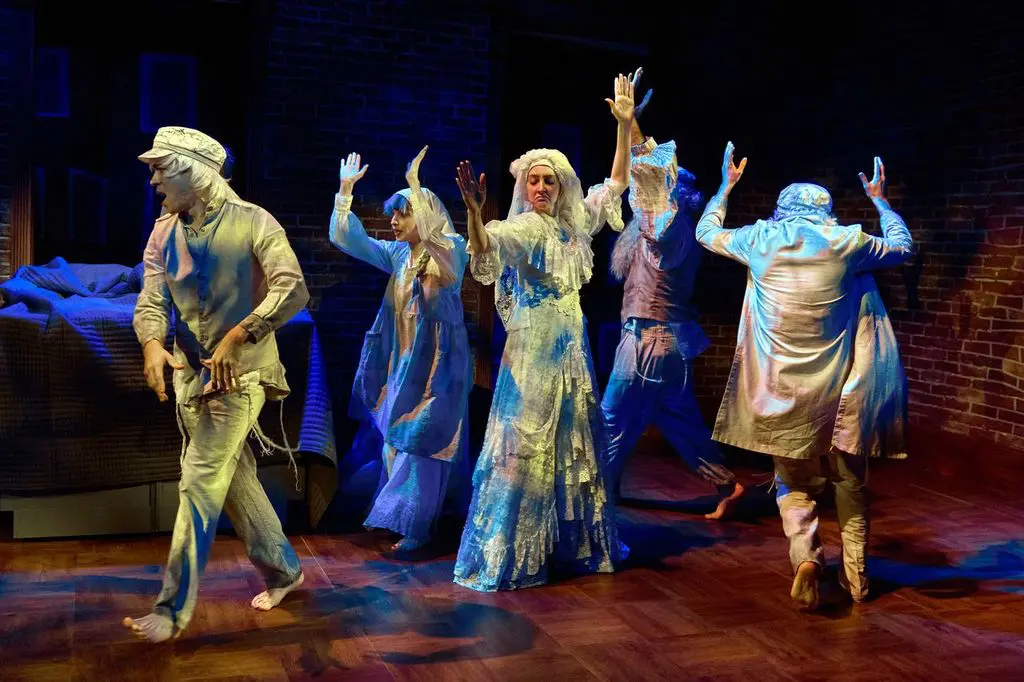
Chagall’s The Blue Violinist presides over the Steins, its central figure seeming to dance above the rooftops of a misty village. The image inspired the title and concept of Fiddler on the Roof, whose Jewish milkman, Tevye, struggles to preserve tradition amid social change in imperial Russia. Here, the painting frames a similar conflict between cultural inheritance and modern life.
The Stein family gathers in its Upper West Side apartment for the celebration. Adam Heller, whose Broadway credits include Some Like It Hot, Elf, and Baby It’s You!, gives a strong performance as patriarch Abe Stein. A spiritual heir to Tevye, Abe clings to tradition, faith, and memory as his children assert their independence. Heller captures the tension between Abe’s religious convictions and his children’s choices. Tony-nominated Barbara Walsh, known for Falsettos, Big, and Ragtime, brings strength to his wife, Dina, who tries to hold both the celebration and the family together as secrets surface.
The Stein siblings have taken sharply different paths. Rachel has distanced herself from her Jewish identity and married Vinny Bianchi, an Italian Catholic policeman. Laural Friedman, whose credits include Broadway’s Prayer for the French Republic and Off-Broadway’s Tech Support at 59E59, portrays Rachel. Mike Labbadia, active in New York’s independent theater scene, plays Vinny with conviction: a devoted husband eager to win over his in-laws, even learning Yiddish and Hebrew phrases.
Yitzhak Stein has moved in the opposite direction, embracing his Jewish identity, settling on a kibbutz, and raising a family in Israel. Etai Benson, seen on Broadway in The Band’s Visit and the revival of Company, conveys Yitzhak’s wholehearted commitment to Judaism and Israel. As Abe observes, “Maybe while the rest of us were trying to fit in, Yitzhak went looking for what we left behind.”
For Joseph Stein, an acting career and romantic relationship come before Judaism. Harrison Bryan, often seen in Classic Stage Company’s Off-Broadway productions, plays Joseph. Israeli-American actor and writer Yair Ben Dor portrays his partner, the grandson of a Jewish man forced to leave Morocco and conveys his deep love for Joseph.
Jake, the youngest Stein sibling, wants to escape his Jewish identity. Actor, writer, and comedian Rory Kutz brings him to life. When Jake introduces his new girlfriend, Jenna, her views on Israel reopen old wounds and expose buried secrets. Actress, classical singer, and theater performer Ali Axelrad gives passionate expression to Jenna’s pro-Palestinian convictions. The clash forces the family to confront what it means to be Jewish—and whether love can withstand opposing worldviews.
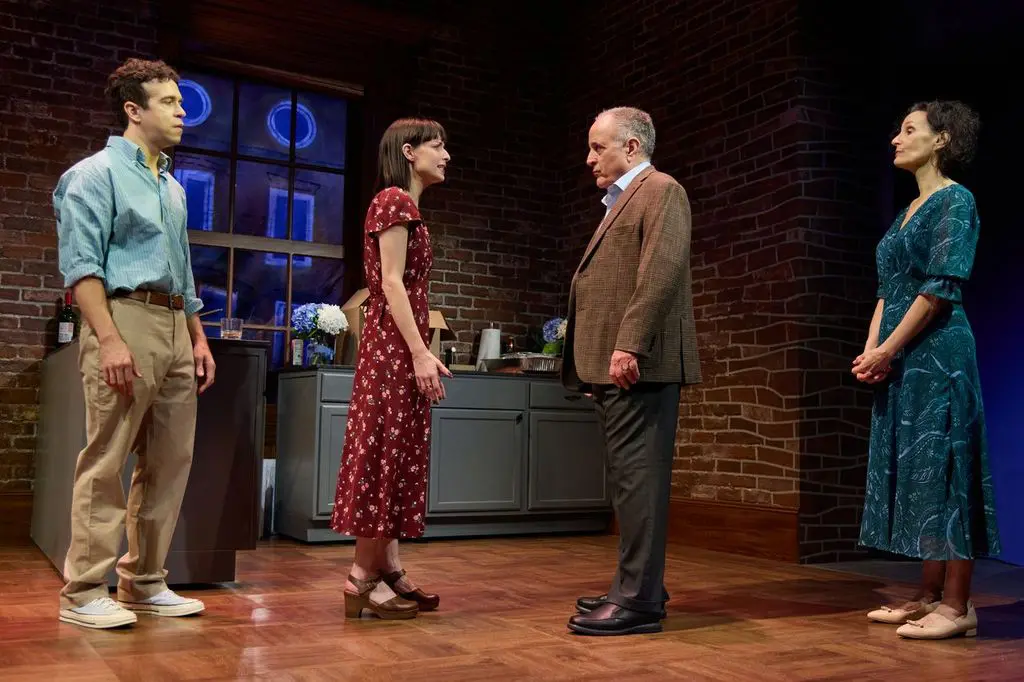
Photo Credit: Jeremy Daniel
Abe’s conflict with Jake echoes Tevye’s anguish when his daughter Chava falls in love with a young Russian Christian. Bound by religious law and fears for his community’s survival, Tevye declares her dead to him after she elopes and converts to Russian Orthodoxy. Yet he whispers, “God be with you.” Abe sees Jake’s support for the Palestinians and Jenna as a rejection of Jewish suffering and the family’s history. He travels to Cambridge to apologize to his son, only to storm out in anger at Jake’s statements. The divisions he hopes to bridge defeat his attempt at reconciliation.
For the Steins, Jewish identity is closely tied to Israel, and the October 7 Hamas attack unsettles even those who thought they had left that identity behind. Yitzhak prepares to return to Israel to join the army in the fight against Hamas. Joseph is hurt that no one in his college group chat has asked whether his brother and his family are safe, despite knowing they live on a kibbutz. He admits he can no longer give so little thought to being Jewish. Rachel lights candles with Dina at the Seder and resolves to raise her unborn son as a Jew. Even Jake questions Jenna when her statement supporting Hamas shows no empathy for the victims. As Dina struggles to keep the family together, Abe reaches out to Jake and asks him to return—a gesture that recalls Tevye’s whispered blessing to Chava.
Over two hours, including a 15-minute intermission, seasoned Broadway veterans and prominent Off-Broadway performers give the Stein family’s fractures emotional weight. The Blue Violinist Over West End Avenue begins with a celebration and becomes a reckoning: with the price of acceptance, the obligations of memory, and the limits of loyalty. Its most compelling question is not whether the Steins can agree on what it means to be Jewish, but whether they can remain a family when they do not. Preserving a heritage matters; preserving the love that carries it may be the harder task.
