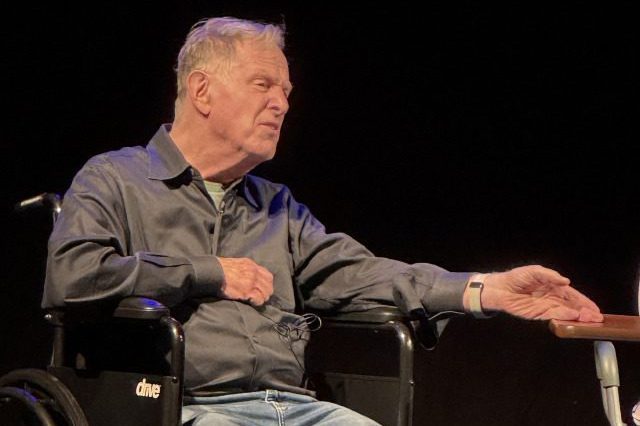
‘Aphasia’ begins with an act of listening.
In his introduction, playwright Marc Straus recalls taking a poetry workshop at the 92nd Street YMCA in 1991, where he began turning his patients’ experiences into poems. An elderly woman in a hospital and a teenager losing his hair during chemotherapy seemed to speak directly to him; he became the transcriber of their stories. That same approach shapes Aphasia, Straus’s intimate portrait of his mother, Dora, after a massive stroke paralyzed her right side and left her with aphasia. Though she could no longer speak, she could still understand. Onstage, Straus gives voice to her inner life while also speaking to her as her son.
Straus is an oncologist and the author of more than 40 scientific papers. In 2006, he left medical practice to devote himself to poetry. His work has appeared in leading literary journals, including The Kenyon Review and Ploughshares.
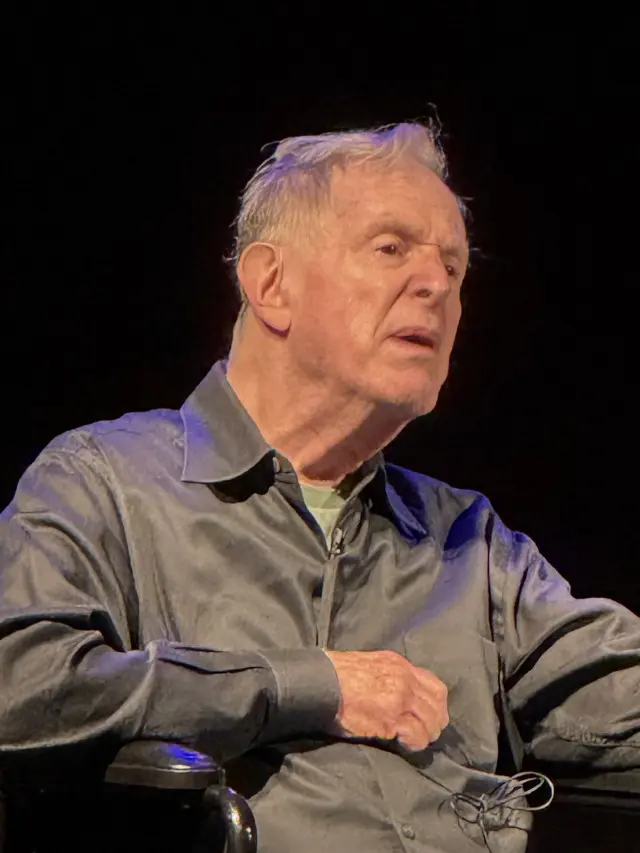
Photo: Mark Straus | Studio Theatre in Exile
In the performance, Straus also assumes the role of Dora. He has said that, while writing the play, he tried to get out of his mother’s way. The result is a dual perspective: Dora voices her private thoughts while her son addresses her from outside them. Together, these viewpoints create a lyrical, layered portrait of a woman confronting her past, her relationships, and, ultimately, her mortality. The story moves honestly among grief, anger, humor, and love.
The spare set consists of a desk with a pad and pencil, a hospital table, and a wheelchair. Straus moves among these pieces as he narrates Dora’s story. Music she loved—Mozart, Bach, Beethoven, and Liszt—provides the transitions.
Director Mara Mills brings more than 45 years of experience as a theatrical director, producer, and educator. She is known for developing and directing original works centered on community and women’s stories. With Jeremy Gratt, she is artistic director and co-founder of Studio Theater in Exile. Gratt, who serves as both production designer and producer, draws on decades of experience in set, sound, and lighting design.
Together, the artists restore a voice to a woman who has lost the ability to speak. Dora asks, “What is life when no one listens?” Over 85 minutes, Aphasia offers a moving answer: a life is sustained when someone listens closely enough to carry its story forward. As Liszt plays, Dora urges us to live “with the blaring of that brass horn.” By the final moments, Straus has drawn us fully into her world—not simply speaking for his mother, but ensuring that this remarkable woman is heard.
