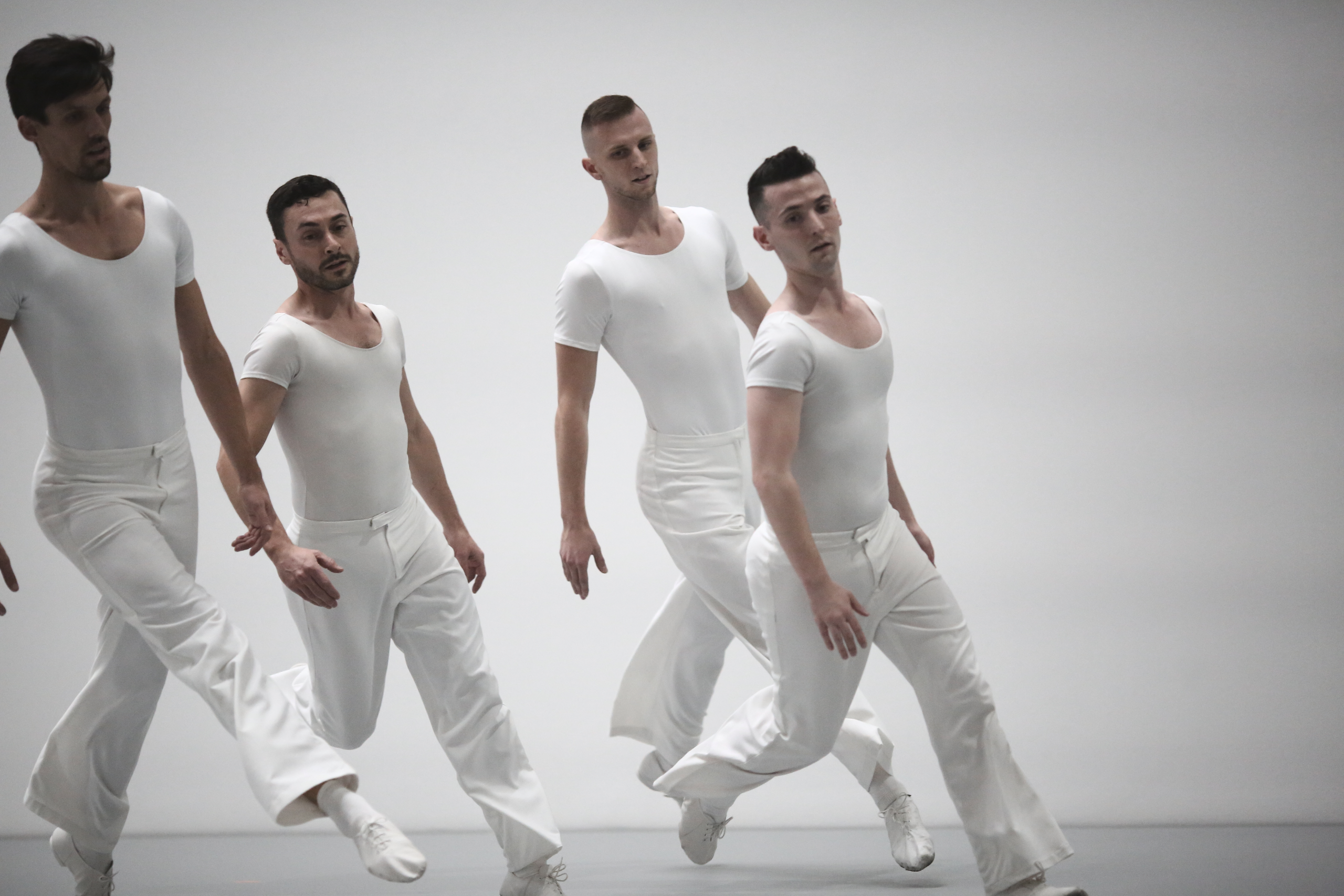
As part of the 2026 Dance Reflections by Van Cleef & Arpels Festival in New York, we had the opportunity to step inside Lucinda Childs’ repertory. On February 26 and 27, at the New York Center for Creativity & Dance, a professional workshop dedicated to Radial Courses offered a rare chance to embody the technical rigor of Childs’ minimalist language. Led by Kyle Gerry, currently dancing with the Lucinda Childs Dance Company, the three-hour session revealed that what appears spare from the audience demands extraordinary mental and physical calibration from within.
Lucinda Childs’ lineage traces back to the Judson Dance Theater, where alongside Yvonne Rainer, Steve Paxton, and Trisha Brown, she helped redefine postmodern dance. After 1968, she applied a deconstructionist logic to classical vocabulary, developing a minimalist language grounded in repetition and spatial clarity. Her later collaborations with Robert Wilson and Philip Glass expanded that rigor into operatic scale. Yet works like Radial Courses remain foundational, illustrating how restriction reveals depth.
Originally created in 1976 after the formation of the Lucinda Childs Dance Company, Radial Courses is choreographed in silence. Four dancers trace intersecting circular paths, dividing the space into shifting quadrants. The vocabulary is deceptively simple, walking and skipping, yet the structure is unyielding. Rhythm is internally counted and the timing is exact, with spatial awareness absolute.
We were four dancers of similar height, positioned along an imaginary clock. The warm-up was brief and efficient before quickly moving into lines, and then jumps around the dial of the clock, establishing directional clarity and pace. Even this initial exercise hinted at the architecture to come: movement was always relational, always tethered to geometry. Kyle emphasized pathway over performance. In Childs’ work, intention is embedded in adherence to score. We began with the walk phrase. Nine counts that were direct, even, and repeated. The simplicity was immediate, but so was the difficulty. Maintaining the same stride length, the same spatial relationship to the others, and the same internal tempo required intense concentration. Without music, the only markers were breath and the soft percussion of our own steps.
Once the walking pattern settled into our bodies, we practiced it repeatedly, tracing the circular pathway. A shift too far inward or outward altered the geometry of the quartet. Next came the skip phrase, which extended across three-quarters of the dial. The shift from walk to skip disrupted the internal rhythm we had established and precision became more precarious. The counts remained fixed, but the propulsion changed the weight of the movement. Only after isolating these elements did we begin to layer them into sections of the actual dance. In three hours, we reached only two sections. The length and complexity of the full work became apparent quickly. Radial Courses is often described as a “pretzel-puzzle,” and inside the structure, the description felt accurate. Losing one’s place often happened and resetting required mental recalibration. The choreography operates like a geometric engine while dancers followed circular paths with sudden yet precisely calculated changes in direction. Pairings of dancers appearing and dissolving. The repetition creates both order and disorientation. At moments, the intersecting pathways felt like the hands of a broken clock, advancing and stalling in abstract relation to time.
After the session ended, Kyle gathered us to watch archival footage of the work performed by the company. Seeing the full performance clarified what felt repetitive in the studio, as the intersecting circles and simple steps came together into a cohesive visual pattern. Inside Radial Courses, minimalism means discipline and sustaining structure without ornament. It means trusting that within a rigid frame, infinite variation exists. For three hours, we experienced that frame from within and understood why Childs’ silent rigor continues to resonate.
On March 14 and 15, Dance Reflections by Van Cleef & Arpels will present Early Works by Lucinda Childs at the Guggenheim New York in collaboration with Works & Process, revisiting seminal pieces from her Judson Dance Theater era through the early years of her company. Featuring works such as Pastime, Calico Mingling, Reclining Rondo, Katema, and Radial Courses, the program highlights the rhythm, geometry, and restrained movement vocabulary that laid the foundation for her later large-scale creations.
