
‘Uncut Gems’ producer Oscar Boyson’s directorial debut challenges viewers right out of the gate-a comedic approach to an extremely dark and disturbing subject matter, led by a pair of truly unlikable anti-heroes to boot.
While this may read as criticism to some, anyone who has seen the film will tell you this is clearly intentional. The discomfort the audience might feel watching the story play out was the intended effect, and it works extraordinarily well.
The lead character, or should I say our hero, Balthazar (Jaeden Martell) is a wealthy New York City teenager who lives with his divorced mother in a Manhattan high-rise. Balthazar (or ‘Balthy’, as he likes to be called,) has never wanted for anything. However, that private school education and personal life coach come at a cost that is not just monetary. Balthy’s privileged upbringing has left him arrogant, self-serving, and lacking empathy to an almost cartoonish degree. When we first meet Balthazar, he is holed up in his bedroom, sobbing profusely into his cellphone camera. Snot drips from his nose as he desperately tries to catch his breath, before he shuts off the camera, and by extension, the waterworks—his tears were fake. As he sets up another take, ring light and all, it becomes clear Balthy passes the time by shooting bizarre, performative videos of himself emoting on camera for internet clout.
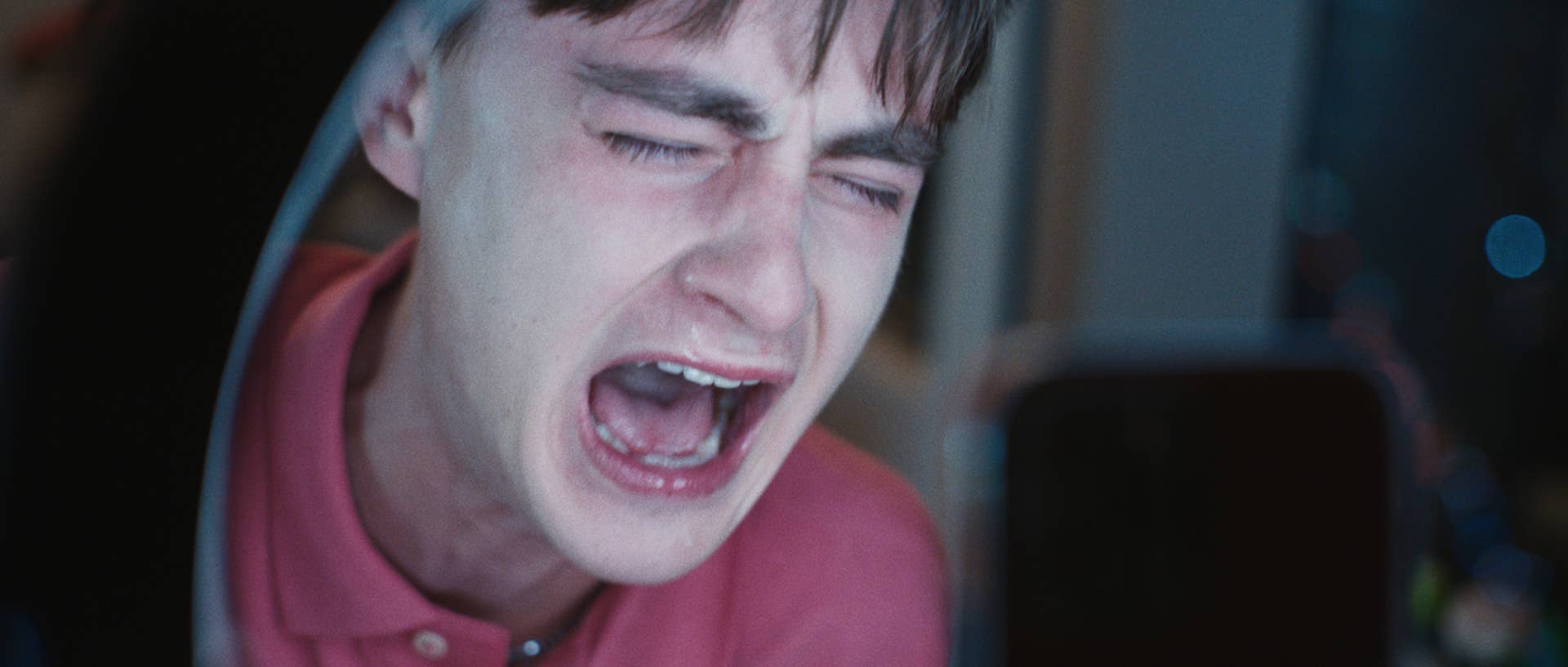
Photo Courtesy: WG Pictures
The following day, Balthy’s high school is visited by a consulting agency specializing in active shooter training protocol, a response to a high-profile shooting that had recently taken place at a school in Arkansas City. It is during this visit that Balthy develops a romantic interest in his classmate, Eleanor (Pippa Knowles) a staunch gun violence prevention activist, who is very vocal about her opinions on the subject (and her opinions on the visiting agency’s complete lack of tact,) Balthazar is quick to exploit this tragedy for his own gain, immediately posting another bizarre crying video as soon as he returns home from school, even going as far as to steal quotes from news articles about the recent shooting, words directly taken from survivors of the massacre (“We’re fighting for our lives, here!”)
This time however, not everyone falls for Balthy’s act. When he shows his video to his new crush, Eleanor immediately senses his lack of sincerity, and takes offense. All seems lost for Balthy, until a strange comment that appears under his video gets his attention. Username “deathdealer_16” mocks Balthy’s clearly fake tears, and boasts that he is going to carry out a mass shooting, just like the one in Arkansas City. Shortly thereafter, this stranger directly messages Balthazar with a link to CCTV footage of the Arkansas City shooting that had leaked online, which Balthy, for some reason, watches more than once. Rather than contact authorities when this stranger doubles down on his claim, Balthy books a plane ticket to rural Texas to find this young man and heroically stop this act of violence, so Eleanor will fall in love with him (Despite her, once she becomes privy to the plan, insistence that he just call the cops instead,)
After arriving in Fort Worth, a string of lies allows Balthy to seamlessly slip into the role of would-be school shooter Solomon’s (Asa Butterfield) new friend, and a strange kind of brotherhood develops between the emotional yet largely unfeeling Balthazar, and the dirt-poor, lonely, gun-obsessed Solomon. The film from here acts as a sort of twisted buddy comedy, and this is where the story is at its strongest. Solomon is Balthazar’s perfect foil, his daily life riddled with struggles Balthy cannot even begin to comprehend (due to most of them being financial,) and his personality in direct contrast-a psychopath pretending to be a crybaby, and a crybaby pretending to be a psychopath.
Where the film loses steam a bit is in its messaging. Our Hero, Balthazar presents a lot of interesting ideas, but doesn’t quite bring all of them over the finish line. Balthy’s crush Eleanor makes some interesting points at the beginning of the film regarding the consulting agency seemingly profiting off of mass shootings, and our fears surrounding them. What seems like a classic thematic statement, especially considering our protagonist, and how he goes on to exploit the same shooting for personal gain, goes completely unexplored. Furthermore, Balthy’s tearful rants are a supposed criticism of current youth culture, and how so much of what you see online today is virtue signaling, even so-called heartfelt activism often a performance. While this is not an unfounded angle by which to explore this story, especially considering how flippantly American culture treats the gun violence epidemic, it is difficult to divorce this fictional story from the real-life events that it parallels. It brings to mind real-life examples of online activism, particularly in the wake of mass shootings, that are growing increasingly common in the age of social media. As a result, Balthy’s fake tears may work for some, but others might not take away from the story what the filmmakers intended there.

Photo Courtesy: WG Pictures
All in all, Our Hero, Balthazar is a strong directorial debut, only elevated by stellar performances from its incredibly talented cast. Balthazar doesn’t answer every single one of our questions, and leaves many things up to interpretation, and while that might not work for some, the film knows exactly what it is, and who it is for—a dark comedy, showcasing bleak characters in a bleak situation, who were doomed to fail from the jump. Few movies have ever left me feeling this hopeless, but one could argue, maybe more films should leave us feeling distraught, angry, and upset. Especially given the subject matter, maybe we should shed some real tears over it, for once.
“Our Hero, Balthazar” is now playing.
