You can’t travel to any corner of the internet without seeing a crying video.
Maybe it’s an influencer apology, a sob story or a breakup announcement. In the case of the title character from “Our Hero, Balthazar,” he wails on Instagram about the tragedies of recent school shootings. But unlike Balthazar, or Balthy’s, social media audience, we know he’s really faking it.
In this directorial debut from Oscar Boyson, producer of films like the Safdie brothers’ “Uncut Gems” and “Good Time,” we see just how quickly performative outcries can spiral. Balthy (played by a chillingly erratic Jaeden Martell) spends his free time in front of an iPhone tripod and ring light in his penthouse Manhattan apartment, taking up gun control activism as a hobby to impress his classmate Eleanor (a confident, outspoken Pippa Knowles) after she expresses her discontent with the school’s performative active shooter drills.
After regurgitating lines like “I’m fighting for my life here” and squeezing out a few tears, Balthy gets an Instagram DM from a burner account belonging to a Texan kid named Solomon (a hilariously unrecognizable Asa Butterfield) threatening to shoot up his local school. Some catfishing using AI voice enhancement ensues, and Balthy decides the best way to win over his crush — sorry, stop the shooting — is to march down to Texas himself and bring Solomon to the light.
But “Our Hero, Balthazar” isn’t really a buddy-comedy, even when the two are gallivanting around Solomon’s trailer park and declaring their friendship to Solomon’s ex coworkers at the gas station. Instead, the film portrays two extremes of toxic masculinity within today’s culture, with both of which leading to deadly consequences. Solomon embodies the school shooter archetype we’ve all probably visualized at some point but without the follow-through: he’s really just a a broke loaner, ignored by his father who’s works for a testosterone supplement pyramid scheme.
A bruised ego leaves Solomon to send menacing DMs, drive around in a busted convertible and hoard the gun paraphernalia he’s inherited. Butterfield impressively disappears into this role with a thick Southern twang and thicker teen angst, eliciting cringes as he’s whining to his grandma and sympathy when seeking paternal validation.
Equally as flawed is Balthy, an off-putting latchkey kid who’s learned he can whine his way into anything. Martell plays up his cocky savior complex, shifting from apathetic stoicism at real-life tragedy into visceral weeping once a camera’s rolling. For both kids, everything’s a performance — they’re deeply alone, deeply troubled teenagers who’d rather hide behind their screens than confront their social ineptness. This vulnerability is what entices the pair to guns in the first place: they both stand to capitalize off of the intimidation and violence that these weapons symbolize.
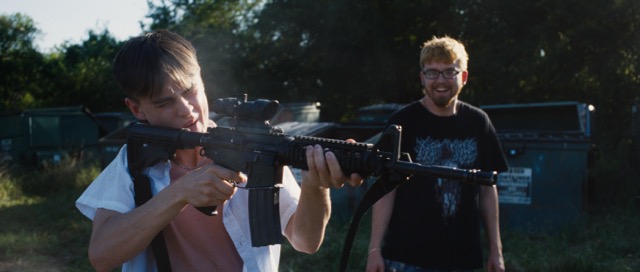
Much of “Our Hero, Balthazar” takes Balthy and Solomon to their most absurd, whether it’s in a makeshift shooting range or a sleazy bar where Balthy word-vomits about his mostly-dramatized fears of Solomon’s behavior. Boyson and Ricky Camilleri’s writing tailor-makes the film for audiences equally as online as the pair, satirizing the volatile social media landscape that has politicians on Instagram Reels calling for gun reform right after CCTV footage of mass shootings. And while this may seem inaccessible for those who don’t frequent an explore feed, you’ll find the best way to meet Balthy and Solomon is where they’re at: the internet.
And much like the infinite stream of content online, this film doesn’t have a clean end. Its prodding into the violent nature of male resentment and how desensitized young people are to tragedies isn’t gratified by an overt thesis, rather a buildup of self-created tensions at the hands of insecurity, opportunity and accessible audiences. The last thing you see is Balthy crying for another camera, and once again, he’s faking it.
“Our Hero, Balthazar” is now playing in New York City and Los Angeles theaters.
(Feature photo courtesy of Picturehouse WG Pictures)
