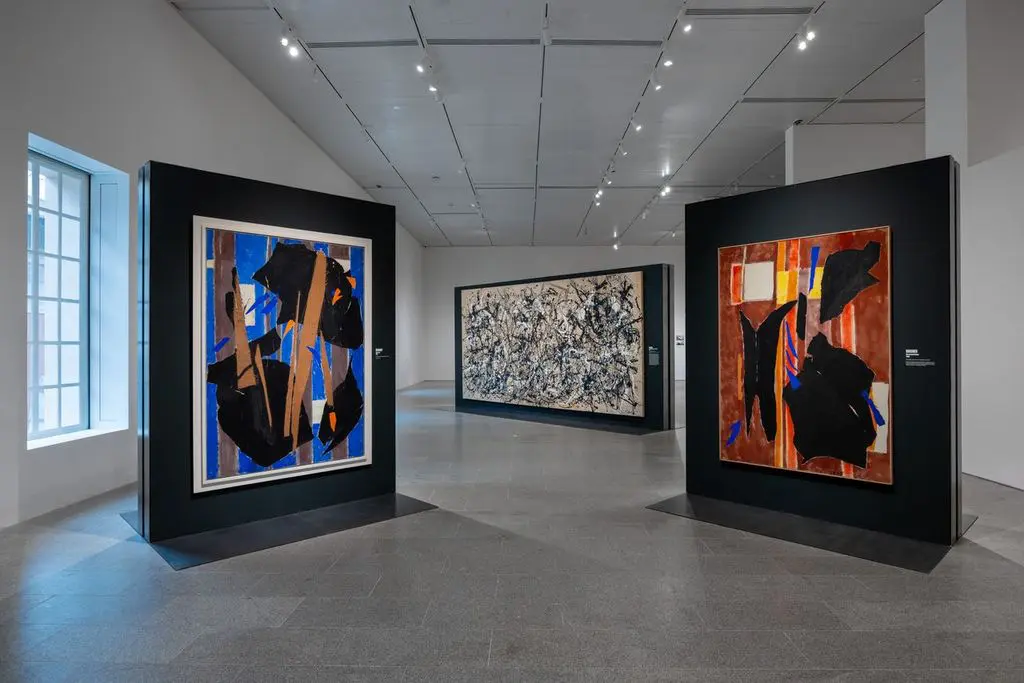
Why did Jackson Pollock become a global icon while Lee Krasner—an equally consequential innovator—remained in his shadow?
The Metropolitan Museum’s Krasner and Pollock: Past Continuous brings their work into direct conversation, presenting both artists as “key innovators in the rupture known as Abstract Expressionism.” Across 120 works, the exhibition asks viewers to reconsider how talent, publicity, circumstance, and gender shaped their sharply different legacies.
The exhibition traces the artists’ parallel lives and converging visions. Pollock, raised in the American West, and Krasner, the Brooklyn-born daughter of Ukrainian Jewish immigrants, brought distinct cultural inheritances to Abstract Expressionism, a movement that used abstraction to convey inner experience. Pollock’s breakthrough was his “drip” technique: he placed unprimed canvas on the floor and poured, dribbled, or flung paint from above, eliminating a single focal point and immersing viewers in overlapping webs of line. Krasner, by contrast, resisted settling into one signature style. As she explained, “I go back on myself, into my own work, destroy it in some way . . . and come up with a new thing.” Her relentless self-critique left a relatively small but remarkably diverse body of work, marked by sustained explorations of abstraction, color, and nature.
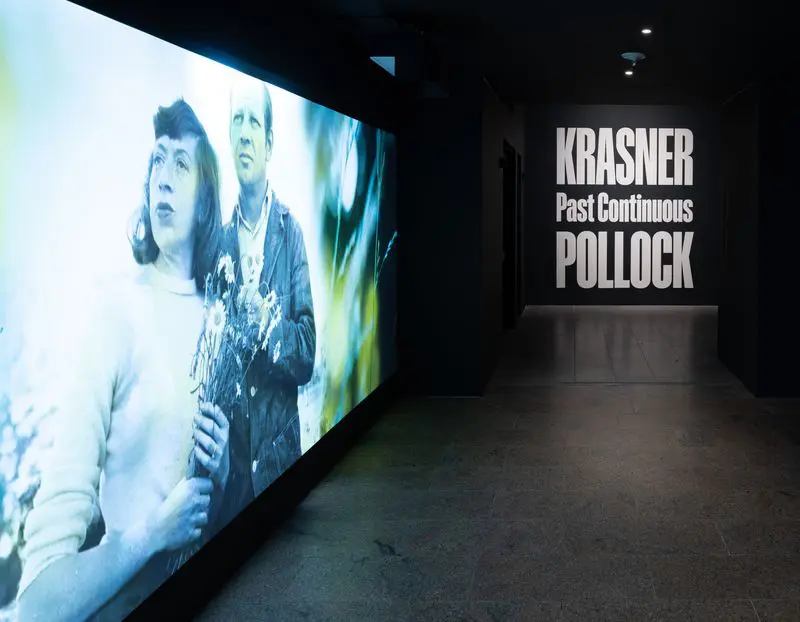
Photo by Anna-Marie Kellen. Courtesy of the Met
This is the first major exhibition in more than 20 years devoted to either artist, and it spans the full arc of both careers: the years before they met, their life together, and Krasner’s work after Pollock’s death. By placing their art side by side, Krasner and Pollock: Past Continuous presents them not as master and supporting figure, but as artistic equals who expanded the possibilities of abstraction.
Throughout the exhibition, Pollock’s varied influences come into focus: Picasso, Surrealism and the subconscious, the European avant-garde, Mexican muralism, and Indigenous American symbols. His sketchbook drawings reveal ideas that later became central to his mature work, while the exhibition follows his development from traditional Regionalism to revolutionary action painting. Seen across two decades, his evolving technique reflects both emotional struggle and sustained artistic experimentation, clarifying why he remains one of the twentieth century’s most influential artists.
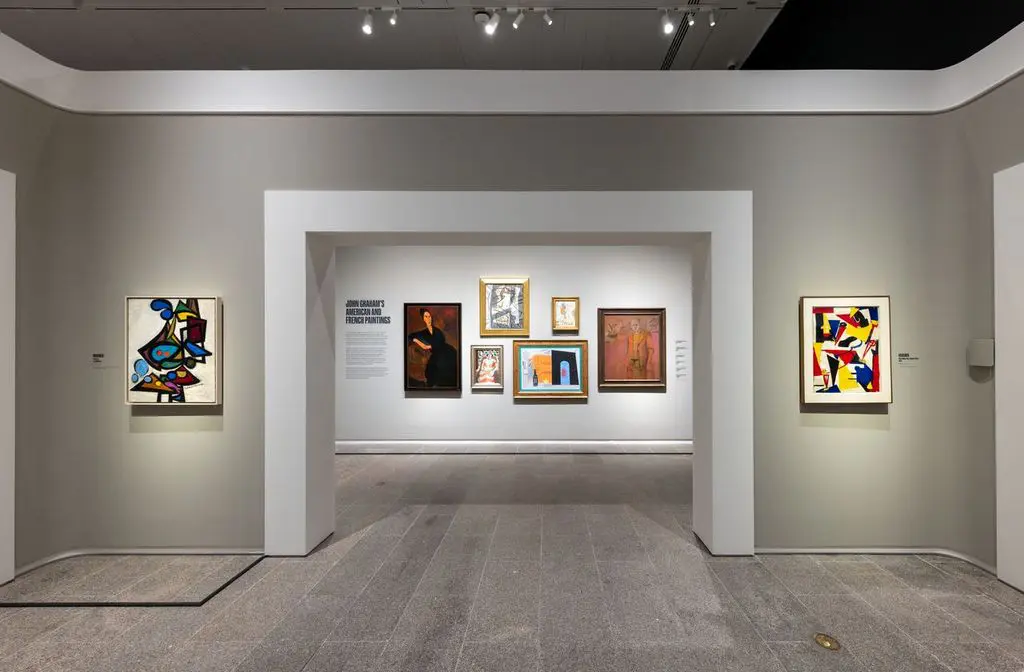
Photo Credit: The Pollock-Krasner Foundation/Artists Rights Society (ARS), Courtesy of The MET
Krasner’s achievement was equally formidable. A driving force in twentieth-century American art, she spent more than 50 years experimenting with portraiture, Cubism, collage, assemblage, and large-scale abstraction. Although she was already an established artist when she met Pollock, their relationship increasingly obscured her career. As Krasner and Pollock: Past Continuous demonstrates, Krasner understood the era’s gendered expectations and deliberately presented herself as Pollock’s domestic support even as she produced one ambitious series after another. Much of that work went unrecognized. As the exhibition guide observes, “Pollock’s life’s work had secured his legacy, while the nearly three decades that Krasner survived him marked some of the most transformative years of her career.”
Krasner and Pollock: Past Continuous does more than explain why Pollock’s drip paintings revolutionized modern art and helped establish American painting as an international force. It also restores Krasner to her rightful place as a pioneering Abstract Expressionist whose restless experimentation matched Pollock’s ambition. By presenting their work together, the exhibition replaces a familiar story of one celebrated genius and one overlooked spouse with a fuller account of two major artists—and shows how cultural power can determine whose innovation becomes history.
