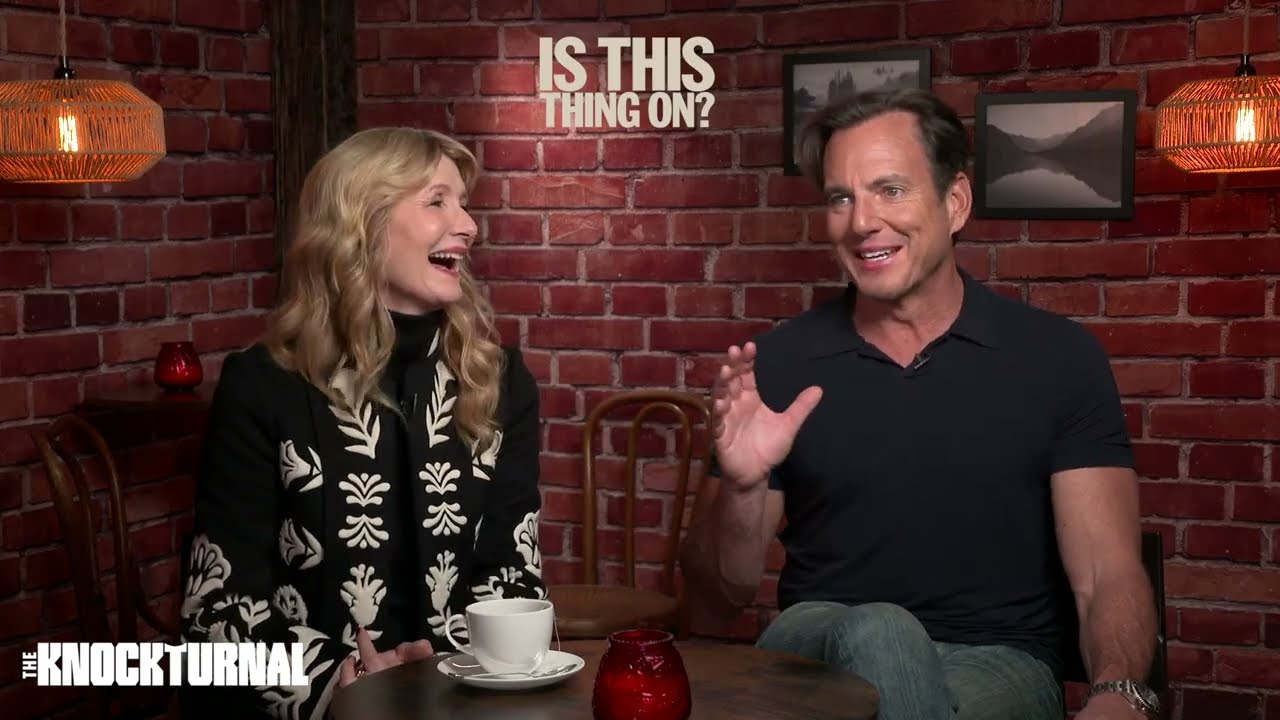
In Is This Thing On?, comedy isn’t just the punchline—it’s the entry point. Beneath the sharp dialogue and laugh out loud moments is a film quietly preoccupied with emotional honesty, miscommunication, and the ways we stall our own growth inside relationships. That tension between humor and heart is exactly what drew Laura Dern and Will Arnett to the project—and what stayed with them long after filming wrapped.
For Arnett, comedy becomes a kind of emotional crowbar. His character may stumble, deflect, and crack jokes at the wrong moments, but those instincts mirror how many people navigate discomfort in real life. Reflecting on whether the film changed how he views relationships, Arnett pointed to the unexpected clarity that comes from working through friction rather than avoiding it. “When you’re working through difficult stuff on set, you end up having these conversations where you go, ‘oh, this is a way to talk through and work through stuff,’” Arnett said. That idea—that humor can open the door to conversations we might otherwise dodge, sits at the core of the film. Is This Thing On? understands comedy not as an escape hatch, but as a Trojan horse. Laughter lowers defenses, making room for uncomfortable truths about ego, emotional laziness, and the stories we tell ourselves to avoid change.
Dern’s performance anchors that emotional excavation. Where Arnett’s character often masks discomfort with humor, Dern’s grapples with the quieter, more insidious danger of being emotionally frozen—by a partner, or by herself. When asked about the film’s take on relationships where one person refuses to see the other as evolving, Dern offered a pointed reframing. “I think it’s something we do to ourselves, not only something our partner does to us,” she said. It’s a line that lands with particular force because it refuses to place blame neatly in one direction. The film suggests that while partners can limit us, we also participate—sometimes unconsciously—in our own stagnation. We accept outdated versions of ourselves because they’re familiar. We perform roles that once worked, even when they no longer fit.
That self-recognition is part of what makes the film linger. Rather than presenting its characters as cautionary tales, Is This Thing On? treats them as mirrors—slightly distorted, often funny, but uncomfortably recognizable. Both Dern and Arnett spoke about discovering things in their characters that felt closer to home than expected. “I’m endlessly moved by considering things that are in the movie,” Dern said. “The beauty of making this movie is, I see things in you [Will Arnett] or myself, or in the other characters that I didn’t even realize at the time that are still kind of teaching me about communication and relationships.”
That sense of delayed revelation that the film continues to teach even after the cameras stop rolling, speaks to its emotional intelligence. The characters’ messiness isn’t something to be fixed by the final act; it’s something to be acknowledged, examined, and lived with. Of course, not all lessons arrive quietly. Arnett also recalled the sheer chaos of sharing scenes with Bradley Cooper, whose character’s unpredictable, unhinged energy made it nearly impossible to keep a straight face. Those moments of barely contained laughter add to the film’s tonal balancing act, underscoring how absurdity and vulnerability often coexist. Life’s most difficult reckonings, the film suggests, are rarely solemn from start to finish—they’re awkward, funny, and emotionally disarming.
That balance is what ultimately makes Is This Thing On? resonate. It doesn’t ask its audience to choose between laughter and introspection. Instead, it argues that the two are inseparable—that sometimes the only way to say the hard things is to laugh first. By the end, the film leaves viewers with a deceptively simple question: are we listening, evolving, and truly seeing the people we love—or are we clinging to versions of them that feel safer?
