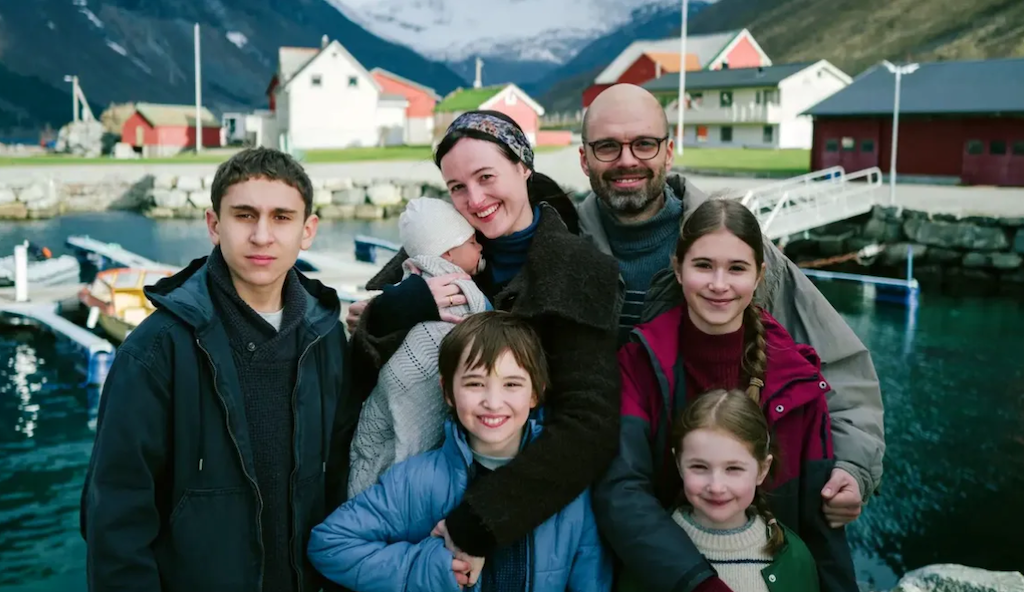
Fjord is a beautifully acted, emotionally grounded drama that trusts its audience with a complicated story and an unconventional ending, making it a film that lingers long after the credits.
I was invited to see Fjord at the New York Film Festival, and it was immediately the kind of film that persists long after the credits roll. Cristian Mungiu’s Palme d’Or-winning drama follows a Romanian family settling into a small Norwegian community, where a dispute over parenting gradually becomes something much larger about faith, family, cultural identity, and the institutions that are meant to protect us. The way the story stayed grounded even as its circumstances become increasingly intense was impressive; there is a naturalism to the filmmaking that makes every conversation and confrontation feel deeply human.
The performances are the heart of Fjord, particularly Sebastian Stan and Renate Reinsve, the latter whose film Sentimental Value from last year absolutely blew me away. They give remarkably restrained performances as parents trying to hold their family together. Stan in particular disappears so completely into the role that it became easy to forget this was an actor previously seen in so many superhero films. Reinsve brings an equally impressive emotional weight to the quieter moments, and together they create a relationship that feels lived-in rather than constructed for the sake of the story. The film’s ensemble, including its young performers, adds to that sense of authenticity, allowing the emotional stakes to build without ever feeling artificially heightened.
What stuck most was the film’s willingness to let its emotional questions remain complicated. Fjord does not offer the kind of traditional happy ending that neatly resolves everything the audience has spent two and a half hours watching unfold; instead, it leaves you sitting with the consequences of what has happened and the realization that there may not be a satisfying answer to every conflict. I found that incredibly effective, because the film is ultimately less interested in telling the audience what to think than in making us examine the assumptions we brought into the theater with us. That ambiguity, combined with Mungiu’s patient direction and the stark Norwegian setting, gives the film an emotional weight that continues to grow after the story itself has ended.
Fjord is one of those movies that feels worth seeing precisely because it trusts its audience to engage with it rather than handing them an easy conclusion. It is beautifully acted, emotionally grounded, and filled with the kind of uncomfortable human moments that can make a story feel much more real than a conventional drama. It leaves you thinking about the characters and their choices rather than simply moving on to whatever comes next, which is always a good sign for me. Given the opportunity to see Fjord, I would absolutely urge anyone to watch it—it is a beautiful drama worth experiencing and, perhaps even more importantly, worth continuing to think about afterward.
