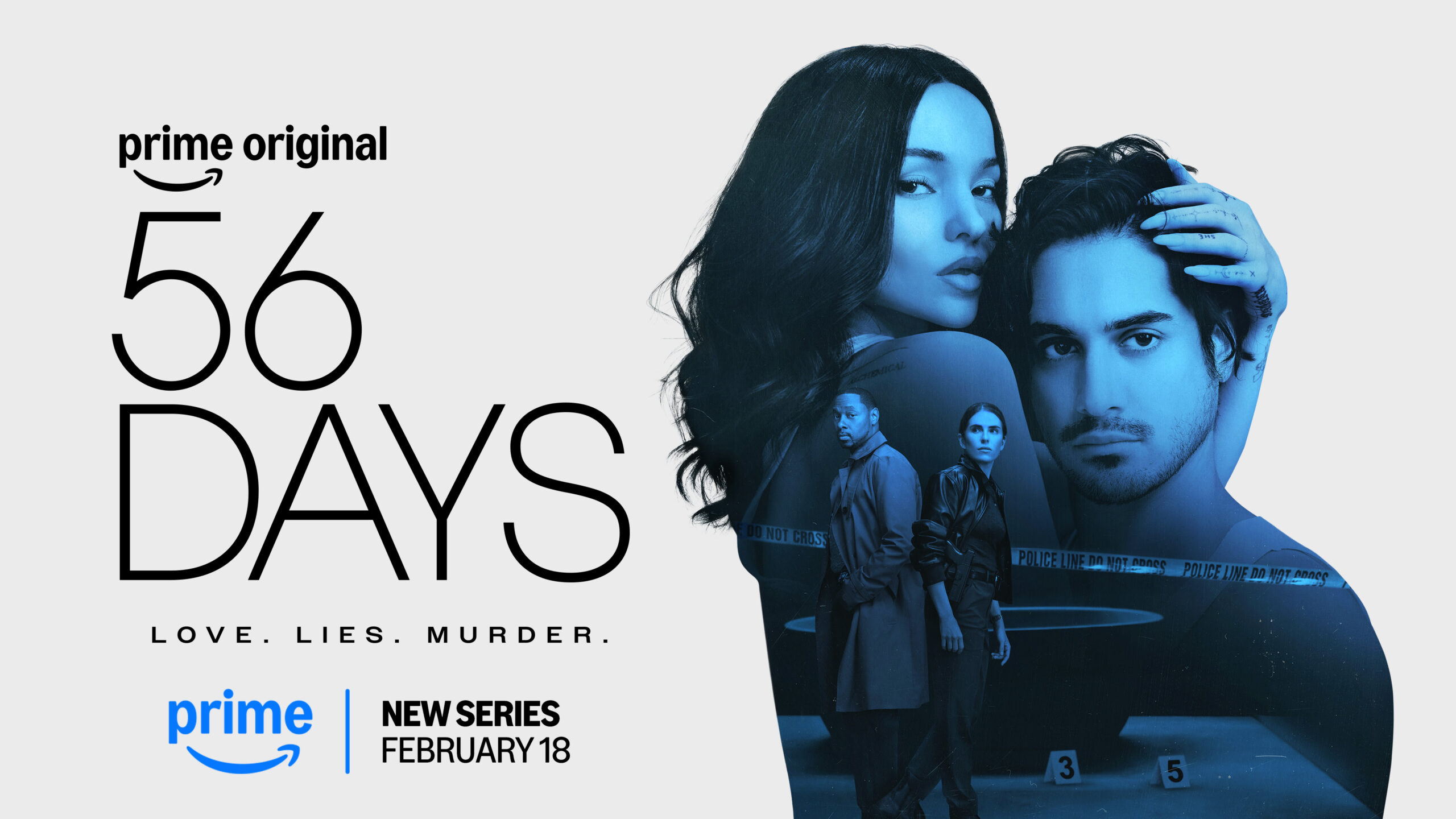
Amazon Prime Video’s 56 Days, Based on Catherine Ryan Howard’s novel and developed by Lisa Zwerling and Karyn Usher, has a slick, pulpy hook and just enough twisted energy to keep you watching.
It wants to be dangerous. Sometimes it even flirts with that danger. But more often than not, it feels like it’s playing dress-up in the erotic thriller genre rather than fully committing to it. However, there are things that I liked about the series.
The premise is undeniably strong. What begins as a chance encounter between two strangers, Oliver Kennedy (Avan Jogia) and Ciara Wyse (Dove Cameron), spirals into a relationship defined by secrecy, manipulation, and escalating risk. From the start, Oliver radiates unease. He laughs during a space documentary when a man dies in an explosion. He stares too long. A random woman warns Ciara to stay away from him. These are not subtle red flags. The intrigue lies in why Ciara ignores them so completely.
When the show finally reveals the reasoning behind her selective blindness, it delivers one of its more satisfying twists. There’s a sly cleverness in how the series reframes what we’ve been watching. For a moment, 56 Days sharpens into something deliciously perverse. It suggests a story about two people who may be more evenly matched in deception than we initially assumed.
That push and pull between Oliver and Ciara is the show’s strongest asset. Their relationship becomes increasingly chaotic, veering into territory that’s sometimes implausible but rarely boring. The series relocates the story from COVID-era Dublin in the novel to present-day Boston, stripping away the lockdown claustrophobia that might have intensified the tension. In its place, we get a glossy, contemporary backdrop that looks polished but feels emotionally muted.
Structurally, the show unfolds across two timelines. The “past” charts the days leading up to the titular 56th day. The “Today” timeline follows homicide detectives Karl Connolly (Dorian Missick) and Lee Reardon (Karla Souza) as they investigate a murder. The device is straightforward. An object discovered in the present prompts a flashback explaining how it got there. A needle in the past reappears in an evidence bag in the present. The structure keeps the narrative clear, but clarity is not the same as suspense.
Instead of escalating tension, the back-and-forth often feels procedural. It fills in blanks rather than tightening the noose. You’re rarely ahead of the characters, but you’re also rarely breathless. The inevitable conclusion feels less like a devastating reveal and more like a box being methodically checked.
As an erotic thriller, 56 Days struggles even more. Yes, there is sex. Quite a bit of it. But hot sex scenes alone are not enough to tell a story. Eroticism in this genre should deepen character, expose vulnerability, and shift power dynamics. It should feel charged with danger. Here, the encounters are filmed plainly, almost clinically. They exist, but they rarely generate the kind of psychosexual tension that lingers.
There’s a difference between nudity and sensuality, between bodies moving and desire driving the plot. I do not mind the sex scenes in 56 Days as it signals that the relationship is intense, but it doesn’t make us feel that intensity. Without emotional stakes or a palpable sense of risk, even the steamiest scene becomes decorative.
The series is also surprisingly incurious about the logistics of its own twists. Characters possess specialized skills without much explanation. Financial realities are brushed aside. These gaps may not derail the story entirely, but they contribute to a sense that the world exists only when the plot needs it to. For a thriller built on deception and manipulation, a little more grounding would have gone a long way.
Performance-wise, the cast does solid work within the material they’re given. Avan Jogia leans into Oliver’s ambiguity, oscillating between charming and unsettling. Dove Cameron, though, is the more compelling presence. She has a cool, feline watchfulness that hints at a sharper, more dangerous version of this character than the script always allows. There are moments when she seems ready to pounce, and in those flashes, the show almost becomes the erotic thriller it wants to be.
That’s the lingering frustration with 56 Days. The ingredients are there. A twisty premise. Two attractive leads with chemistry. A structure designed to tease out a murder mystery. At times, the series gestures toward something audacious and darkly funny. It hints at lovers circling each other like predators, equal parts seduction and threat.
But it rarely pushes far enough. The aesthetics are bland where they could be bold. The sex is explicit but not electric. The suspense is competent but not suffocating. Instead of leaning into its own madness, the show smooths out its roughest edges.
Still, there’s a certain glossy watchability to 56 Days. The twists, even when predictable, are entertaining. The central dynamic remains compelling enough to carry you through slower stretches. It may not redefine the erotic thriller or leave you rattled, but it offers a sleek, bingeable mystery with just enough bite to satisfy viewers in search of escapist intrigue.
