
There are shows that arrive with hype.
And then there are shows that arrive with expectation.
Anything created by Vince Gilligan automatically falls into the second category.
After redefining modern television with Breaking Bad and Better Call Saul, Gilligan has built a reputation that is almost impossible to separate from the work itself. His name carries a certain promise. Precision. Control. Character-first storytelling. A world where tone can shift on a dime without ever feeling like it’s losing its grip.
So when Pluribus, his latest series for Apple TV+, began to take shape, there was a natural question hanging over it.
What does a creator like that do next?
From everything I’ve seen and heard, the answer is simple.
He swings.
And then he swings again.
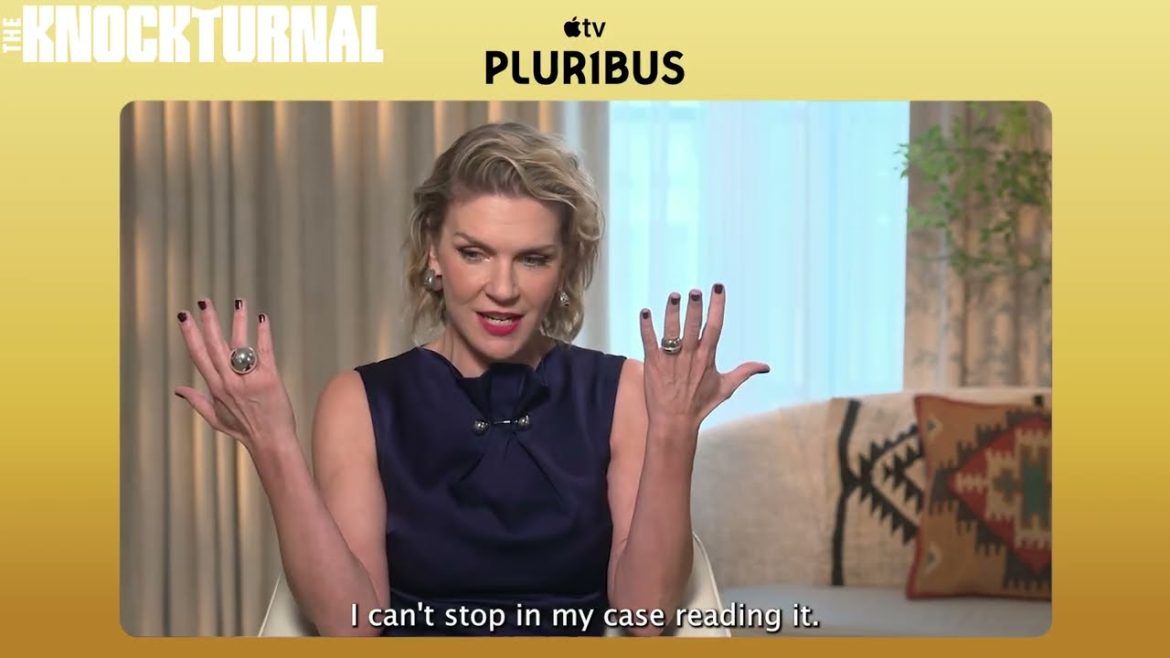
I sat down with Rhea Seehorn, who leads the series, to talk about stepping into a project that feels intentionally unpredictable, tonally ambitious, and deeply rooted in character, even as it moves through genres that don’t usually sit comfortably together.
By the end of the conversation, one thing became very clear.
This is not Vince Gilligan repeating himself.
This is him pushing further.
A Project You Don’t Say No To
Before getting into anything about tone or storytelling, I asked Seehorn how she came onto the project and what initially drew her to it.
Her answer was immediate.
There wasn’t really a decision to make.
When Gilligan reached out, she said yes before even reading the script. He hadn’t told her what the show was about yet. He wasn’t ready to send the material. None of that mattered. The trust was already there.
And that says a lot.
Because in an industry where decisions are often calculated, strategic, and cautious, that kind of instinctive yes only happens when there is a deep creative confidence in the person leading the project.
When she finally did read the script, what struck her most was not clarity, but momentum.
She described the experience of reading it as something you can’t quite categorize while you’re inside it. It keeps shifting. You think you understand what kind of story it is, and then it moves. It starts to feel like one genre, then pulls away from it. It builds tension, then pivots into something unexpectedly funny. It asks big questions, then refuses to answer them in a straightforward way.
The word she kept coming back to, in essence, was unpredictability.
Not in a chaotic sense.
In a deliberate one.
A Show That Refuses to Sit Still
One of the most interesting things about Pluribus, based on how Seehorn described it, is that it does not allow the audience to get comfortable.
There are familiar entry points. You might recognize the language of suspense. You might think you’re watching something rooted in horror or science fiction. You might start to build expectations around where the story is heading.
And then it shifts.
That kind of storytelling is difficult to pull off, because it requires absolute control underneath the surface. If the tone slips even slightly, the whole thing can feel disjointed instead of intentional.
But that is exactly where Gilligan thrives.
Seehorn talked about the way the show moves between tension and humor, sometimes within the same sequence. One moment, her character is going through something deeply uncomfortable or emotionally raw. The next, there is a moment of dark humor rooted in behavior, not punchlines. And then it swings back again.
That elasticity is part of what makes the experience engaging.
It demands attention.
It assumes the audience is paying close enough attention to keep up.
And more importantly, it trusts them to.
Vince Gilligan’s Approach: Character First, Always
At a certain point, the conversation naturally turned toward Gilligan himself.
Why his work feels so watchable.
Why his shows hold tension so well.
Why his tone, even when it shifts, never feels accidental.
Seehorn’s answer cut straight to the foundation.
It starts with character.
Not concept. Not genre. Not spectacle.
Character.
She explained that even when Gilligan is exploring larger ideas or unusual narrative structures, he builds everything outward from the people inside the story. What they want. What is in their way. How they behave under pressure.
That may sound simple, but it is actually what allows everything else to work.
Because once the character is grounded, you can move them through almost any situation, and the audience will follow.
That is what gives Pluribus its freedom.
It can move between tones, because the core is stable.
Collaboration Without Fear
One of the most revealing parts of the conversation had nothing to do with plot or genre.
It was about environment.
Seehorn described Gilligan as someone who creates a space where actors feel safe to take risks. That may sound like a cliché, but the way she explained it made it feel very real.
She talked about how, over time, working with him helped build her confidence to bring ideas into the room. Not just to execute what’s on the page, but to actively explore it. To try something. To push a moment in a different direction. To experiment with tone.
And crucially, to not be afraid of getting it wrong.
That kind of environment is rare.
A lot of actors, she pointed out, carry a quiet fear into the room. The fear of failing. The fear of being judged. The fear of taking a swing that doesn’t land. And in some environments, that fear gets reinforced.
Here, it’s the opposite.
If something works, it stays. If it doesn’t, someone else tries something. The process becomes collaborative rather than performative.
That freedom matters, especially on a show like Pluribus, where tone is constantly shifting and there is no single “correct” way to play a scene.
You have to feel your way through it.
And that only works if the environment allows you to.
A Decade of Creative Trust
At one point, Seehorn mentioned something almost in passing that ended up reframing the entire conversation.
She realized that she and Gilligan have effectively been working together for close to a decade.
That kind of creative relationship is not common.
And it shows.
There is a shorthand there now. An understanding of rhythm, of tone, of how far to push something, of when to pull it back. That kind of trust doesn’t just make the work easier. It makes it deeper.
Because instead of figuring out how to collaborate, you are building on something that already exists.
That is part of what gives Pluribus its confidence.
It is not a first experiment.
It is an evolution.
Why This Feels Different
From the outside, it would be easy to look at Pluribus and try to categorize it through Gilligan’s previous work.
But that misses the point.
This does not sound like a continuation of anything.
It sounds like a departure.
A show that is willing to take tonal risks. A show that is less interested in staying within a single lane and more interested in seeing how far it can stretch without breaking. A show that leans into discomfort, humor, tension, and ambiguity all at once.
And importantly, a show that still trusts the audience to come along for that ride.
That trust is everything.
Because it creates a different kind of viewing experience. One where you are not being told how to feel in every moment. One where you are allowed to sit in uncertainty. One where you are not handed easy answers.
That is harder.
But it is also more rewarding.
Final Thoughts
By the end of my conversation with Rhea Seehorn, what stayed with me most was not just excitement about the show itself.
It was the clarity of the process behind it.
A creator who builds from character outward.
An actor who is willing to step into something without fully knowing what it is, simply because she trusts the person guiding it.
A set environment that encourages risk instead of punishing it.
And a story that refuses to stay in one place for too long.
That combination is rare.
And if Pluribus delivers on what it sounds like it’s aiming for, something unpredictable, tonally ambitious, and fully committed to the intelligence of its audience, then it won’t just be another entry in Vince Gilligan’s career.
It will be a continuation of what he does best.
Taking control of chaos.
And making it feel intentional.