
At first glance, Slave Play takes place on a plantation, confined to the framework of slavery as we know it.
The set is designed with an array of mirrors that fit the height and width of the stage, reflecting a plantation from the portrait behind the audience. In the midst of the plantation are the many faces from the audience—projecting onstage, viewers from the orchestra to mezzanine seats. We feel everything, and in a way, we’re all apart of the conflict.
The set changes are minimal throughout the two-hour run, yet what remains is the huge signboard of the following: “nuh-body-touch-me-you-nuh-righteous,” —a lyric from Rihanna’s song, “Work.”
Aside from Kaneisha’s opening scene, where she’s twerking to this “theme song,” Slave Play is depicting the well-rehearsed textbook definition of slavery, but soon enough, we find that there’s a double meaning.
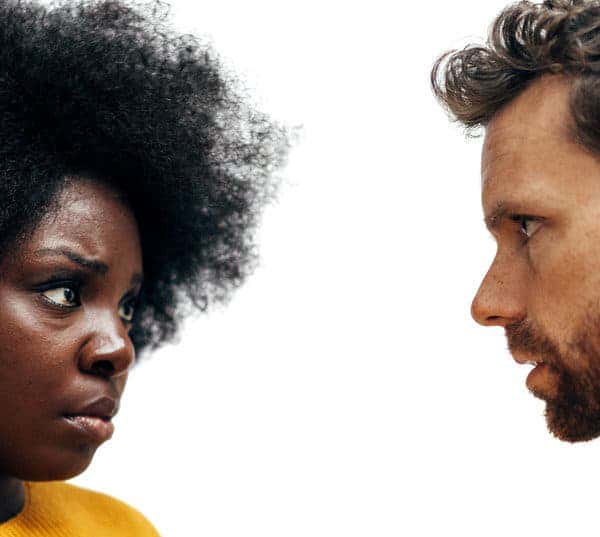
Slave Play
There are three sexual vignettes that unfold from the start of the story.
First, there’s a slave, Kaneisha (Joaquina Kalukango) who is caught—by her white slave master, Jim (Paul Alexander Nolan)—twerking (and cleaning) to “Work” by Rihanna. Jim is aroused by Kaneisha’s movements and so begins a bit of foreplay after he commands her to eat cantaloupe off the floor. Between the seemingly unnatural debate of what’s fair and not fair in their power dynamic, the two continue on in sexual encounters while Jim is at psychological warfare with his superiority over Kaneisha. Despite his internal struggle, he is leading Kaneisha with control. She begs him to refer to her as “nasty negress,” and his discomfort toward the request is made known through their dialogue.
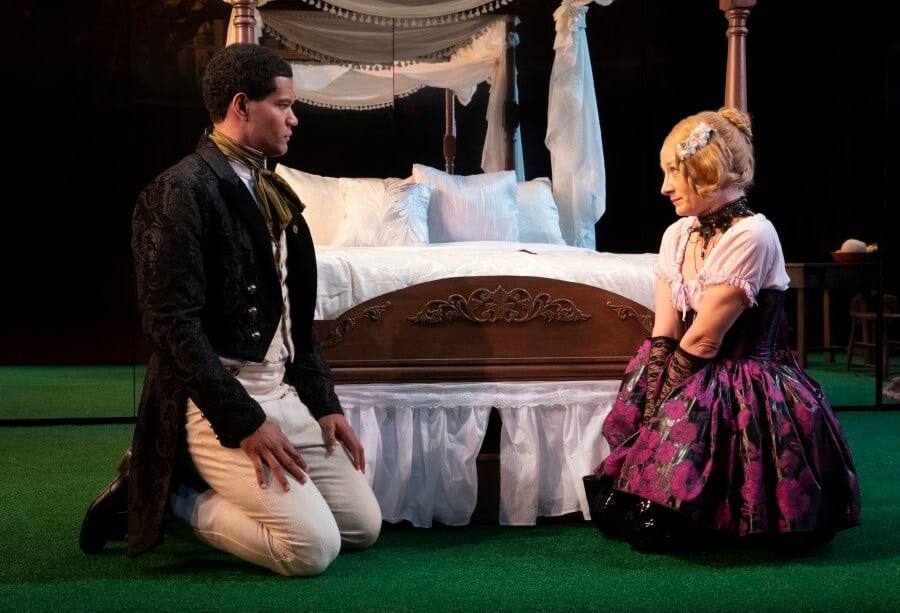
The second vignette is Alana (Annie McNamara), a white plantation mistress and Phillip (Sullivan Jones), her black house slave. Alana’s one fantasy is to be in control of Phillip, so after he inadvertently seduces her with the stokes of his violin, Alana pulls out a black dildo and begins to penetrate him. While Phillip becomes submissive, he can’t immediately decide whether he likes the feeling of being penetrated or not. For Alana, the fantasy is right up her alley, or in this case, up her petticoat. She feels at peace with dominating the partnership.
Thirdly, we’re taken to the last vignette where Dustin (James Cusati-Moyer), a white servant, is barely wheeling in a heap of cotton from the fields. Gary (Ato Blankson-Wood) is overseeing his work. Between their quarrels of power, they engage in a well-choreographed fight that intensifies as the sexual tension builds, ending in a war of kisses and with Dustin literally at Gary’s foot. Dustin caresses and passionately licks Gary’s black boot until Gary reaches his peak. The beat ends in Gary crying hysterically and all members of each vignette appear onstage mid-scene.
Suddenly, the world surrounding this trio shatters. When the play’s opening scene begins with twerking and Rihanna playing in the background, a plot twist is anticipated, and with that expectation, no sooner do we hear Jim scream out, “Starbucks” just seconds before Kaneisha reaches her peak.
The lights drastically shine on the dark world of slavery that is embedded quite close to the surface of Kaneisha, Jim, Alana, Phillip, Gary, and Dustin, who turn out to be present-day interracial couples undergoing sexual performance therapy.

Slave Play
Upon this revelation, the two therapists leading the discussion—Teá (Chalia La Tour) and Patricia (Irene Sofia Lucio)–suggest that the newly revealed interracial couples take fifteen.
Later, they circle up to unpack and express the prompts from the group session, and the black partners begin to draw connections from the fantasy to being racialized.
In the midst of the therapy, the framework of Jeremy O. Harris’ Slave Play unfolds with the following: Kaneisha barely formulates words of response and only communicates in silence, Jim is over-expressive and is insensitive to Kaneisha’s effort, Alana is within close proximity to white supremacy by constantly speaking up for her black partner, Phillip asserts himself to be beyond race—neither black or white, just the man that everyone loves, while Dustin claims to experience erasure, referring to himself as non-white, and Gary voices a violently true monologue which brings to surface, all the underlying issues that have prevented the couples from sex satisfaction.
Slave Play
While some characters onstage seem to have no recollection of trauma, others arrive at the discovery of it all through sexual performance therapy. As one in each couple plays the slave, race based trauma invites itself back into the wounds—from the past—that were never healed, only covered.
Can these couples move on past slavery, and playing slavery? One thing is clear, there is no turning back once Harris exposes certain truths which are not possible to be interpreted, only absorbed.
Harris blends, or more so exposes the emotional contract between past and present, sex and race, power and fantasy, and uniquely links a famous pop song to help reveal those complexities. As each partner demands a listening ear, I recount Rihanna’s following lyrics:
Work, work, work, work, work, work
Ner ner ner ner ner ner
When yuh ago learn learn learn learn learn learn
Before the tables turn turn turn turn turn turn
The tables indeed turn on this wild ride with the actors.
The last line in the play is by Kaneisha. She says, “Thank you for listening,” to Jim. Those last words are parallel to the key theme in “Work,” and Slave Play radically exposes a history of unheard souls. At the very least, you will leave wanting to take a second, closer listen to “Work” to ensure those parallels aren’t missed.
For tickets to Slave Play, click here.
