
Reader beware, a few spoilers ahead.
Chants across social media scream “’Marty Supreme’ on Christmas Day,” but who exactly is Marty — and what’s his obsession with orange ping pong balls? That was the question I walked in with ahead of A24’s screening at Cinépolis in Inglewood, California, introduced by Hawthorne’s very own Tyler, The Creator.
Before the film began, Tyler emphasized how important it was for A24 to bring a screening to Inglewood, reflecting on how different the area looks now compared to when he was growing up. “This s— nice, goddamn,” he told the audience. “This was not here while I was growing up — this is gorgeous,” he said, gesturing toward the newly upgraded cinema. Once an isolated neighborhood, Inglewood now sits surrounded by major entertainment landmarks like SoFi Stadium and the Intuit Dome.
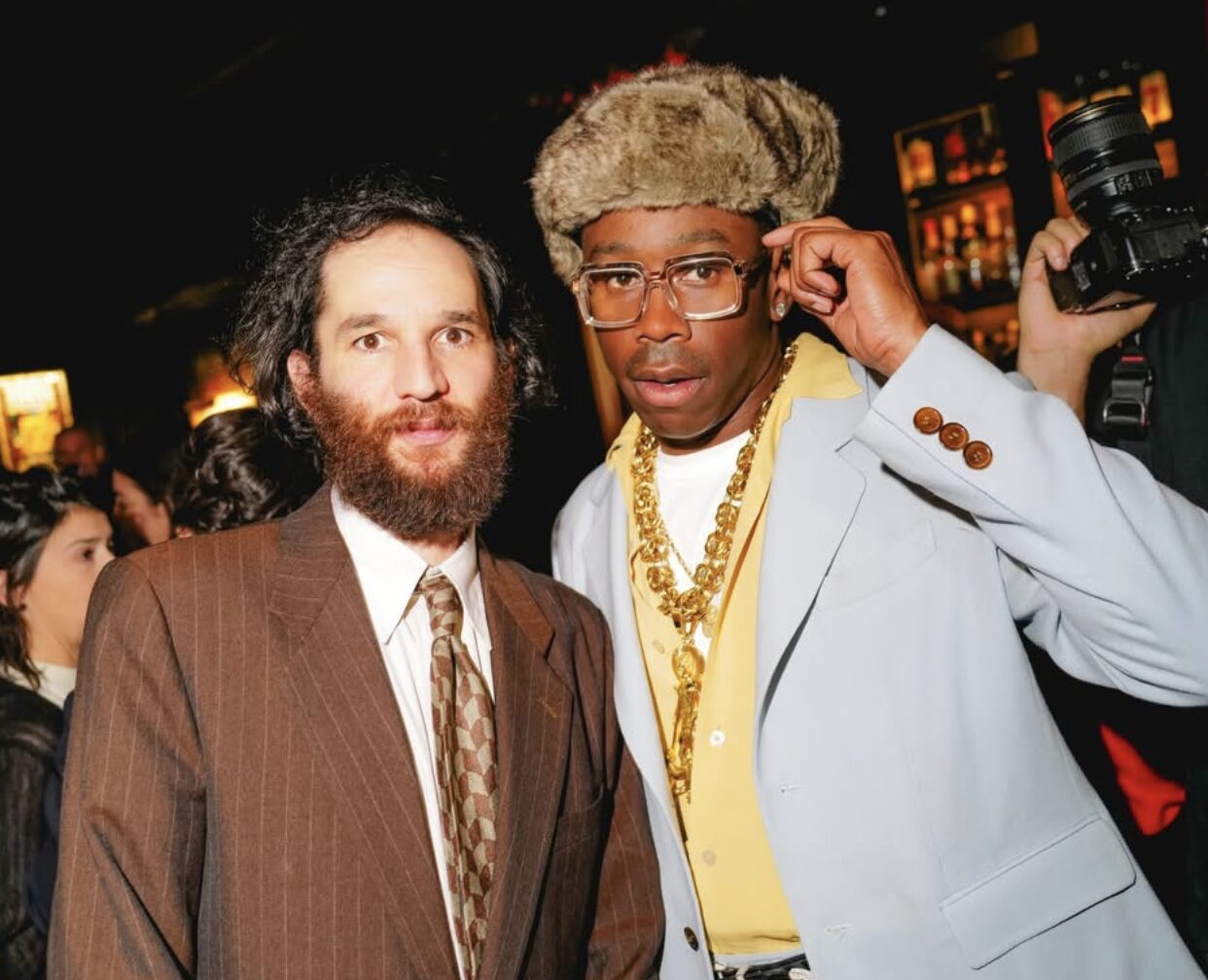
Credit: @A24 on Instagram
Tyler went on to explain that the screening was something he personally pushed for. “A24, they are super nice,” he said. “I hit ’em up and was like, ‘Yo, I want to do a couple screenings — little s—, nothing crazy.’ I asked them if they could do one here in Inglewood.” With that, he exited the stage, letting the audience know that the main cast and director Josh Safdie sent their greetings — and encouraged everyone to enjoy the film.
From the opening shot, it felt as if Timothée Chalamet’s Marty was physically grabbing my hand and pulling me through the film at full speed. The adrenaline never lets up, and neither does Marty. His constant motion, ambition, and hunger are what define him. As selfish as his actions may appear, the film quietly asks: is that the secret to winning it all? Marty uses every person and opportunity in front of him to get what he wants — but does it all truly pay off in the end?
Chalamet’s performance is what keeps Marty Supreme constantly in motion. He doesn’t ask the audience to like Marty — only to keep up with him. His physicality, from the frantic pacing to the calculated stillness in moments of control, turns Marty into a character fueled entirely by impulse and confidence. It’s a performance that feels exhausting in the best way, mirroring the film’s nonstop energy and making it nearly impossible to look away, even when Marty’s choices become increasingly questionable.

Credit: A24 Website
That instability becomes most visible in Marty’s relationship with Koto Endo, the stoic, world-champion Japanese ping-pong player portrayed by real-life deaf table tennis star Koto Kawaguchi. Endo serves as the ultimate rival to Timothée Chalamet’s overconfident hustler, Marty Mauser, and their tension quietly drives the film forward. Endo embodies both belief and doubt, his calm skill and presence contrasting sharply with Marty’s chaotic energy and representing the challenge that Marty can neither easily manipulate nor ignore. Marty’s defeat by Endo fuels his frantic schemes to earn a rematch, exposing his most dangerous habit, the ability to fool not only those around him but also himself. Each failure is reframed as a temporary setback, and each lie is softened by charm, turning Marty’s persistence from ambition into a compulsion to convince everyone, including himself, of a version of his own greatness that may never fully exist.
This cycle of self-deception extends to the film’s supporting characters, who orbit Marty with varying levels of hope, frustration, and exhaustion. Rather than existing as mere background players, these characters serve as emotional checkpoints, reflecting the consequences of Marty’s actions. Some are drawn in by his certainty, while others grow increasingly wary of the damage left behind. Their reactions ground the film’s heightened energy in something more human, reminding the audience that Marty’s wins are often built on someone else’s loss.
Together, these relationships reinforce the film’s central question: is belief enough to justify repeated failure? Marty Supreme never offers a clear answer, instead allowing the audience to sit with the discomfort of watching ambition blur into manipulation. The film thrives in this ambiguity, using Marty’s charisma as both its engine and its warning. By the time the credits roll, it becomes clear that Marty’s greatest talent is not winning but convincing everyone, including himself, that he already has.
There’s an undeniable parallel between Marty’s obsessive pursuit of greatness and Timothée Chalamet’s own career trajectory. Chalamet has built a filmography defined by risk-taking and transformation, consistently choosing roles that demand intensity, vulnerability, and momentum, qualities that Marty embodies to an almost self-destructive degree. Having seen the film, it becomes clear how intentionally those paths align. Marty’s hunger to be remembered mirrors Chalamet’s commitment to pushing himself beyond comfort, making the performance feel less like an act and more like a collision between character and actor. Paired with a cast already known for their range and reliability, there was a baseline confidence in every performance before the film even began. Marty Supreme does not just meet that expectation; it amplifies it, turning anticipation into something fully realized.

Credit: @A24 Instagram
That pursuit of greatness ultimately reframes the film’s final moments, particularly in the closing scene where Marty becomes a father. Rather than presenting it as redemption or resolution, the moment feels deliberately complicated. Fatherhood introduces a new kind of responsibility, one that cannot be outrun, manipulated, or reframed through ambition. It forces Marty to confront the difference between chasing legacy and actually leaving one behind. The ending does not suggest that Marty has changed, but it does suggest that the stakes have. In that quiet shift, Marty Supreme finds its most grounded moment, closing the film not with certainty, but with the weight of what comes next.
Seen in Inglewood, Marty Supreme felt less like a cautionary tale and more like a challenge, one that dares the audience to decide how much belief is too much.
Tickets for Marty Supreme are now available for purchase online and at participating theaters nationwide.
