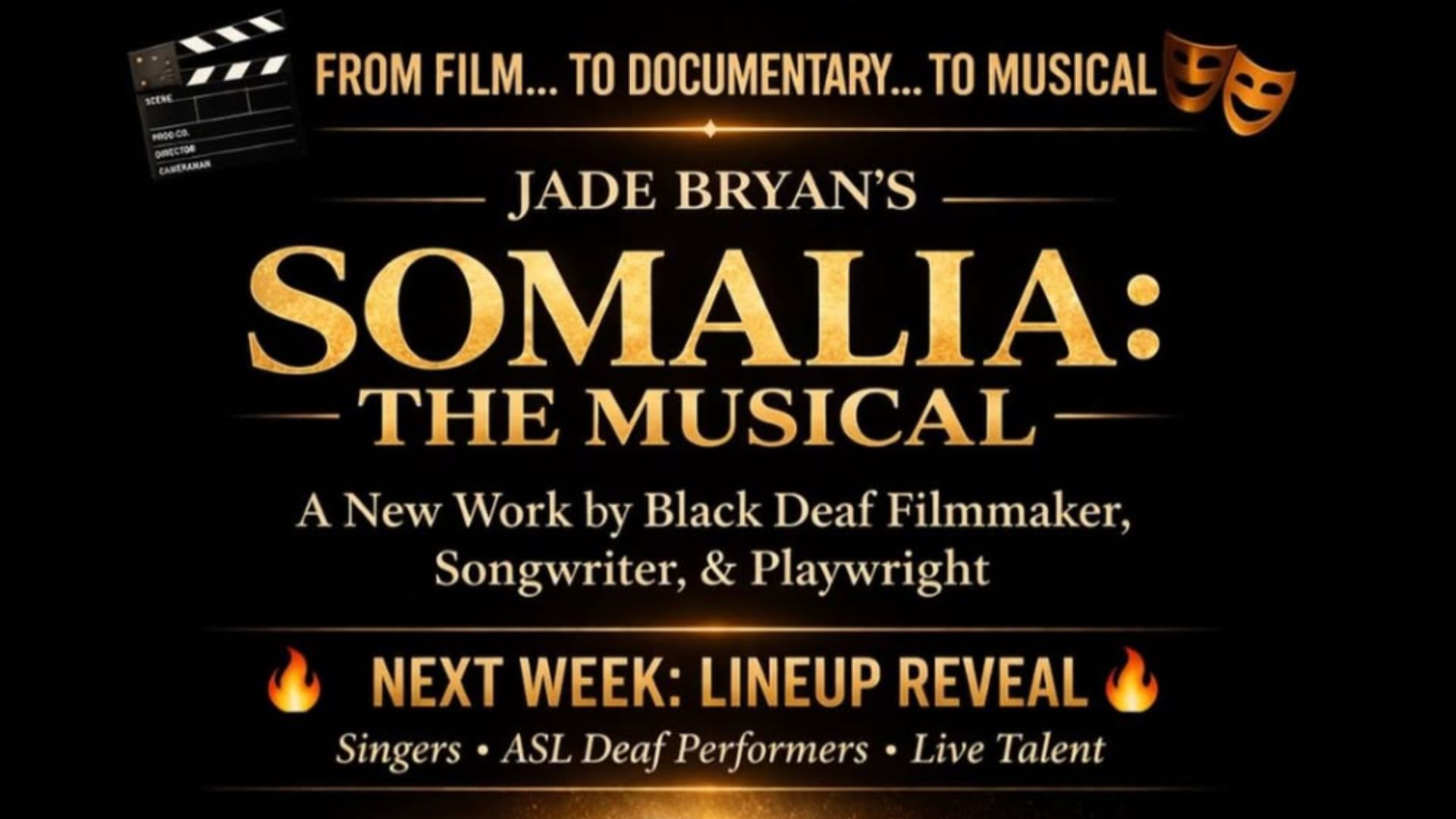
Jade Bryan is an award-winning film producer. She is the first Black deaf filmmaker to graduate from New York University’s famed film school. Bryan is a social activist who fights against the boxes that others are crammed into. She started the Deaf Talent Movement.
This has become a part of her fight to include Blacks, People of Color (POC), and other outsiders (LGBT+) in the film and television industry. As part of this struggle for recognition, Bryan has shifted to writing and producing a musical. On April 25th, she presented a staged reading of Somalia The Musical. This will lead to a final production. This reading brings the world into the community of deaf Black people. Somalia The Musical was presented by BASL Lit®️ Slam!
When this goes into production, deaf actors will shadow the speaking actors. These “shadows” will be using American Sign Language (ASL). ASL is a visual language, using hands, facial expressions, and body movements. Black American Sign Language (BASL) is a distinct dialect. It was the result of segregated schools. BASL uses more space for signing, more two-handed signs, and vocabulary coming out of Black culture. ASL and BASL result in an evocative, graceful language that can pull in even those who do not know or understand ASL. BASL and ASL will be incorporated into the tale. Thus, Bryan is adding depth to her production.
Somalia The Musical focuses on a Black Harlem-based fashion designer. She is a member of several intersecting communities – the fashion world, Harlem, the deaf world, and the hearing world. Despite the adversities she faces, Somila walks with pride. Brielle Blood portrays Somalia brilliantly. We enter her communities through Blood’s acting. The songs help establish character. We can see Somalia’s struggles as she sings, “let me love all of me before I love again.” Her pride in pre-Starbucks (before gentrification) Harlem is evident when she sings that “Harlem is who I am.” We can see how her world changed on September 11th, 2001. Blood’s acting and singing give this character dimension.
Joel Bunche brings us Zavier Powell. He is ideally cast as an annoying pest who is obsessed with Somalia. Bunche makes it clear that this obsession is fueled by Somalia’s deafness while he is hearing. He is not willing to enter her world. We cannot wait for Somalia to dump him. Bunche creates a character whom we love to dislike.
Sarita Pagan is a powerful woman. She and Somalia have been friends since childhood. Chrystal Campbell clearly shows the strength of this character. She is so strong that some fear this lesbian lounge owner. Campbell shows us the fierce, protective love that Pagan has for Somalia.
Amuri brings Hennessy “Honey” Taino to life. Honey is a flamboyantly gay hairstylist. He freely gossips about everyone. None of it is malicious. Nabeel grabs the song, “He’s so vain,” and makes it his. His lover, Brandon Gambi, is portrayed by Steven Pinnella. Pinella shows us a confident guy who cares about others.
Lamar Jones is a musician and rapper who is courting Somalia. James Brooks creates a character that is almost a mirror image of Zavier Powell. Somalia fears that Lamar doesn’t understand her world, which is shaped by her deafness. However, Brooks makes his love real when he raps to Somalia, saying that he wants to “travel through your world, learn your existence.”
Camille Justiniano is Somalia’s roommate. She and Somalia are working together to develop their own fashion show. Gi DiFebbo brings us an artistic free spirit. DiFebbo and Blood show us how women can work together to achieve their dreams.
Mara is an Arab woman who wears a hijab. She is also a guitarist. Bella Pacheco Barick easily slides into this role. She is particularly effective when her character meets Islamophobic hatred after 9-11.
All the actors fill their roles with grace and clarity. Astonishingly, there were only three days of rehearsal for this staged reading. Jade Bryan clearly demonstrates her abilities as a director. Somalia The Musical shows Bryan’s multi-faceted talents as a playwright, songwriter, producer, and director. It also reflects her drive to be inclusive. At times, it seems that society is turning its back on the idea of being inclusive. Trump no longer uses ASL interpreters in White House briefings. The argument is that the interpreters “intrude” on the control of his public image. Bryan’s incorporation of ASL is only one facet of her drive to be inclusive. Her drive to knock down barriers shapes this work.
This is clearly a work that is being developed. I have one complaint. I agree with the two people in the post-production discussion who pointed out that this seems to be two different works – the story of Somalia and her worlds, and the impact of 9-11. I am sure that Jade Bryan will meld these two themes. I am looking forward to the final version of Somalia: The Musical.
